
If I want a restraining order in Ocala, Florida, I need facts the judge can test – not just fear or broad claims. In most Florida injunction cases, the court looks for proof that it is more likely than not that violence, stalking, threats, or harassment happened, or that I have a real fear of future harm. For Risk Protection Orders, the burden is higher: clear and convincing evidence.
Here’s the short version:
- A sworn petition matters first. I need dates, places, exact words, and clear details.
- Records back up the story. Texts, emails, call logs, photos, police reports, 911 records, and medical records can help.
- Witnesses can fill gaps. People who saw or heard what happened themselves often help more than secondhand accounts.
- Physical injury is not required. In many Florida cases, a judge can act if the facts show a real and immediate fear of future harm.
- Timing matters. Hearings are often set within 14 days of filing, so I should gather records fast.
A few points change by injunction type:
- Domestic violence: I must show I was a victim of domestic violence or have reason to fear immediate danger.
- Repeat violence: I must show at least 2 acts, with 1 act in the last 6 months.
- Dating violence: I must show a dating relationship within the last 6 months, plus violence or fear of immediate danger.
- Risk Protection Order: Law enforcement must show, with a higher level of proof, that the person poses a danger with firearms.
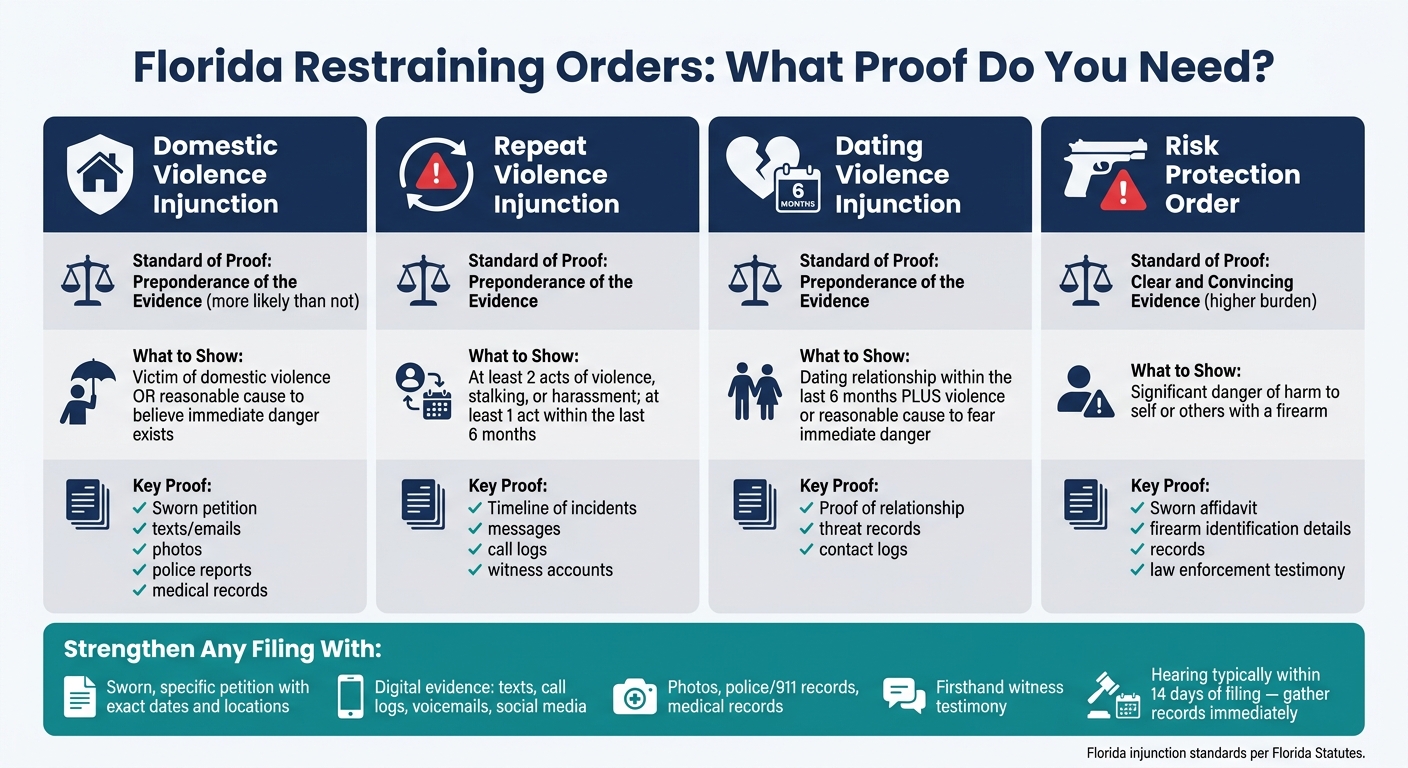
Florida Restraining Order Types: Proof Requirements at a Glance
Quick Comparison
| Injunction type | What I need to show | Key proof |
|---|---|---|
| Domestic Violence | Violence happened, or I have reason to fear immediate danger | Sworn facts, texts, photos, police or medical records |
| Repeat Violence | At least 2 acts of violence, stalking, or harassment | Timeline, messages, call logs, witness accounts |
| Dating Violence | Dating relationship within 6 months plus violence or fear | Proof of relationship, threats, contact records |
| Risk Protection Order | Danger to self or others with firearms | Sworn affidavit, firearm details, records, testimony |
Put simply: in Florida, the strongest filing is usually a sworn timeline + hard records + firsthand testimony. That gives the judge a clear path to decide whether an injunction should be entered in Ocala or anywhere else in Florida.
sbb-itb-bb7ced0
What proof do you need for a restraining order in Florida
In Florida, most injunctions for protection come down to a preponderance of the evidence. Put simply, the judge has to believe it’s more likely than not that the facts support the request.
What you need to prove depends on the type of injunction:
| Injunction Type | What You Need to Show |
|---|---|
| Domestic Violence | Victim of domestic violence or reasonable cause to believe immediate danger exists |
| Repeat Violence | At least two acts of stalking, harassment, or violence |
| Dating Violence | A significant, ongoing intimate or romantic relationship within the last six months, plus violence or reasonable cause to believe immediate danger exists |
| Risk Protection Order | Clear and convincing evidence of significant danger of causing harm to self or others with a firearm |
In most cases, those facts need to be laid out in a sworn petition and backed by supporting records.
Specific facts carry more weight than general accusations
Florida courts look for specific facts they can check and weigh. General claims like saying someone is “dangerous” or “scary” usually won’t carry much on their own.
What helps most? Exact dates, clear locations, and the actual words used. If a respondent showed up at a petitioner’s workplace on March 3 and said, "You’ll regret this," that gives the judge something concrete to evaluate. That’s much stronger than saying the respondent “keeps making threats.”
Details like weapon use, a recorded pattern of repeated contact, and prior incidents can also add weight. The more concrete the facts, the easier it is for the court to assess what happened.
Reasonable fear of future harm can be enough
Most Florida injunctions do not require a recent physical injury. The key issue is whether the facts show a real and immediate fear of future violence.
That can include escalating threats, repeated unwanted contact, stalking behavior, or intimidation that builds over time. But even then, the court still needs facts it can measure, not just a general sense of fear.
That’s why the petition matters so much. It’s where those facts get put into sworn form and supported with records.
Sworn petitions and written statements that support the request
Start with the facts in the sworn petition.
In Florida, the petition must be sworn under penalty of perjury. That matters because it can support a temporary ex parte order before the full hearing.
What to include in a verified petition
Use the verified petition to set out each incident in order. Include dates, locations, and the exact conduct involved. The more specific you are, the easier it is for the court to follow what happened.
For domestic violence injunctions, Florida law requires the petition to allege that the petitioner is a victim of domestic violence or has reasonable cause to believe they are in immediate danger.
For repeat violence, the petition must allege at least two separate acts of stalking, harassment, or violence. At least one of those acts must have happened within the last six months. Vague accusations usually won’t cut it.
If the case involves a firearm-based risk order, the petition must include a sworn affidavit with specific facts showing a reasonable fear of serious dangerous acts. It also needs to identify the firearms and ammunition by type and location. That affidavit is supporting evidence, not just paperwork.
How written timelines and attached statements help
When several incidents happened over time, a timeline can help the court track the sequence. It puts the events in plain view, step by step.
Signed statements from witnesses with direct knowledge can also support the petition.
Together, they help the judge follow the sequence of events.
Texts, photos, and police reports can then back up that timeline.
Texts, photos, police reports, and other records that strengthen your case
Supporting records help turn the petition’s claims into proof a court can check. They back up the dates, exact words, and contact patterns described in the filing. In Florida, injunction hearings are often set within 14 days of filing, so it’s smart to gather records right away.
Digital evidence showing threats, stalking, or repeated contact
Texts, emails, call logs, voicemails, and social media posts can help show threats, stalking, or repeated unwanted contact. Timestamps matter here. They can help show that the contact wasn’t a one-off event, but part of a pattern.
Social media can also help in a big way. Posts, messages, tags, or account activity may show cyberstalking, public threats, or close monitoring of the petitioner.
Save digital records as soon as you can. A respondent may delete messages or hide accounts after the case is filed. Screenshot conversations, download voicemails, and export call logs while the data is still there.
Screenshots of location sharing or GPS data can also help back up claims of close contact near a home, school, workplace, or vehicle.
Photos, police records, and medical records as corroboration
Physical records add another layer of proof. They help support the story told in the petition without leaning only on live testimony.
Police reports and 911 records can show that the petitioner reported the incident when it happened. That timing can matter. Photos of injuries or damaged property can show what happened in a direct, visual way. For sexual violence injunctions, the report to law enforcement and cooperation with the investigation matter. Medical records can document injuries and treatment.
| Proof Type | What It Helps Prove | Why It Matters at a Florida Hearing |
|---|---|---|
| Texts & Emails | Direct threats, harassment, or unwanted contact | Establishes reasonable cause to believe the petitioner is in danger |
| Call Logs & Voicemails | Frequency of contact and repeated unwanted communication | Supports claims of stalking or repeat violence patterns |
| Social Media Posts | Cyberstalking, public threats, or monitoring of the petitioner | Demonstrates harassment or attempts to intimidate |
| Photos & Videos | Physical injuries, property damage, or presence at restricted locations | Provides visual corroboration of the events described in the petition |
| Police & 911 Records | Timely reporting of incidents and official documentation of threats | Strengthens credibility by showing the incident was reported close in time |
| Medical Records | Physical trauma or treatment resulting from domestic violence | Provides objective evidence of injury or treatment |
Witness accounts and what Florida courts look for at the hearing
When paperwork doesn’t tell the whole story, witnesses can help fill in the blanks. A person who saw the injuries, heard the threats, or watched the harassment, stalking, or property damage happen can back up the petition with direct testimony. At the hearing, the judge looks at those facts and decides whether protection is justified.
Who can serve as a useful witness
The strongest witnesses are the ones who saw or heard the conduct themselves. Direct, firsthand testimony usually carries more weight than something passed along from someone else.
That can include:
- Responding officers who can testify about what they saw and wrote down
- Family members or household members who were there during the incident
- Other people who personally saw threats, stalking, repeated contact, or property damage
If a witness only heard about the incident from someone else, that testimony usually won’t help as much.
What to bring and how to present it clearly
Once you’ve identified the right witnesses, line up their testimony around the incidents they personally saw. Put your evidence in chronological order so the judge can follow the timeline without extra guesswork.
When a witness testifies, keep the focus on specific incidents, exact words, and clear actions. It also helps to match each witness’s testimony to the petition and the records the judge will review. That way, the story stays consistent and easy to follow.
Conclusion: Clear facts and supporting records make the strongest case
The judge’s job is simple in theory: decide whether the facts meet the legal standard. That’s why specific, sworn facts backed by records matter so much. They give the court the clearest basis to act.
Physical injury is not required. Under Florida law, protection may be granted based on specific facts that show a reasonable fear of future harm.
A detailed verified petition, supporting records, and firsthand witness testimony help show the court the full picture. Put together, they make the petition stronger and help the judge decide whether the request is more likely than not supported.
If the paperwork and records feel overwhelming, legal help can make the filing process easier. If you need help preparing a petition or response in Ocala, Law Firm Ocala can help organize the sworn statement and records.
FAQs
What counts as enough proof for a Florida restraining order?
In Florida, you have to prove your case by a preponderance of the evidence. In plain English, that means showing it’s more likely than not that domestic violence happened, or that you have a reasonable fear of immediate harm.
The strongest cases usually include a sworn petition with clear facts: specific dates, times, and places. On top of that, courts often look at supporting proof like police reports, medical records, text messages, emails, voicemails, photos, videos, and witness statements.
Courts also pay close attention to whether the evidence lines up. If the details stay consistent across your petition and the other records, that can make your case much stronger.
Can I get an injunction without injuries or a police report?
Yes. You can ask for an injunction for protection without filing a police report.
What matters most is a sworn statement that lays out the abuse or threats in specific terms, along with a relationship that fits the legal rules.
It also helps to bring any proof you have, such as:
- Medical records
- Photos
- Text messages
- Emails
- Voicemails
- Witness accounts
The court can look at that material even if law enforcement was never involved.
How should I organize texts, photos, and witnesses for the hearing?
Build a chronological timeline of events with exact dates and times. That helps show behavior patterns instead of isolated incidents.
Keep your evidence in clearly labeled folders by category, such as:
- Police reports
- Medical records
- Witness statements
- Communication logs
For digital evidence, save full-context screenshots that show the date, sender details, and timestamp. Don’t crop out surrounding context if it helps explain what happened.
It also helps to create a master index with exhibit numbers, short descriptions, and source details. Bring three copies: one for the court, one for your attorney, and one for the opposing party.