
If I’m a landlord in Ocala, Florida, the first step before filing for eviction is simple: match the notice to the reason. In most cases, that means 3 business days for unpaid rent, 7 days for lease violations, or 30, 60, or 7 days to end a periodic tenancy, depending on how the tenant pays rent.
Here’s the short version:
- Unpaid rent: serve a 3-day notice
- Fixable lease issue: serve a 7-day notice to cure
- Serious or repeat lease issue: serve a 7-day notice to vacate
- No-fault lease ending: serve a 30-day, 60-day, or 7-day termination notice
One wrong date, one wrong amount, or one wrong notice type can force me to start over. That matters because eviction cases often turn on small drafting and service errors.
Quick Comparison
| Reason | Notice | Time |
|---|---|---|
| Rent not paid | 3-day notice to pay rent or move out | 3 business days |
| Lease issue that can be fixed | 7-day notice to cure | 7 days |
| Serious or repeat lease issue | 7-day notice to vacate | 7 days |
| Month-to-month tenancy | Termination notice | 30 days |
| Year-to-year tenancy | Termination notice | 60 days |
| Week-to-week tenancy | Termination notice | 7 days |
A few points matter most:
- The 3-day rent notice is for rent only
- Saturdays, Sundays, and legal holidays do not count in that 3-day period
- Charges like property damage or security deposits do not belong in a 3-day rent notice
- A notice should list the tenant name, property address, reason, amount due if any, deadline, and service date
- Service method matters just as much as the wording
Put simply, if I want an eviction case in Florida to move forward, I need the right notice, the right deadline, and the right delivery method from day one.
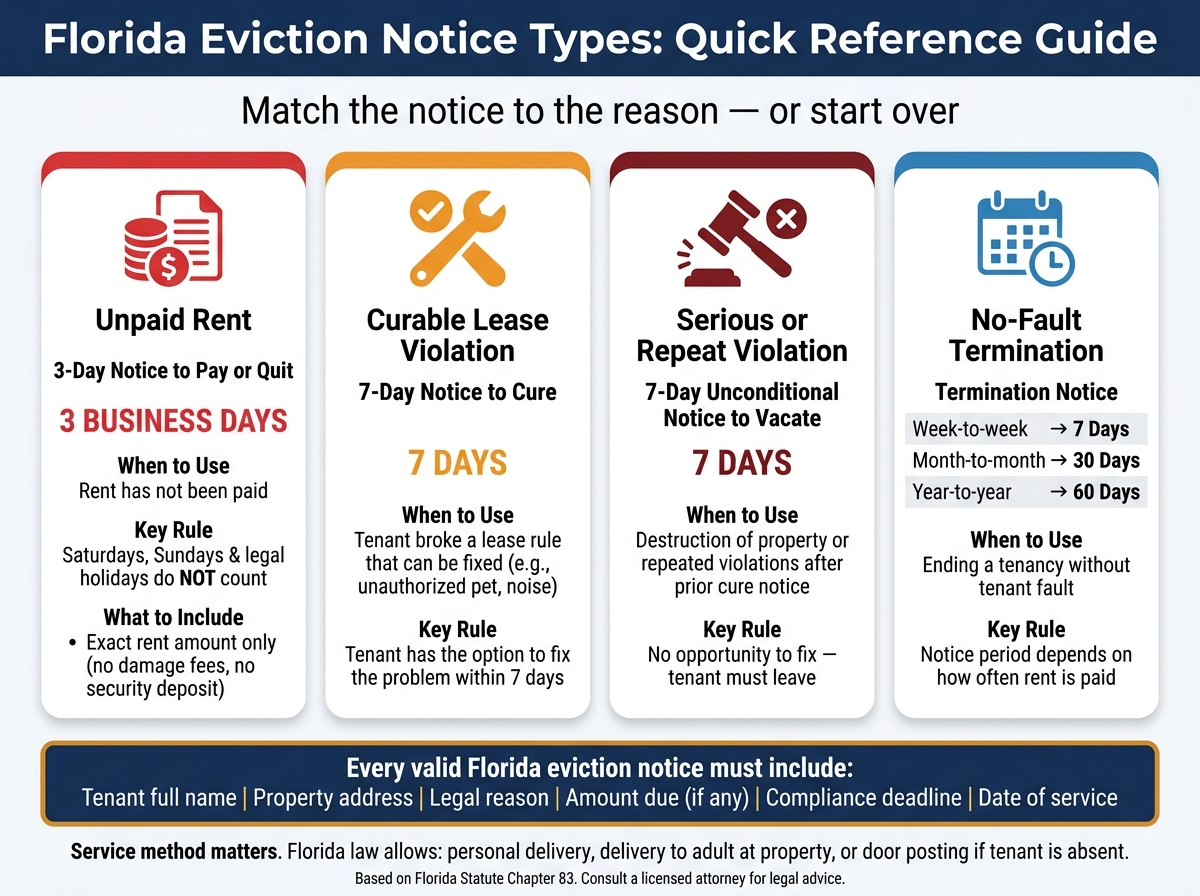
Florida Eviction Notice Types: Quick Reference Guide
What notice must a Florida landlord give before filing for eviction?
Florida law links each eviction notice to the reason the landlord wants the tenant to leave. In plain English, the notice has to fit the problem.
| Reason for Eviction | Notice Period | Notice Type |
|---|---|---|
| Unpaid rent | 3 days | 3-day notice to pay rent or move out |
| Curable lease violation | 7 days | Notice to Cure |
| Serious or repeated violation | 7 days | 7-day unconditional notice to quit |
| Ending a periodic tenancy | 30 or 60 days | Termination Notice |
The notice must match the eviction reason
A landlord can’t pick a notice just because it’s faster or easier. The notice must match the legal basis for the eviction.
Think of it like using the right key for the right lock. If the issue is unpaid rent, the landlord generally uses a 3-day notice to pay rent or move out. If the issue is a lease violation that the tenant can fix, the landlord uses a 7-day Notice to Cure instead.
A wrong notice can delay or restart the eviction
Using the wrong notice can slow everything down. In some cases, the landlord may have to start the process over from the beginning.
The notice used most often is the 3-day notice for unpaid rent.
sbb-itb-bb7ced0
When is a three-day notice required?
The most common notice is the 3-day notice for unpaid rent. Use it only when rent has not been paid.
The notice must tell the tenant to do one of two things within three business days:
- Pay the full amount of rent due
- Move out of the rental unit
Three-day notices apply only to unpaid rent
A 3-day notice is not the right tool for other lease problems.
That means you can’t use it for things like:
- Unauthorized pets
- Noise issues
- Property damage
- Extra occupants
How to count the three-day deadline
The three-day period does not include Saturdays, Sundays, or legal holidays.
So if you serve the notice on Thursday, Day 1 is Friday, and the deadline runs through Tuesday.
This part matters a lot. If you get the date wrong, even by one day, the tenant may have grounds to challenge the notice.
What can and cannot be included in the amount demanded
The notice must list the exact rent due and the payment deadline. Don’t add charges unless the lease says those charges count as rent.
| Charge | Included in 3-Day Notice? |
|---|---|
| Base rent | Yes |
| Late fees | Only if the lease defines them as additional rent |
| Utilities | Only if the lease defines them as additional rent |
| Property damage costs | No |
| Security deposit | No |
If you add non-rent charges, the notice can be defective. That can delay the case or get it dismissed.
If the issue is something other than unpaid rent, Florida law usually calls for a different notice.
When is a seven-day notice required?
If the problem isn’t unpaid rent, the next notice type is a 7-day notice. In Florida, landlords use this notice for lease violations. Some violations can be fixed. Others are serious enough that the tenant has to leave.
Seven-day notice to cure a lease violation
This notice is used when a tenant broke a lease rule that can reasonably be corrected. The tenant gets 7 days to fix the violation.
Seven-day unconditional notice for serious or repeat violations
In some situations, Florida law lets a landlord serve an unconditional 7-day notice to vacate. This applies to serious violations, such as destruction of the premises, or repeat violations when the tenant has already had a chance to cure the issue once before.
With this notice, the tenant must leave. There is no chance to fix the problem.
How cure and unconditional notices differ
The difference is straightforward: a cure notice gives the tenant time to correct the issue, while an unconditional notice does not.
Here’s the day-to-day difference:
| Notice Type | When to Use | Tenant’s Option |
|---|---|---|
| 7-Day Notice to Cure | Curable lease violation | Fix the problem within 7 days |
| 7-Day Unconditional Notice | Serious or repeated violation | Leave; no chance to fix the problem |
Next, the notice period changes again when a landlord ends a tenancy without blaming the tenant.
When is a thirty-day, sixty-day, or other termination notice required?
A landlord can also end a tenancy without claiming tenant fault. This often happens when a lease term ends or when a month-to-month rental is being brought to a close.
Termination without alleging tenant fault
For residential tenancies, the notice period depends on the type of tenancy.
Notice periods by tenancy type
Florida residential termination notices are governed by Chapter 83. The amount of notice required depends on how often rent is paid.
| Tenancy Type | Required Notice |
|---|---|
| Year-to-year | 60 days |
| Month-to-month | 30 days |
| Week-to-week | 7 days |
Even if the landlord gives the correct amount of notice, the notice must still clearly state the termination date and be served the right way.
What must a valid Florida eviction notice include?
Once the landlord picks the right notice type, the next step is simple in theory but easy to mess up in practice: draft it the right way and serve it the right way.
A valid Florida eviction notice needs specific details, and it has to be delivered in a way Florida law allows.
Basic information the notice should contain
A valid Florida eviction notice should include:
- The tenant’s full name
- The rental property address
- The legal reason for the notice
- The amount due, if rent is unpaid
- The deadline to comply or move out
- The date the notice was served
The tenant’s name and the property address should match the lease exactly. Even a small typo can cause trouble in court. That may sound minor, but in eviction cases, little mistakes can turn into big delays.
Common service and drafting mistakes
The notice only works if both the wording and the delivery follow Florida law.
Florida allows certain delivery methods, including personal hand delivery to the tenant, leaving it with another adult at the property, or posting it on the front door if the tenant is not home.
Problems often come from basic errors: wrong dates, the wrong rent amount, vague deadlines, missing tenants, or using a delivery method the law does not allow. The affidavit or return of service also needs to show exactly when, where, and how the notice was delivered.
If the notice has any defect, the landlord may have to start over.
Key points
Florida landlords must use the right notice type for the reason they want to end the tenancy, include every required detail, and serve the notice properly before filing for eviction.
FAQs
What if I serve the wrong notice?
Serving the wrong eviction notice in Florida can slow your case down and, in some situations, put it at risk.
Florida law requires strict compliance with approved notice methods. That usually means service by personal delivery, certified mail, or electronic delivery when both parties have agreed to it in writing.
If the notice is served the wrong way, or if you can’t show proof that it was sent, the service may be invalid. In that case, you may need to fix the notice and serve the tenant again, which means the required waiting period starts over.
For help getting the notice right the first time, consult Law Firm Ocala.
Can a tenant stop eviction by paying after notice?
Yes. In many Florida non-payment cases, a tenant can stop an eviction by paying the rent that’s past due. Courts often let tenants stay once they pay what they owe.
The key is to move fast. Eviction cases come with strict deadlines and filing rules, and missing one can make things much harder. Law Firm Ocala helps tenants in Ocala protect their rights during the eviction process.
Should I keep proof of service?
Yes. Keeping proof of service matters because it shows the legal delivery happened and helps head off disputes.
Hold on to copies of:
- emails and sent receipts for electronic notices
- certified mail receipts for mailed notices
- signed receipts or witness notes for in-person delivery
- filing receipts and service confirmations
If someone later claims they never got the notice, these records can help you show that service was made.