
If your child is facing burglary charges in Ocala, Florida, acting quickly is critical to protect their future. Florida’s juvenile justice system prioritizes rehabilitation, but delays or missteps can lead to harsher outcomes, including transfer to adult court. Here’s what you need to know:
- Stay calm and support your child. Your reaction matters – provide reassurance and avoid panic.
- Stop police questioning without a lawyer. Anything said without legal counsel can be used in court.
- Hire a juvenile defense attorney immediately. A detention hearing happens within 24 hours of arrest, so quick action is essential.
- Gather arrest details. Collect arrest reports, officer names, and other key information to assist your attorney.
- Prepare for the detention hearing. Present evidence (e.g., school records, community ties) to argue for your child’s release.
Florida’s juvenile justice process includes detention hearings, arraignments, and potential diversion programs. However, serious cases may be moved to adult court, where penalties are much harsher. Supporting your child through compliance with court orders, counseling, and diversion programs can improve outcomes and reduce long-term consequences.
For families in Ocala, Law Firm Ocala specializes in juvenile defense and can help you navigate this challenging time. Acting now can make a significant difference for your child’s future.
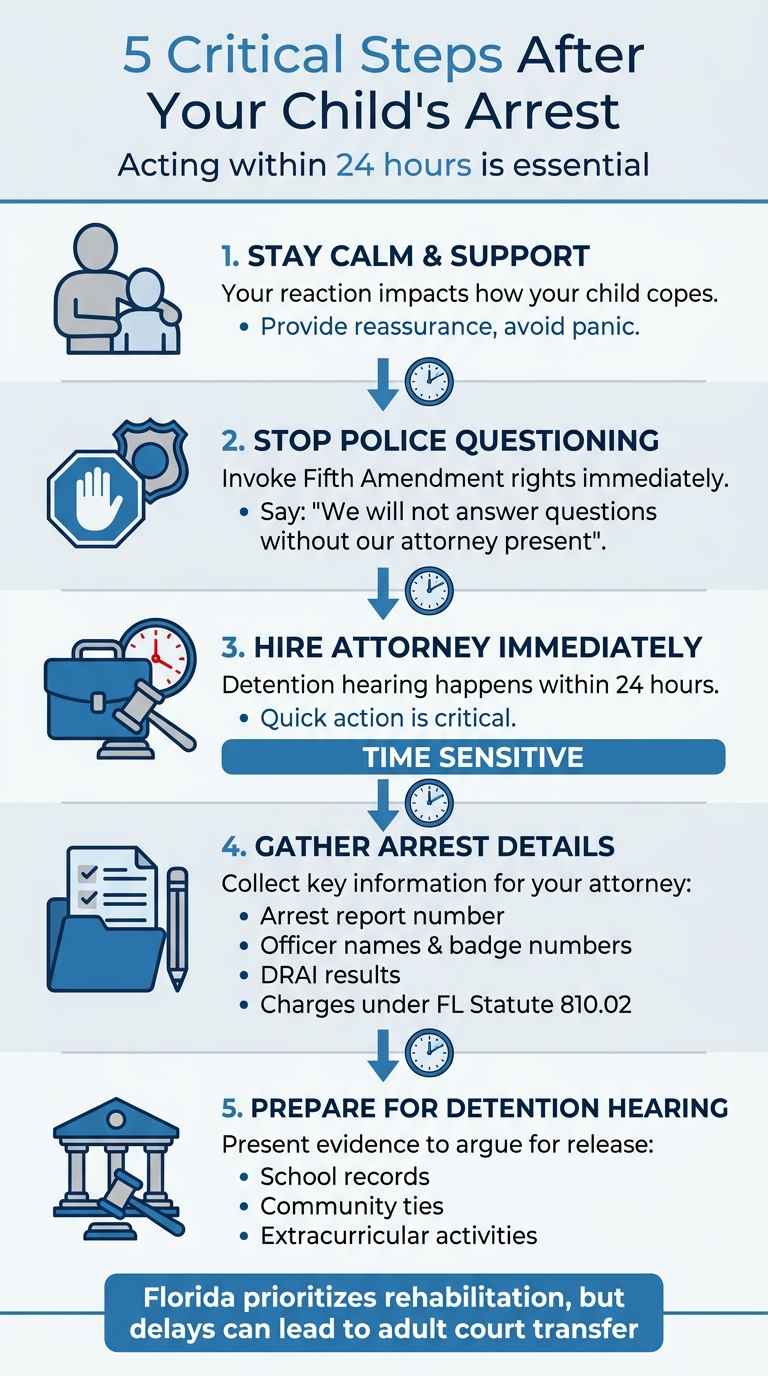
5 Critical Steps Parents Must Take After Juvenile Burglary Arrest in Florida
First Steps After Your Child’s Arrest
Stay Calm and Support Your Child
How you react in this moment can have a huge impact on how your child copes with the situation. Staying calm is key. If you panic or lash out, it could make an already stressful situation worse for your child. Instead, focus on reassuring them. Let them know you’re there to support them and that you’ll handle this together.
Stop Any Police Questioning Without a Lawyer Present
Make it clear to law enforcement that your child will not answer any questions without an attorney present. In Florida, anything your child says without legal counsel can be used against them. You have the right to invoke their Fifth Amendment protection. A simple statement like, "We will not answer questions without our attorney present", is enough to protect this right.
Hire a Juvenile Defense Attorney Immediately
Time is critical. Florida law requires a detention hearing within 24 hours of an arrest, so contacting a juvenile defense attorney right away is essential. Law Firm Ocala specializes in juvenile criminal defense in Ocala, Florida, and can provide the guidance you need to protect your child’s rights. An experienced attorney can argue for your child’s release during the detention hearing and start building a defense strategy immediately. Once you secure legal representation, begin gathering all the details related to the arrest.
Collect Information About the Arrest
The more information you can provide your attorney, the better they can prepare. Gather key details such as the probable cause affidavit, arrest report number, booking number, JJIS ID, and the names and badge numbers of the officers involved. You’ll also need to know where your child is being held, typically a Juvenile Assessment Center, and obtain any documents from the DJJ intake officer, including the Detention Risk Assessment Instrument (DRAI) results. Additionally, request the exact charges under Florida Statute 810.02 and the degree of burglary alleged. Keep a detailed record of all interactions with law enforcement, DJJ staff, and court personnel, noting the time, date, and what was discussed.
Get Ready for the Detention Hearing
At the detention hearing, the judge will decide if your child will remain in custody or be released while the case proceeds. To help your case, prepare evidence that shows your child is not a flight risk and has strong ties to the community. This could include school records, proof of extracurricular activities, or treatment records. These documents can demonstrate to the judge that your child is better off at home than in a detention facility. Solid preparation and documentation can strengthen your attorney’s argument for release and help safeguard your child’s future.
sbb-itb-bb7ced0
How Florida’s Juvenile Justice System Works
Knowing the steps in Florida’s juvenile justice process can help you navigate the system more effectively. Each stage plays a critical role in determining the outcome of your child’s case.
The Detention Hearing
A detention hearing happens soon after a minor is taken into custody. During this hearing, the Department of Juvenile Justice (DJJ) evaluates your child’s background and assesses any potential safety risks. Based on this review, they recommend one of three options:
- Secure detention: Your child is placed in a locked facility.
- Non-secure detention: A less restrictive environment is provided.
- Home detention: Your child stays at home under your supervision while maintaining regular contact with a DJJ officer.
Detention – whether secure or non-secure – can last up to 21 days. If the case proceeds, the next step is the arraignment, where your child will enter a plea and may have the option to pursue a diversion program.
The Arraignment
If the State Attorney decides to file formal charges, the next step is the arraignment. At this hearing, your child and their attorney will enter a plea: guilty, not guilty, or no contest (nolo contendere).
For minors with a clean record and less serious charges, diversion programs may be an option. These programs often involve completing tasks like community service or counseling and can result in the charges being dropped. However, if a not guilty plea is entered, the case will proceed to an adjudicatory hearing, where prosecutors must prove the charges in court.
When Juvenile Cases Move to Adult Court
Although most cases involving minors under 18 are handled in the juvenile system, Florida law allows certain cases to be transferred to adult court. This typically happens when the offense is particularly serious or if the minor has a prior record. Once transferred, your child faces adult penalties, which may include incarceration, instead of the rehabilitative focus of the juvenile system.
In these situations, having an experienced juvenile defense attorney is essential to protect your child’s rights and advocate for the best possible outcome.
For guidance through these challenging legal proceedings, reach out to Law Firm Ocala (https://lawfirmocala.com).
Burglary Charges and Penalties in Florida
Understanding the specifics of burglary charges and their associated penalties can be crucial when preparing for legal proceedings. This knowledge can shape your approach and discussions with your attorney.
What Counts as Burglary Under Florida Statute 810.02
Florida law defines burglary as entering or remaining in a dwelling, structure, or conveyance with the intent to commit an offense inside. This does not apply if the premises are open to the public or the individual has permission to enter.
"Burglary means entering or remaining in a dwelling, a structure, or a conveyance with the intent to commit an offense therein, unless the premises are at the time open to the public or the defendant is licensed or invited to enter." – Florida Statute 810.02
The statute also includes situations where someone stays after their permission to be there is revoked or changes the purpose of their entry. Evidence of unauthorized entry often strengthens the case for intent to commit a crime. Florida classifies burglary into three degrees:
- First-Degree: Includes cases involving assault or battery, the use of a dangerous weapon, or property damage exceeding $1,000.
- Second-Degree: Typically involves illegal entry into an occupied dwelling, structure, or conveyance.
- Third-Degree: Applies to cases involving entry into an unoccupied structure or conveyance.
These distinctions are essential, as they determine the severity of penalties that may follow.
Penalties for Juveniles Convicted of Burglary
For juveniles, the legal system focuses more on rehabilitation than punishment. Penalties may include detention, probation, residential treatment programs, mandatory counseling, community service, restitution, and a juvenile record. However, this record can still affect opportunities for education, employment, and housing later in life.
Direct File to Adult Court and Harsher Penalties
In certain cases, Florida law allows prosecutors to transfer juveniles to adult court through a process called "direct file." This is typically reserved for more serious offenses. For juveniles aged 14 or 15, prosecutors may transfer cases involving armed burglary, burglary of a dwelling or structure, or burglary with assault or battery. For those aged 16 or 17, prosecutors have broader discretion and can file any felony burglary charge in adult court if they believe adult penalties are appropriate.
Here’s a breakdown of how direct filing works based on age and offense:
| Age Group | Transfer Type | Offense Criteria |
|---|---|---|
| 14–15 | Discretionary | Armed burglary, burglary of a dwelling/structure, or burglary with assault/battery |
| 16–17 | Discretionary | Any felony burglary |
| 16–17 | Mandatory | Three prior felony adjudications at least 45 days apart |
Juveniles convicted in adult court face much harsher penalties. These include up to life imprisonment for first-degree burglary, 15 years for second-degree burglary, and five years for third-degree burglary. Additionally, Florida’s "once an adult, always an adult" rule means that once a juvenile is tried as an adult, they will face adult prosecution for any future state law violations.
If your child is facing burglary charges, it’s critical to seek legal advice immediately. For residents of Ocala, Law Firm Ocala provides dedicated legal counsel to help safeguard your child’s future.
How to Support Your Child Through the Legal Process
As you move through the legal process, your ongoing involvement can make a big difference in the outcome. In Florida juvenile cases, courts often consider parental support when determining penalties – 85% of courts, in fact, weigh this factor heavily. By staying engaged and following these steps, you can help your child navigate this challenging time.
Follow All Court Orders and Requirements
Missing a court order – whether it’s a hearing, curfew, or truancy requirement – can lead to serious consequences. Under Florida Statute 985.439, violations might result in secure detention, extended probation, or even transferring the case to adult court. A 2023 study by the Florida Department of Juvenile Justice found that 40% of juveniles who didn’t comply with court orders faced harsher penalties, compared to only 15% of compliant individuals.
Here’s how you can ensure compliance:
- Enforce court-ordered curfews (e.g., 8:00 PM curfew times)
- Make sure your child attends school every day
- Monitor and ensure completion of all scheduled drug tests
- Keep track of probation officer check-ins
- Oversee timely completion of community service hours
Keep in mind: If your child fails to comply, it doesn’t just affect them. Florida Statute 985.15 allows courts to hold parents in contempt for not ensuring their child meets court requirements.
Look Into Counseling and Diversion Programs
Diversion programs offer a path to avoid a conviction entirely. These programs in Florida focus on rehabilitation over punishment. For example:
- Juvenile Arbitration: An informal program emphasizing restitution and avoiding formal charges.
- Civil Citation Programs: Designed for first-time offenders, these programs require community service and counseling, leading to dismissed charges upon completion.
Court-ordered counseling, such as cognitive behavioral therapy, anger management, or substance abuse treatment, can also address the underlying causes of the offense.
To explore these options, contact your child’s attorney right away. Under Florida Statute 985.15, eligibility for diversion programs must typically be determined within 30 days of arrest. You can also use the Florida Department of Juvenile Justice’s online portal at myflfamilies.com or reach out to your county’s Juvenile Justice Council. Fees for these programs are usually minimal. For residents of Ocala, Law Firm Ocala offers guidance for theft and burglary cases.
Taking advantage of these programs and counseling services can significantly improve your child’s case.
Keep Records of Your Support Efforts
Documentation is key to showing your commitment. Judges often rely on evidence of parental involvement and compliance when making decisions. Keep thorough records such as:
- School attendance reports showing perfect or improved attendance
- Receipts and sign-in sheets from counseling sessions
- Notes from probation officer meetings
- Logs or photos proving curfew compliance
- Chronologically organized restitution payment receipts
Organize these materials in a binder or digital folder, dividing them into categories like School Records, Counseling, Probation Compliance, and Community Service. Florida courts accept these records as evidence under Rule 8.025. Sharing these records with your attorney can strengthen your case. Additionally, affidavits from teachers or therapists highlighting your child’s progress and your active involvement can further demonstrate your dedication to their rehabilitation efforts.
Conclusion
Facing juvenile burglary charges can be overwhelming, but acting quickly and wisely is crucial to safeguarding your child’s future. Here’s a quick recap of the key steps: stay calm, secure legal representation immediately, understand Florida’s juvenile justice process, and support your child through court requirements and diversion programs.
The numbers highlight the importance of taking action early. In 2024, Florida handled about 2,500 juvenile burglary cases, with Marion County seeing an average of 150 cases annually. Of those, 35% were diverted from formal court proceedings when parents acted promptly. Having legal representation made a significant difference – juveniles with attorneys were 50% more likely to avoid detention compared to those without.
However, the risk of being tried as an adult is real, with juveniles as young as 14 facing potential sentences of 5–30 years. On the bright side, diversion programs and counseling have been shown to reduce repeat offenses by 15–25%, offering a path to protect your child’s record and future opportunities.
If your child is facing burglary charges, it’s essential to act fast. Law Firm Ocala specializes in juvenile criminal defense, including burglary cases, across Ocala and Marion County. Their attorneys have deep experience navigating Florida’s juvenile justice system and have helped families achieve reduced penalties, diversions, and better outcomes. With the right legal support and your involvement, your child can overcome this difficult period and move forward.
Reach out to Law Firm Ocala today for a free consultation. Protect your child’s rights and work toward a brighter future – don’t wait.
FAQs
Can my child’s burglary charge be expunged later?
Whether a juvenile burglary charge can be cleared from someone’s record depends on the details of the case and Florida’s laws regarding expungement. To get clear answers, it’s best to consult a criminal defense attorney who specializes in juvenile cases. Professionals like those at Law Firm Ocala can evaluate your child’s circumstances and offer tailored advice.
What should I bring to the 24-hour detention hearing?
It’s usually wise to have relevant legal documents, a valid ID, and your attorney’s contact information ready. For tailored advice, consider consulting a legal professional or referring to the article "Juvenile Burglary Charges: Steps Parents Should Take."
Will a burglary arrest affect school or college admissions?
A burglary arrest can have a ripple effect on school or college admissions, especially if it leads to a formal record or conviction. Many educational institutions take disciplinary or legal records into account during the admissions process. To better understand these potential outcomes and explore ways to safeguard your child’s future opportunities, seeking guidance from a legal professional with expertise in juvenile defense is crucial.