
Florida’s 10-20-Life law is not a separate charge. In Ocala, Florida, it is a sentencing rule under Fla. Stat. § 775.087 that can force a judge to impose 10 years, 20 years, or 25 years to life if a gun was possessed, fired, or fired and caused death or serious injury during certain felonies.
If I had to sum up the article in plain English, I’d put it this way: the case turns on three things – the underlying felony, what happened with the firearm, and whether the State charged and proved those facts the right way. Just having a gun in a case is not enough. The offense must be one of the felonies listed in the statute, and the jury must make the needed firearm finding.
Here’s the short version:
- 10 years: actual possession of a firearm during a listed felony
- 20 years: discharge of a firearm during a listed felony
- 25 years to life: discharge that caused death or great bodily harm
- The law can affect the minimum sentence, and in some cases the felony level too
- Not every gun case qualifies, including many cases outside the statute
- Charging mistakes can block the added prison term
- Early case review matters because mandatory prison terms can limit the judge’s options
A few points matter right away:
- “Actual possession” usually means the gun was on the person or close enough for immediate use
- Great bodily harm means a serious injury, such as permanent damage or a high risk of death
- Some offenses, including aggravated assault after July 1, 2016, are often outside 10-20-Life
- Some weapon types, like machine guns or certain semiautomatic firearms with large magazines, can bring other harsh sentencing rules
- In some narrow cases, a court may avoid the minimum term if specific written findings are made
| Tier | What the State must prove | Minimum prison term |
|---|---|---|
| 10-Life | Actual possession during a listed felony | 10 years |
| 20-Life | Discharge during a listed felony | 20 years |
| 25-to-Life | Discharge caused death or great bodily harm | 25 years to life |
One last point: this law can shape plea talks, trial risk, and sentencing from day one. So if you’re dealing with a firearm case in Ocala, Florida, the first question is simple: does § 775.087 even apply at all?
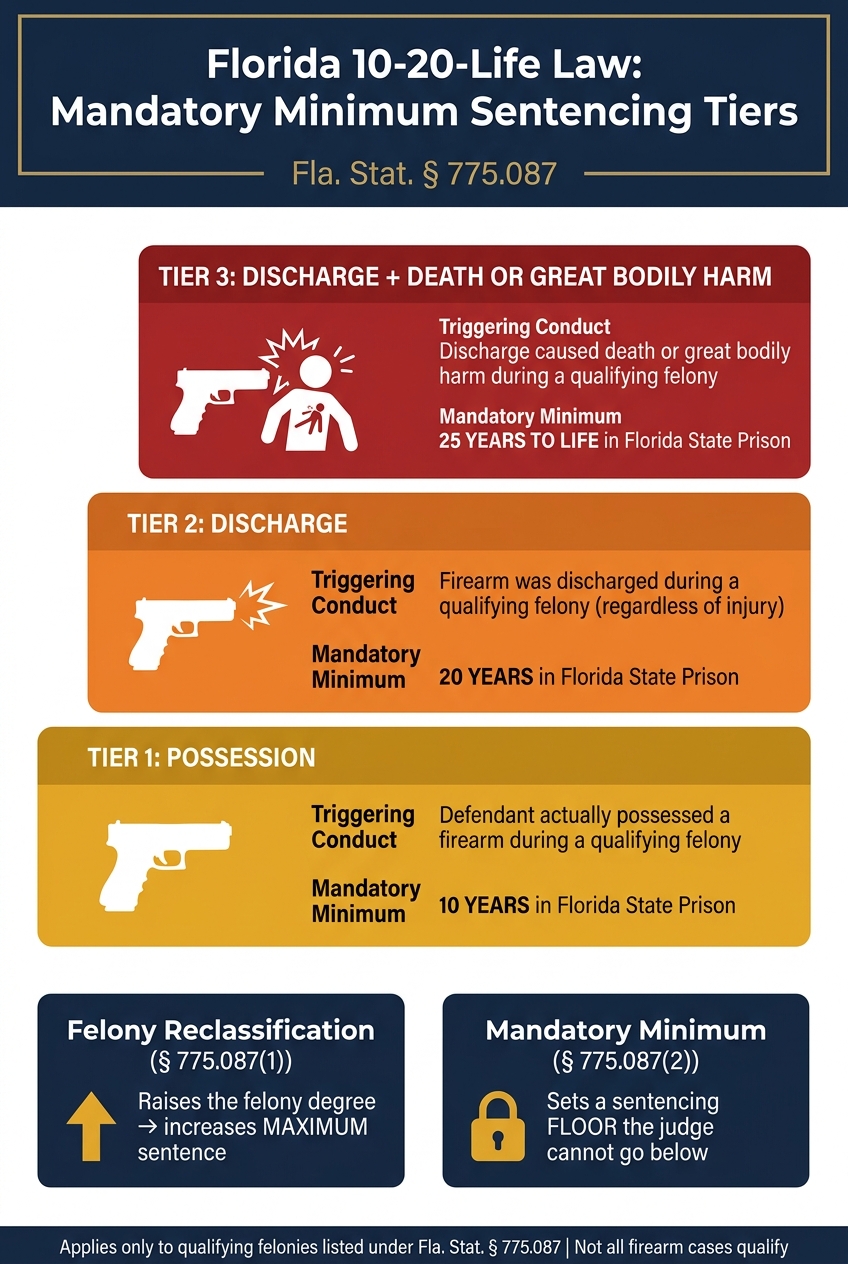
Florida 10-20-Life Law: Sentencing Tiers at a Glance
How Section 775.087 Works
Florida Statute § 775.087 does two things. And that split is the key to seeing how a firearm-related felony can get much more serious.
At the most basic level, the question is simple: does the firearm conduct increase the maximum sentence, the minimum sentence, or both?
One part of the statute can increase the degree of the underlying felony. The other part requires a minimum prison term that the judge must impose. In some cases, both apply at the same time.
Mandatory Minimums vs. Felony Reclassification
Reclassification comes from subsection (1) of § 775.087. It applies when the underlying felony does not already make weapon use an element of the crime. If the defendant carries, displays, uses, threatens to use, or attempts to use a firearm or weapon during that offense, the felony moves up by one degree.
That change matters because it increases the felony degree and, with it, the maximum sentence.
Mandatory minimums, by contrast, come from subsection (2). These rules set a floor, not a ceiling. So even if the sentencing guidelines would otherwise point to less time, the judge cannot go below that floor once the statute is triggered.
Put plainly:
| Effect | Source | What It Changes |
|---|---|---|
| Felony reclassification | § 775.087(1) | Raises the degree and increases the maximum sentence |
| Mandatory minimum | § 775.087(2) | Sets a floor the judge cannot go below |
That difference matters because each part changes a different piece of sentencing. One pushes the top end higher. The other locks in the bottom end.
And yes, both can apply to the same defendant in the same case. When that happens, the sentencing exposure can increase a lot.
What Conduct Triggers the Sentencing Enhancement
The mandatory minimum rules in subsection (2) do not apply to every crime that involves a gun.
Reclassification can apply to firearms or weapons. But 10-20-Life focuses on firearm or destructive-device conduct. The minimums come into play only when the defendant commits or attempts to commit one of the qualifying felonies listed in the statute, such as:
- robbery
- burglary
- murder
- sexual battery
- aggravated battery
And even then, the firearm conduct must meet one of three stated thresholds during that offense.
Actual possession of a firearm or destructive device during a qualifying felony triggers the 10-year minimum. Under § 775.087(4), actual possession means the firearm was on the defendant’s person or within immediate reach and available for use during the offense.
That last part is a big deal. A gun somewhere in the same room is not enough by itself. The statute requires more than simple proximity.
From there, the penalties increase by tier. Discharge carries a higher minimum than possession alone. Discharge causing death or great bodily harm carries the highest minimum. And before the court can impose that minimum, the State must obtain the required firearm finding.
The next section explains when each tier – 10, 20, or 25-to-life – applies.
sbb-itb-bb7ced0
When 10 Years, 20 Years, or 25-to-Life Applies
Once § 775.087 kicks in, the sentence turns on what happened with the firearm: possession, discharge, or discharge that caused death or great bodily harm.
At its core, the statute looks at three facts: possession, discharge, and harm.
| Tier | Triggering Conduct | Mandatory Minimum |
|---|---|---|
| 10 years | Actually possessed a firearm during the commission or attempted commission of a qualifying felony | 10 years in Florida state prison |
| 20 years | Discharged a firearm during the commission or attempted commission of a qualifying felony, regardless of injury | 20 years in Florida state prison |
| 25 years to life | Discharged a firearm during a qualifying felony and caused death or great bodily harm | 25 years to life in Florida state prison |
That said, not every firearm case falls under 10-20-Life. Some weapons enhancements are handled under separate rules.
10 Years: Possession or Carrying During a Qualifying Felony
The 10-year minimum applies when the defendant actually possessed a firearm during a qualifying felony. If the jury makes that finding, the court must impose at least 10 years in prison.
20 Years for Discharge and 25-to-Life for Death or Great Bodily Harm
The 20-year minimum applies when the firearm was discharged during the qualifying felony, even if no one was hurt. The 25-years-to-life minimum applies when that discharge caused death or great bodily harm. If the jury finds both discharge and the resulting harm, the judge must impose at least 25 years, and the sentence can go up to life.
Qualifying Felonies Listed in the Statute
These tiers apply only to the felonies listed in § 775.087. If the offense is outside the statute, 10-20-Life does not apply, even when a gun is present. And even within the statute, exceptions and related weapons rules may change the outcome.
Limits, Exceptions, and Related Provisions
10-20-Life applies only when both parts line up with § 775.087: the felony must be one of the listed offenses, and the firearm conduct must match what the statute requires. If the case falls outside those tight limits, the tiered minimums do not apply.
Why Not Every Firearm Charge Falls Under 10-20-Life
Not every case involving a gun turns into a 10-20-Life case. The statute applies only if the defendant is convicted of a listed felony under § 775.087(2)(a)1 and the state proves the required firearm conduct. If either piece is missing, the enhancement is off the table.
That point matters more than many people think. Improper exhibition of a firearm under § 790.10, for example, is a standalone Chapter 790 offense. It is not a 10-20-Life case. Aggravated assault also is generally outside 10-20-Life for offenses committed after July 1, 2016, even though other sentencing laws may still come into play.
The charging document matters too. The information or indictment must allege the firearm elements. If it does not, the enhancement cannot be imposed. In plain English: the state does not get to add those minimums later if it failed to charge them the right way at the start.
There are also a few narrow safety valves. In certain aggravated assault cases, the court may avoid the mandatory minimum if it makes written findings that:
- the defendant reasonably believed the use of force was justifiable
- the assault was not committed during another crime
- the defendant does not pose a threat to public safety
- the circumstances do not justify the mandatory minimum
Some weapon types are handled under their own enhancement rules, which can change the sentencing picture even when the felony analysis stays the same.
Separate Treatment for Certain Weapons and Enhancements
Some weapons bring harsher minimum terms. Section 775.087 separately increases penalties for machine guns and semiautomatic firearms with high-capacity magazines. Under the statute, a high-capacity magazine holds more than 20 centerfire cartridges.
If one of these weapons is discharged during a qualifying felony, the statute requires a minimum term of 20 years. Those minimum terms apply to each qualifying count and run consecutively to other sentences. That separate enhancement can make these cases more severe than ordinary firearm cases.
Why Early Case Review Matters
Once the statute is in play, speed matters. If 10-20-Life applies, the judge usually can’t go below the mandatory minimum. That puts a lot of weight on the very start of the case.
Early review should zero in on the proof. A close look at the case can spot charging defects or suppression issues before evidence disappears, gets damaged, or becomes harder to use.
It also tests whether the facts even fit the enhancement in the first place. For example, the defense may have room to fight the enhancement if:
- no firearm was recovered
- more than one person had access to the location
- a shot can’t be tied to the defendant in a reliable way
In that kind of situation, the goal isn’t just asking for leniency. It’s trying to beat the enhancement altogether.
Early review can also protect plea leverage. If plea talks happen before the State fully commits to a firearm-enhanced theory, there may be a chance to reduce the charge to an offense outside § 775.087. And that can avoid a mandatory minimum entirely. Once the prosecution digs in and the case gets closer to trial, that leverage often gets smaller.
If you are facing a possible 10-20-Life enhancement in Ocala, contact a criminal defense lawyer immediately.
FAQs
Does 10-20-Life apply if no gun was recovered?
Yes. Florida’s 10-20-Life law can still apply even if no gun is recovered.
What matters is whether prosecutors can prove the firearm element required under §775.087 during the charged offense, not whether the weapon was physically found.
Can a judge avoid the mandatory minimum?
Generally, no. If someone is convicted of an offense covered by Florida’s 10-20-Life law, the judge must impose the mandatory minimum and can’t set it aside.
In plain terms, the court usually can’t swap that sentence for probation, a diversion program, or a shorter term based on mitigating facts. That’s why the most important defense work often happens before a conviction – when there may still be room to challenge the charge, the firearm claim, or the facts of the case.
Can a plea deal remove a 10-20-Life enhancement?
Usually, no. If the underlying charges are proven in court, the 10-20-Life enhancement comes with mandatory minimum penalties that a judge can’t waive.
That said, before a conviction, an experienced attorney may be able to negotiate a plea to a lesser charge that doesn’t trigger the enhancement. Timing matters here. Act early, because that window can close fast.