
Drug classifications in Florida are organized into five schedules (I–V), based on abuse potential and medical use. This system affects charges for drug-related offenses, from misdemeanors to felonies, and penalties vary by the drug’s schedule. Florida law aligns with federal classifications but has unique regulations, such as treating chemically similar substances as Schedule I or II drugs. Here’s what you need to know:
- Schedule I: High abuse risk, no medical use (e.g., heroin, LSD, marijuana).
- Schedule II: High abuse risk, limited medical use (e.g., fentanyl, cocaine, methamphetamine).
- Schedule III: Moderate abuse risk (e.g., ketamine, anabolic steroids).
- Schedule IV: Low abuse risk (e.g., Xanax, Valium).
- Schedule V: Lowest abuse risk (e.g., cough syrups with small amounts of codeine).
Possession penalties range from misdemeanors for lower schedules to felonies for higher ones. Selling drugs near schools or public areas increases penalties, especially for fentanyl disguised as candy or vitamins. In Ocala, understanding these classifications is key to navigating legal challenges under Florida and federal laws.
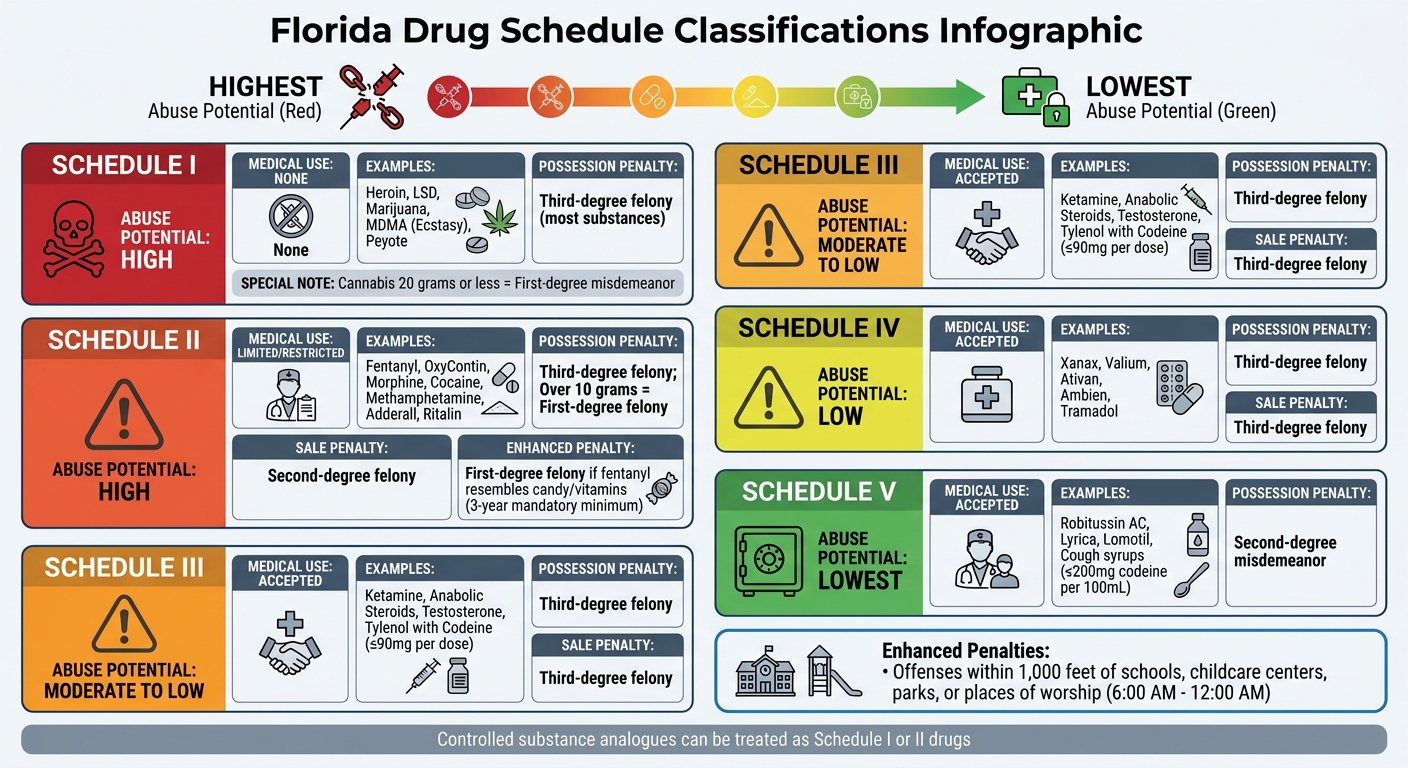
Florida Drug Schedule Classifications: Abuse Potential, Medical Use, and Penalties
1. Florida Drug Schedule Classifications
Legal Criteria and Definitions
Florida organizes controlled substances into five schedules, focusing on two main factors: their potential for abuse and whether they have any accepted medical use. Schedule I drugs are considered the most dangerous, with a high likelihood of abuse and no recognized medical applications. Schedule II drugs also carry a high risk for abuse but are permitted for limited medical use under strict regulations.
Moving down the scale, Schedule III substances have a lower potential for abuse compared to Schedules I and II. These drugs may lead to moderate or low physical dependence or high psychological dependence. Schedule IV drugs have an even lower abuse potential, while Schedule V substances are considered the least risky, often including medications with small amounts of narcotics.
Florida also regulates substances that are chemically similar to controlled drugs, known as controlled substance analogues. If these are intended for human use, they can be treated as Schedule I or II drugs, even if they haven’t been officially classified.
Examples of Controlled Substances
- Schedule I: Heroin, LSD, marijuana, MDMA (ecstasy), and peyote
- Schedule II: Fentanyl, OxyContin, morphine, cocaine, methamphetamine, Adderall, and Ritalin
- Schedule III: Ketamine, anabolic steroids, testosterone, and Tylenol with codeine (not exceeding 90 milligrams of codeine per dose)
- Schedule IV: Xanax, Valium, Ativan, Ambien, and Tramadol
- Schedule V: Robitussin AC, Lyrica, and Lomotil (including cough syrups with no more than 200 milligrams of codeine per 100 milliliters)
Penalties and Legal Implications
Possession penalties in Florida vary significantly depending on the drug’s schedule. For most Schedule I through IV substances, simple possession is treated as a third-degree felony. However, possessing 20 grams or less of cannabis is considered a first-degree misdemeanor – though this doesn’t apply to cannabis resin or derivatives. Schedule V substances, on the other hand, usually result in a second-degree misdemeanor charge.
More severe penalties apply for possession of over 10 grams of certain high-potency Schedule I(a), I(b), or II(b) drugs, which can lead to a first-degree felony charge.
The consequences become even tougher when possession is paired with intent to sell. For most Schedule I and II substances, this offense is classified as a second-degree felony. Selling Schedule III or IV drugs typically results in a third-degree felony. The stakes are raised even higher if the offense occurs within 1,000 feet of schools, childcare centers, parks, or places of worship during specific hours (6:00 a.m. to midnight).
Florida imposes particularly harsh penalties for selling fentanyl or its derivatives when they are made to resemble candy, cereal, vitamins, or feature cartoon designs. These offenses are charged as first-degree felonies and come with a mandatory minimum sentence of three years.
Florida’s detailed drug scheduling system lays the groundwork for understanding how it compares to federal classifications. The next section will explore the differences between state and federal approaches to drug scheduling.
sbb-itb-bb7ced0
2. Federal Drug Schedule Classifications
Legal Criteria and Definitions
The Controlled Substances Act categorizes drugs into five schedules, based on their potential for abuse and recognized medical applications.
"Schedule I drugs, substances, or chemicals are defined as drugs with no accepted medical use and a high potential for abuse." – DEA
Schedule I substances, like heroin and LSD, are considered the most dangerous, with no approved medical use and a high risk of abuse. Schedule II drugs, such as fentanyl and methamphetamine, also carry a high risk of abuse but are permitted for restricted medical use. Schedule III drugs, including ketamine and anabolic steroids, have a moderate to low risk of abuse. Schedule IV substances, like Xanax and Valium, have an even lower abuse potential, while Schedule V includes drugs with the least risk, such as certain cough medicines containing limited amounts of narcotics.
Federal laws also treat controlled substance analogues – chemicals designed to mimic Schedule I drugs – as if they are in Schedule I when intended for human consumption. This classification system plays a major role in determining how federal laws differ from state regulations, especially in sentencing.
Examples of Controlled Substances
| Schedule | Abuse Potential | Medical Use | Examples |
|---|---|---|---|
| Schedule I | High | None | Heroin, LSD, marijuana |
| Schedule II | High | Restricted | Fentanyl, cocaine, methamphetamine |
| Schedule III | Moderate to Low | Accepted | Ketamine, anabolic steroids |
| Schedule IV | Low | Accepted | Xanax, Valium, Ambien |
| Schedule V | Lowest | Accepted | Robitussin AC, Lyrica |
Federal rules also set specific thresholds for certain drugs. For instance, Schedule III drugs may contain less than 90 milligrams of codeine per dosage unit, while Schedule V cough medicines are limited to less than 200 milligrams of codeine per 100 milliliters. These precise measurements are critical in federal charging decisions, just as they are under state guidelines.
Penalties and Legal Implications
Federal penalties are closely tied to the drug schedules and often differ from state laws. Crimes involving Schedule I and II substances generally result in second-degree felony charges. Schedule III and IV offenses are typically classified as third-degree felonies, while Schedule V violations are usually treated as first-degree misdemeanors.
Federal sentencing can also include location-based enhancements. For example, drug offenses committed within 1,000 feet of schools (between 6:00 a.m. and midnight), child care centers, parks, or community facilities can lead to harsher penalties. In such cases, charges may be elevated by one degree – for instance, a second-degree felony could be upgraded to a first-degree felony, significantly increasing the potential prison time and fines for those convicted.
Comparing Florida and Federal Classifications
Florida’s scheduling system and federal standards share some common ground but also have key differences. Both frameworks classify substances based on their potential for abuse and accepted medical use. Under the federal Controlled Substances Act, substances are placed into one of five schedules using eight factors, including abuse potential and risks to public health. This system provides a foundation for understanding how state and federal classifications may diverge.
For example, federal law prosecutes analogues of Schedule I and II drugs as Schedule I substances. Florida also regulates controlled substance analogues, but differences in state legislative priorities can lead to variations in classification and enforcement.
These differences can significantly impact legal outcomes depending on the jurisdiction. For residents of Ocala and Florida, understanding both systems is crucial. The experienced attorneys at Law Firm Ocala are prepared to help protect your rights in such cases.
Conclusion
To navigate the legal landscape in Ocala, it’s crucial to understand the differences between Florida’s drug schedules and federal classifications. Both systems categorize controlled substances from Schedule I to Schedule V, focusing on abuse potential and medical use. However, enforcement priorities and specific regulations can vary, leading to significant differences in how charges are handled. A drug classified one way federally might be treated differently under Florida law.
As discussed earlier, the severity of penalties aligns with the abuse risk: Schedule I and II drugs carry the most severe consequences, while Schedule V offenses are less harsh. For defense attorneys, knowing whether a substance is deemed to have medical use under state versus federal definitions can play a key role in crafting a legal strategy. The added layer of dual licensing requirements further complicates matters in drug-related cases.
These classifications don’t just affect penalties; they also shape the level of judicial oversight and the seriousness of charges for possession, manufacturing, or distribution. Florida’s laws can sometimes be stricter than federal guidelines, creating potential conflicts where compliance with one system might not ensure compliance with the other. This complexity makes informed legal representation essential.
If you’re dealing with drug charges in Ocala, Law Firm Ocala offers experienced criminal defense attorneys who understand these intricacies. Their team can help you navigate the legal system, ensuring your rights are protected. They provide free consultations to assess your case and explain your options under Florida’s detailed drug laws.
FAQs
Can the same drug be scheduled differently under Florida and federal law?
Yes, a drug can fall under different schedules depending on whether you’re looking at Florida law or federal law. The federal government, through the DEA and the Controlled Substances Act, classifies drugs based on factors like medical use and potential for abuse. However, Florida has its own scheduling system and legal penalties, which don’t always align with federal classifications.
What is considered a “controlled substance analogue” in Florida?
In Florida, a "controlled substance analogue" refers to a substance that has a chemical structure and effects on the central nervous system resembling those of a controlled substance. Under Florida law, these substances are treated similarly to controlled substances and carry comparable legal consequences.
How do ‘1,000 feet’ drug-free zones increase penalties in Florida?
In Florida, drug-free zones are established within 1,000 feet of areas like schools, aiming to protect these spaces from drug-related activities. If someone is caught selling or using drugs in these zones, they face stricter penalties. This reflects the state’s commitment to keeping these areas safe and secure.