
In Florida, monthly child support usually does not cover uninsured medical bills. If you live in Ocala, Florida or anywhere else in the state, the rule is simple: base child support pays for routine costs, while extra medical expenses are often split separately under the court order.
I’d break it down like this:
- Base child support covers regular living costs like food, housing, clothing, and transportation.
- Health insurance premiums for the child are usually added to support as a separate cost.
- Work-related child care is also added separately.
- Uninsured medical bills like co-pays, deductibles, braces, therapy, dental work, and prescriptions are often paid later based on each parent’s income share.
- In many cases, that split follows the same percentage used in the Florida child support worksheet under Fla. Stat. § 61.30.
- The exact wording in the final order controls deadlines, notice, proof, and payment.
Here’s the short answer: if a bill is routine and shows up every month, it usually fits inside support. If it is a medical bill that comes later and insurance did not fully pay it, it often falls under the reimbursement part of the order.
Quick Comparison
| Issue | Base Child Support | Extra Medical Expenses |
|---|---|---|
| What it pays for | Regular child costs | Uninsured or unpaid medical bills |
| When it is set | Up front in the support order | After the bill happens |
| Common examples | Food, rent, clothes, utilities | Co-pays, deductibles, orthodontics, therapy |
| How it is split | Guideline formula | Often by income percentage |
| Proof needed | Income and payment records | Bills, EOBs, receipts, notice |
One missed deadline or missing EOB can affect collection, so I’d treat the order language and paperwork like the main rulebook.
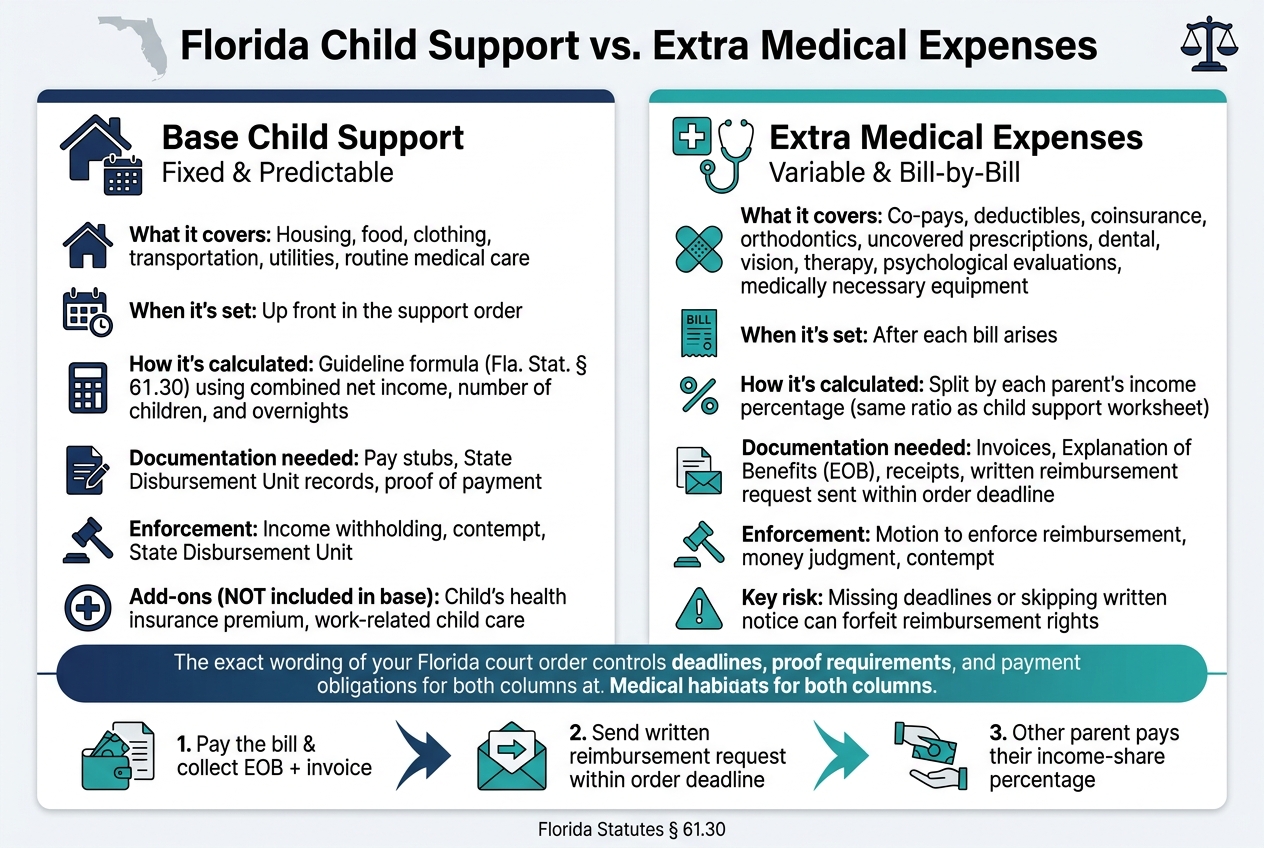
Florida Child Support vs. Extra Medical Expenses: Key Differences
What Base Child Support Covers Under Florida Guidelines
While navigating Florida’s child custody laws, the state sets base child support under Florida Statutes section 61.30 by looking at each parent’s net monthly income. The court adds both incomes together, checks the guideline schedule, and then splits the basic support amount based on each parent’s share of that income.
Standard Living Expenses Included in Monthly Support
The monthly guideline amount is meant to cover a child’s regular day-to-day costs. That includes housing, food, clothing, utilities, transportation, and routine medical care.
In plain English, base support is meant for the bills that tend to show up month after month. Bigger and less predictable expenses, like surgery or specialist care, are usually dealt with outside that base amount.
Health Insurance and Child Care as Separate Add-Ons
Two expenses often trip people up because many assume they’re already built into base support. They aren’t: the child’s health insurance premium and work-related child care costs.
Under Florida Statutes section 61.30, both are treated as add-ons. That means they’re calculated on top of the basic support amount and then divided between the parents based on their income shares.
For health insurance, Florida looks at the incremental cost of adding the child to the policy, not the parent’s whole premium. Work-related child care is handled the same way as a separate added expense.
| Cost Type | Included in Base Support? | How It’s Handled |
|---|---|---|
| Child’s health insurance premium | No | Added on top of the basic obligation |
| Work-related child care (daycare, etc.) | No | Added separately |
| Large uninsured medical bills | No | Addressed through separate order provisions |
The next issue is which medical bills Florida treats as extraordinary rather than part of base support.
sbb-itb-bb7ced0
Extra Medical Expenses That Fall Outside Standard Support
Uninsured or unpaid medical costs sit outside base support because they aren’t steady month-to-month expenses. They can change a lot, and that makes them hard to build into a standard support amount.
Because of that, the court may add these costs to the child support obligation or order each parent to pay a set share separately. The split depends on the exact wording in the support order. In plain English: the order controls who pays what.
Common Examples of Uninsured or Unpaid Medical Costs
These costs often include:
- Co-pays, deductibles, and coinsurance
- Uncovered prescriptions, dental and vision care, orthodontics, counseling, psychological evaluations, and therapy
- Therapy services and medically necessary equipment when insurance pays only part of the bill
If insurance doesn’t cover the full amount, the unpaid balance is often split between the parents.
When Medical Costs Are Treated as Extraordinary
Some medical costs go far beyond what the guideline formula is meant to handle. In those cases, a court may deviate from guideline support when a child has extraordinary medical, psychological, educational, or dental expenses.
Examples can include chronic illness, intensive behavioral therapy, and major dental or orthodontic care. These expenses don’t replace base support. They are added on top of it, or they may support a different split of costs between the parents.
Courts usually want solid backup before making that kind of adjustment. That often means itemized bills, EOBs, provider records, and proof that the costs are recurring and substantial. Those records can support either a percentage split or a deviation from the guideline amount. The final order should spell out that division clearly.
Base Child Support vs Extra Medical Expenses: Key Differences
Under Florida’s support rules, base child support is fixed and predictable, while extra medical expenses come up only when a bill shows up. Base support is set ahead of time. Extra medical costs are split after they happen. The contrast gets a lot easier to see when you look at calculation, proof, and enforcement side by side.
| Aspect | Base Child Support | Extra Medical Expenses |
|---|---|---|
| What it covers | Housing, food, clothing, transportation, and other routine child costs | Co-pays, deductibles, orthodontia, uncovered therapy, and prescriptions |
| How costs are calculated | Set once by guideline formula using income, children, and overnights | Apportioned as each bill arises, based on each parent’s income percentage |
| Documentation needed | Proof of payment or nonpayment, such as pay stubs or State Disbursement Unit records | Invoices, EOBs, receipts, and written requests for reimbursement |
| How payment is enforced | Income withholding, State Disbursement Unit records, and contempt | Motion to enforce reimbursement, money judgment, and contempt, usually with proof of the expense and notice |
How Florida Courts Divide Added Medical Costs
Florida courts usually split uninsured medical expenses using the same income percentages already used in the child support calculation. Put simply, each parent pays the same percentage as that parent’s share of the combined net income. You can find that percentage on the child support worksheet.
Courts then apply that ratio to the actual bill when it comes due. On paper, that sounds simple. In practice, though, problems often start when bills aren’t shared on time or the paperwork is incomplete.
Why Order Wording and Records Matter
Even when the percentage split seems plain, the court order still runs the show. The exact wording in the parenting plan or final judgment decides what counts as a reimbursable expense, how fast documents must be sent, and how the other parent is supposed to respond.
Many Florida orders require the parent who paid the bill to send:
- A copy of the invoice
- The insurance Explanation of Benefits (EOB)
- A written request for reimbursement within the deadline in the order
The other parent then usually gets a separate deadline to pay that share.
Miss the deadline, or skip the written notice step, and a court may refuse to enforce reimbursement or may limit how much can be collected. That risk gets higher if the delay makes it harder for the other parent to respond. Clean, organized records can make a big difference if a motion to enforce reimbursement becomes necessary.
How Florida Support Orders Are Structured and What Parents Should Know
Once you know which costs are covered, the next step is figuring out where those costs show up in the order. In Florida, a child support order often lists a few separate duties, and the exact wording of the order decides how reimbursement works.
That’s the part many parents miss. It’s not only about whether the order mentions a cost. It’s about which clause controls reimbursement. In most cases, the uninsured medical expense clause is the one that matters. That section usually spells out what counts for cost-sharing, how soon documents must be sent, and what happens if someone misses the deadline.
Check your order for a section called medical and dental expenses or noncovered medical expenses. That’s usually where the rules are. If your child’s healthcare needs have changed in a major way since the order was entered – for example, a new diagnosis that now requires regular occupational therapy – you may need a formal modification instead of just sending a reimbursement request under the current clause.
For each request, keep:
- EOBs
- Invoices
- Receipts
- Proof of delivery
Conclusion: The Main Legal Distinction to Remember
Now that the order’s setup is clear, the main distinction is straightforward: routine costs belong in base support, while noncovered medical bills are dealt with separately. Base child support covers routine costs. Extra medical expenses are separate and paid under the order’s reimbursement clause.
FAQs
What counts as an uninsured medical expense in Florida?
In Florida child support, an uninsured medical expense is a cost for your child that is not covered by the child’s health insurance.
These costs may be treated as special or extraordinary medical expenses beyond base guideline support, especially for ongoing treatment, specialized care, or uncovered medications. Courts usually require bill records and details about what the insurance plan did or did not cover.
How do Florida courts split extra medical bills between parents?
In Florida, courts usually add extra medical costs on top of the base child support amount. That can include uninsured medical bills, therapy, specialized care, health insurance, and child care.
The total is often split based on each parent’s share of net income. A judge can also depart from the standard guidelines if a child has ongoing, extraordinary medical needs.
What if my child support order is silent on medical reimbursements?
Document every related expense and keep the receipts, especially for uninsured medical bills. Then talk with a family law attorney.
In Florida, courts generally do not allow retroactive changes for expenses that came up before a formal petition was filed. So timing matters. If these costs were not part of the current order, you may need to file a Supplemental Petition for Modification.
The court can change support when there has been a substantial, continuing change in circumstances, such as extraordinary medical needs.