
If your overtime, bonuses, tips, or commissions happen often in Ocala, Florida, they will often count for child support. Under Florida Statute § 61.30, courts look at more than base pay. They look at whether extra income shows a pattern, whether it is likely to continue, and whether records back it up.
Here’s the short answer:
- Regular overtime is often added to income
- Guaranteed bonuses are usually counted
- Commissions and seasonal pay are often averaged over 12 to 24 months
- One-time bonuses or short spikes in hours may be left out
- A support change usually needs a lasting income shift, not just a brief change
- In Florida, a new support amount must differ by at least 15% or $50 per month, whichever is more, before a court can approve a change
If I were getting ready for a child support case in Ocala, Florida, I would start with my pay stubs, tax returns, W-2s or 1099s, bonus records, and any employer notice about overtime cuts or pay-plan changes. That paper trail often decides whether extra pay counts or not.
Quick Comparison
| Type of pay | Often counted? | How courts often look at it |
|---|---|---|
| Base wages | Yes | Monthly income |
| Regular overtime | Yes | Past pattern and future likelihood |
| Extra shifts once in a while | Sometimes | May be reduced or left out |
| Guaranteed bonus | Yes | Annual amount split over 12 months |
| Commissions | Yes, if steady | Often averaged over 12–24 months |
| One-time bonus | Often no | May be excluded if no pattern |
| Seasonal income | Often yes, if repeated | Averaged across past earnings |
The main point is simple: Florida child support is based on what you actually earn, not just what your hourly rate says.
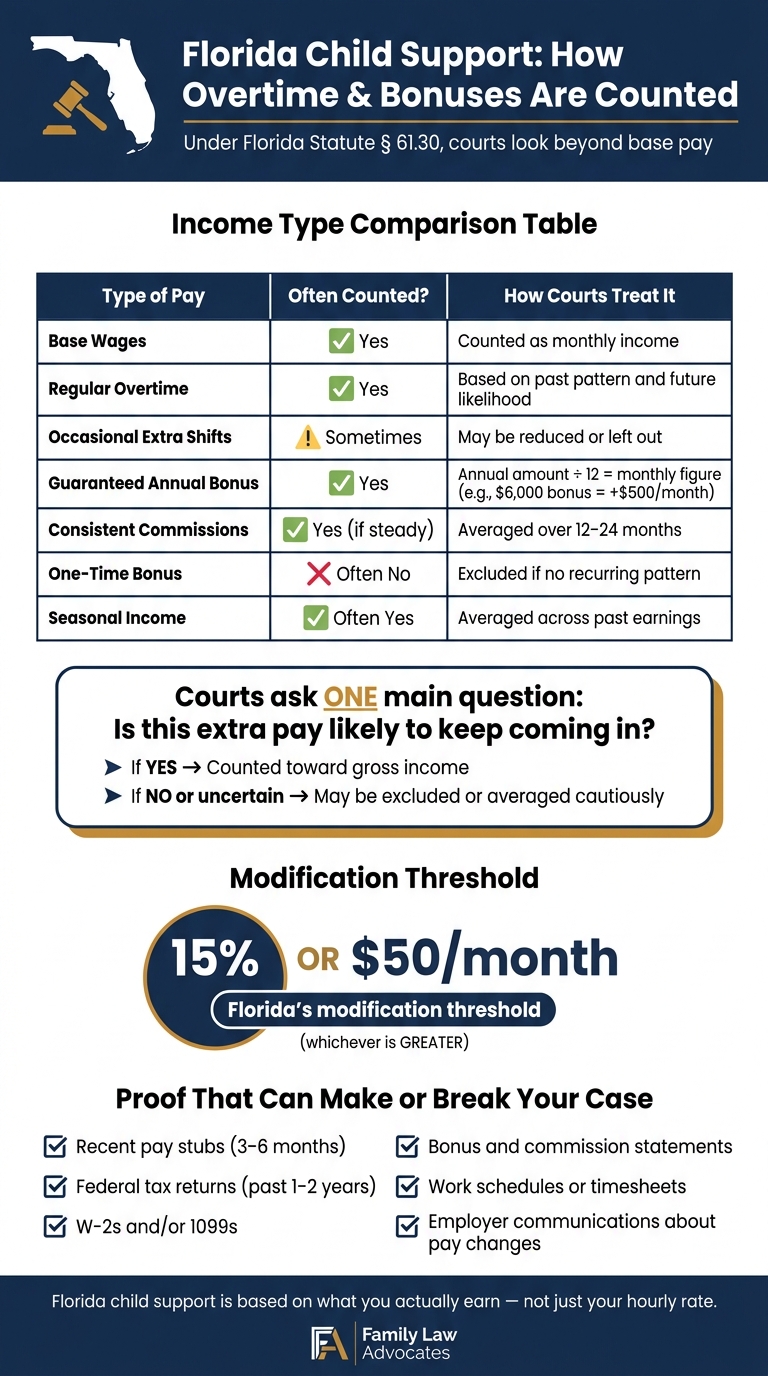
Florida Child Support: How Overtime & Bonuses Are Counted
What counts as income under Florida child support law
Florida Statute § 61.30 defines gross income in broad terms. It includes wages, salary, bonuses, commissions, allowances, overtime, tips, disability benefits, workers’ compensation, pension and retirement income, rental income, interest, dividends, and spousal support received. Courts may also include similar recurring compensation.
Once gross income is set, the court subtracts allowed deductions to figure out net monthly income. Then it applies the guideline schedule and makes adjustments for health insurance, work-related childcare, and timesharing.
Why gross income goes beyond base salary
Florida courts don’t stop at the base pay listed on a pay stub. The point is to measure what a person actually earns, not just the guaranteed wage. So courts look at recurring overtime, shift differentials, commissions, and bonuses when they calculate income.
That matters because recurring pay is treated differently from one-time income. A paycheck can tell part of the story, but not the whole thing.
When this income definition applies
These same income rules apply when a court sets child support and when it later reviews an existing order.
The next issue is whether overtime, bonuses, and other extra pay are regular enough to be included in the support calculation.
sbb-itb-bb7ced0
When overtime, extra shifts, bonuses, and commissions are counted
Courts look at one main issue: is the extra pay likely to keep coming in? If the answer is yes, that money will often count toward gross income. If the pay was irregular or tied to a short stretch of work, the court may give it less weight. When variable pay shows up in a steady pattern, courts often average it.
Overtime and extra shifts: recurring versus occasional
If you’ve worked extra shifts on a steady basis for months or years, courts are more likely to treat that pay as part of your gross income. But if those extra hours came from a short-term project or just a few busy weeks, the court may not count them the same way.
To sort that out, courts look at things like pay stubs, tax returns, and employer statements. The goal is simple: figure out whether the overtime is likely to continue, and separate recurring pay from temporary pay.
| Overtime Type | Likely Treatment |
|---|---|
| Regular overtime over many months | Generally included in gross income |
| Occasional or intermittent overtime | May be discounted or averaged cautiously |
| No overtime history | Not included; support calculated on base wages only |
The same basic test applies to bonuses and commissions. Courts want to see consistency, not a one-time jump in pay.
Bonuses, commissions, and seasonal pay
Most cases fall into three common rules.
- Guaranteed annual bonuses are included in gross income. For example, a $6,000 guaranteed year-end bonus would usually be divided by 12, which adds $500 per month to guideline income.
- Consistent commissions are often averaged over 12 to 24 months to estimate monthly income.
- Nonrecurring or discretionary bonuses may be left out or handled separately.
| Bonus/Commission Type | Typical Treatment | Averaging Method |
|---|---|---|
| Guaranteed annual bonus | Included in gross income | Annual amount ÷ 12 = monthly figure |
| Consistent commission history | Included through averaging | 12–24 month average of total commissions |
| Nonrecurring or discretionary bonus | May be excluded or treated separately | Multi-year average if a pattern exists; otherwise excluded |
How courts handle irregular income and support changes
When pay goes up and down, courts stop looking only at what someone earned in the past. The main issue becomes what income is likely to continue.
Income averaging and proof of future earnings
If income changes from month to month, courts often average past earnings to come up with a more realistic monthly number. That can help with jobs where pay swings a lot, like work with heavy overtime, commission-based pay, or seasonal employment.
The proof behind that number matters a lot. Tax returns, W-2s, 1099s, pay stubs, and employer letters can help show whether the change is temporary or part of a longer pattern.
When a change in overtime or bonuses may support a modification
That same pattern matters when a parent later asks to change support.
One bonus or a short burst of overtime usually isn’t enough on its own. Florida law requires a substantial, material, and unanticipated change in circumstances, and the new amount must meet Florida’s threshold for modification. Courts want to see a lasting shift, not a brief drop. Short-term changes rarely support modification.
| Scenario | Modification likely? |
|---|---|
| Temporary overtime increase | Unlikely |
| Permanent loss of overtime | Likely if the threshold is met |
| Involuntary job loss | Likely if supported by records |
If someone voluntarily cuts back overtime or passes up bonus chances, that can hurt a request to modify support.
The same records that show a real income shift also help the court decide whether support should remain in place as is.
Conclusion: Key points for Florida parents with variable pay
In Florida, recurring overtime, bonuses, commissions, and extra shifts can count as income if they happen on a regular basis and are likely to keep happening. That same pattern matters later if child support needs to be changed. A one-time windfall usually won’t count. Variable pay that shows up again and again often will.
The big thing is proof. Good records make it much easier to show whether extra income is part of your normal pay or just a short-term bump.
Records to gather before speaking with a lawyer
These records can help show whether the extra income is recurring or temporary. Before your first conversation with a family law attorney, gather:
- Recent pay stubs (at least 3–6 months): These show base pay, overtime hours, bonuses, and commissions in one place.
- Federal tax returns for the past 1–2 years: These help show whether variable income has been a steady part of your yearly earnings.
- W-2s and/or 1099s: These identify all income sources and separate regular employment from contract or side work.
- Bonus and commission statements: These can show how often incentive pay happens and the conditions tied to it.
- Work schedules or timesheets: These help show whether overtime is part of your normal routine or only happens once in a while.
- Employer communications: Emails, letters, or policy notices about overtime cuts, schedule changes, or pay-plan changes can help show whether an income shift is permanent.
List everything in date order and make note of any gaps or changes. That simple step can help your lawyer spot patterns fast.
Florida law says the recalculated support amount must differ from the current order by at least 15% or $50 per month, whichever is greater, before a modification can be approved.
Law Firm Ocala handles child support cases in Ocala, Florida involving overtime, bonuses, and fluctuating income.
FAQs
How far back do courts look at overtime or bonus income?
Florida courts look at past earnings to decide if overtime or bonus income shows up in a regular, predictable way. In practice, that means overtime is often averaged across recent months. Bonuses may be reviewed over a longer stretch, sometimes several years.
The court also looks for recurring payments, like annual bonuses or seasonal overtime, when deciding whether this income should count toward ongoing child support.
Can child support be based on income I no longer receive?
Usually, child support is based on your current income, because the goal is to match what you can actually afford now.
So if you no longer get bonuses or overtime, that money generally should not be factored into your ongoing support amount.
That said, courts may still review your past earnings to decide whether that extra income was predictable. If your income has dropped in a major way, you need to deal with it formally by filing a Supplemental Petition to Modify Child Support.
What records best prove my extra pay is temporary?
Provide records that show your earnings history and that the extra pay likely won’t continue. For example:
- At least 12 months of pay stubs showing regular pay and overtime
- W-2s and tax returns showing income trends
- Employment contracts and an employer statement about your usual schedule or expected changes
These records can help show that overtime, bonuses, or similar pay is irregular or temporary.