
If a parent in Ocala, Florida keeps breaking a parenting plan, the court can step in fast. In most Florida custody cases, civil contempt depends on 3 things: a clear court order, proof the parent knew about it, and proof the parent chose not to follow it even though they could.
Here’s the short version:
- I can ask the court for contempt when a parent:
- denies time-sharing
- misses exchanges
- blocks calls or video contact
- ignores transportation terms
- I have to show the judge:
- the order was specific
- the other parent had notice
- the violation was willful
- I should bring proof like:
- texts
- emails
- call logs
- time-stamped photos
- witness statements
- the signed court order
- If contempt is found, the judge may order:
- makeup time-sharing
- attorney’s fees and costs
- fines
- classes or counseling
- stricter exchange rules
- For repeat violations, the court may do more, but it cannot permanently change custody just as a contempt penalty without a separate legal process.
Florida courts use civil contempt in these cases to force compliance, not just to punish. And under Florida law, when time-sharing is wrongly denied, makeup time is often the first fix. In many cases, written findings by the judge matter just as much as the missed visit itself.
Quick Comparison
| Issue | What I need to show | What the court may do |
|---|---|---|
| Denied visit or missed exchange | Clear order, notice, willful violation | Makeup time, fees, fines |
| Blocked calls or contact | Order required that contact | Enforcement order, sanctions |
| First violation | Proof of one willful breach | Warning, makeup time, tighter instructions |
| Repeat violations | Pattern of willful breaches | Contempt, money sanctions, closer court watch |
| Lasting change to parenting plan | More than contempt alone | Separate modification case |
If I’m dealing with time-sharing problems in Ocala, Florida, this gives me the basic roadmap: prove the order, prove the violation, and bring dated proof.
sbb-itb-bb7ced0
What Must Be Proven for Civil Contempt in a Florida Custody Case
After a missed exchange, denied visit, or blocked call, the court looks at one basic issue: can contempt be proven? In a Florida civil contempt case, the parent who files the motion has to prove three things. There must have been a clear, enforceable court order. The other parent must have known about that order. And the other parent must have willfully failed to follow it even though they were able to do so.
If even one of those parts is missing, the contempt motion fails.
The burden of proof is a preponderance of the evidence. Put simply, the moving parent must show that their version is more likely than not.
The Required Elements: Clear Order, Knowledge, and Willful Noncompliance
The order must be clear and enforceable. A parent can’t be held in contempt for breaking an order that’s vague, fuzzy, or open to guesswork. If the parenting plan doesn’t clearly say what had to happen, the court may not treat the violation as contempt.
Knowledge is often the easy part. It’s usually shown by the parent’s presence in court when the order was entered or by proof that they received the signed order.
Willful noncompliance is where most hearings turn. The judge isn’t asking whether compliance was annoying, difficult, or a hassle. The court wants to know whether the parent chose not to comply. That’s a big difference.
If the accused parent can show a real inability to comply, the court may decide not to find contempt. That might include a documented illness, a vehicle breakdown, or interference by the other parent. The accused parent can present evidence showing that they could not comply.
Evidence Parents Should Bring to a Contempt Hearing
At a contempt hearing, dated records often matter more than angry testimony. Good proof can be the difference between a contempt finding and a denied motion.
Useful evidence includes:
- Text messages or emails showing the other parent refused or ignored exchange plans
- Call logs showing repeated unanswered calls around scheduled pickup times
- Time-stamped proof that you appeared for the exchange
- Witness testimony from someone who saw the missed exchange or heard the other parent say they would not comply
- The signed parenting plan and order
If those parts are proven, the court can then move to enforcement remedies.
Notice, Hearing Rights, and Written Court Findings
The accused parent must receive proper notice of both the contempt motion and the hearing date before the court can take action. At the hearing, that parent also has the right to be heard and to present evidence.
The judge must make written findings that identify the order that was violated, the willful noncompliance, and the ability to comply. This step matters. Florida appellate courts have overturned contempt orders when trial judges skipped it or made the findings too vague.
If you’re asking for contempt, it’s smart to ask the court to include those findings in the written order.
What a Florida Judge Can Order After Finding Contempt
After a judge finds contempt, the next step is enforcement. The goal is to make up for lost time-sharing and get everyone back in line with the court order. In practice, the judge ties the remedy to what happened and to the child’s best interests.
Makeup Time and Compensatory Time-Sharing
If one parent wrongly blocks court-ordered time-sharing, the judge must award makeup time-sharing. Under § 61.13(4)(c)(1), the court must order enough extra time-sharing to make up for the missed time. That time must be set as expeditiously as possible, in a way that works for the parent who lost time, and at the expense of the noncompliant parent.
The exact schedule can vary. Judges look at things like the child’s age, school calendar, daily routines, and general wellbeing. The idea is pretty simple: restore parent-child contact without turning the child’s life upside down.
If the denials keep happening, the court can move beyond makeup time and use stronger tools.
Fines, Attorney’s Fees, Courses, and Other Sanctions
When makeup time by itself won’t fix the problem, the court may add fees, fines, or other compliance orders. That can include:
- Attorney’s fees and court costs, after weighing each party’s need and ability to pay under § 61.16
- Compensatory fines to repay actual losses, such as travel costs or missed work
- Fines designed to force future compliance
- A court-approved parenting course
- Counseling or therapy
- Community service that does not interfere with time-sharing or the child’s welfare
- Other tailored sanctions the court finds fit for the case
In long-distance cases, judges may also move transportation costs and travel duties to the noncompliant parent. That can help preserve contact and cut down on future interference.
Comparison Table: Common Contempt Remedies and When Courts Use Them
| Remedy | Purpose | Type | Typical First-Time Use | Typical Repeated/Egregious Use |
|---|---|---|---|---|
| Makeup time-sharing | Restore missed parent-child contact | Compensatory | Usually ordered | Usually ordered, often in larger blocks |
| Attorney’s fees & costs | Reimburse enforcement expenses | Compensatory | Common | Common |
| Compensatory fines | Cover real losses like travel or missed work | Compensatory | Sometimes ordered | More common |
| Coercive fines | Force future compliance | Coercive | Sometimes ordered | More common |
| Parenting course | Improve co-parenting skills | Coercive | Common | Common |
| Counseling/therapy | Address conflict or behavior issues | Coercive | Sometimes ordered | More common |
| Community service | Consequence for noncompliance | Coercive | Less common | More likely |
| Transportation burden shift | Reduce interference and preserve contact | Both | Sometimes ordered | More likely |
| Incarceration with purge condition | Last-resort coercion for willful defiance | Coercive | Rare | Possible in serious cases |
Repeated violations can lead to stricter enforcement at the next stage.
How Judges Respond to Repeated or Serious Violations
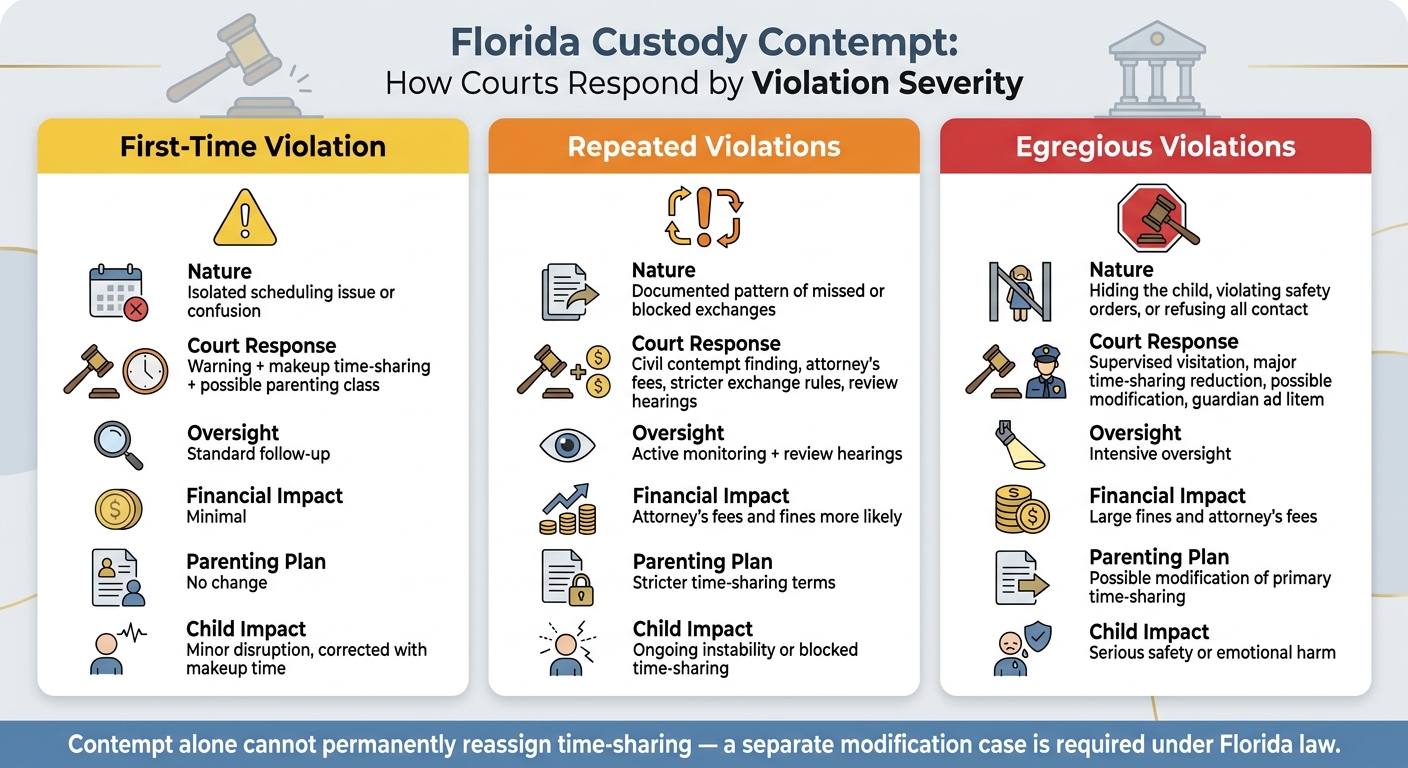
Florida Custody Contempt: Court Responses by Violation Severity
When makeup time, fees, and warnings don’t stop the problem, the court steps in more forcefully. One missed exchange will often bring a limited response. But when violations keep piling up, Florida judges usually move to stronger enforcement aimed at getting the parent back into compliance and protecting the child’s time-sharing schedule.
How Enforcement Escalates From a First Violation to Repeated Misconduct
For a first, isolated violation, the court may clear up the order, give a warning, and award makeup time-sharing. If the judge thinks the conduct was intentional, the court may add extra conditions, like a neutral exchange site or a court-approved parenting app.
If the same parent keeps violating the order, the response usually gets tougher. Courts may move toward formal civil contempt findings, stricter exchange terms, mandatory parenting classes, and money penalties. The judge may also schedule review hearings to keep a close eye on whether the parent starts following the order.
When Time-Sharing Terms May Be Tightened or Modified
If enforcement still doesn’t work, the court may look at whether the parenting plan needs tighter guardrails. Repeated or serious violations can support a request to modify the parenting plan. Under Florida law, that takes proof of a substantial, material change in circumstances and proof that the change serves the child’s best interests. A long-running pattern of violations – especially one that upsets the child’s stability or keeps blocking the other parent’s time-sharing – can sometimes meet that standard.
Courts may answer with supervised visitation, fewer overnights, or stricter exchange terms as temporary safeguards, not permanent punishment.
The main takeaway is simple: contempt alone cannot be used as a shortcut to permanently reassign time-sharing. Florida appellate courts have reversed trial court rulings that changed time-sharing as a contempt sanction without the required statutory analysis. Any lasting change has to go through the proper modification process, with separate findings on changed circumstances and the child’s best interests.
Comparison Table: First-Time, Repeated, and Egregious Violations
The court’s response usually tracks how often the violation happens and how serious it is.
| Factor | First-Time Violation | Repeated Violations | Egregious Violations |
|---|---|---|---|
| Nature of conduct | Isolated scheduling issue or confusion | Documented pattern of missed or blocked exchanges | Hiding the child, violating safety orders, or refusing all contact |
| Typical court response | Warning, makeup time-sharing, or a parenting class | Civil contempt finding, attorney’s fees, stricter exchange rules | Supervised visitation, major time-sharing reduction, possible modification |
| Court oversight level | Standard follow-up | Review hearings and monitoring | Intensive oversight, possible guardian ad litem involvement |
| Financial consequences | Minimal | Attorney’s fees and fines more likely | Large fines and attorney’s fees |
| Impact on parenting plan | No change | Stricter time-sharing terms | Possible modification of primary time-sharing |
| Child’s situation | Minor disruption, corrected with makeup time | Ongoing instability or blocked time-sharing | Serious safety or emotional harm |
Filing a Motion for Civil Contempt and Next Steps
What to Include in a Motion for Contempt or Enforcement
Once contempt or repeated interference is clear, the next step is a formal enforcement filing. You start by filing a Motion for Civil Contempt/Enforcement in the court that entered the parenting plan. This motion is used when the other parent keeps blocking court-ordered time-sharing or communication. In Florida, courts use Supreme Court Approved Family Law Form 12.960 for this.
Be specific. Identify the order by its title, date, case number, and court. Then quote the exact parts of the order that were violated. For each violation, spell out:
- what the order required
- what happened
- why the noncompliance was willful
You should also clearly state the relief you want the court to order.
How Legal Help Can Strengthen Your Enforcement Case
The more specific the motion, the easier it is for the court to enforce the order. A detailed motion, backed by organized evidence, can make a big difference at the hearing. Judges often need a clean timeline they can follow without guessing what happened or when.
An attorney can help by reviewing your records, spotting which violations best support a finding of willful noncompliance, and putting the motion together in a way that is easy for the judge to track. Counsel can also organize exhibits and prepare for the other parent’s defenses, which may affect the court’s ruling.
Law Firm Ocala handles child custody and family law matters in Ocala and the surrounding North Central Florida communities. The firm can help parents decide whether their situation calls for a formal contempt motion, prepare the needed filings, and represent them at enforcement hearings.
Conclusion: Key Points Parents Should Remember
A few points matter most here. Civil contempt depends on a clear order, notice, and willful noncompliance. If contempt is found, courts can award makeup time-sharing, attorney’s fees, fines, and other sanctions aimed at getting the parent to comply. When violations are repeated or serious, the court may impose tighter time-sharing terms or, in a separate modification case, make lasting changes to the parenting plan.
FAQs
What counts as willful noncompliance?
In Florida, willful noncompliance means intentionally failing to follow a valid court order even though you have the ability to do so.
Common examples include unauthorized relocation, ignoring a parenting plan schedule, or not paying court-ordered support without a valid, legally documented reason.
Judges may see this as a deliberate disregard for the court’s authority and as grounds for contempt proceedings.
What if the parenting plan is vague?
A vague parenting plan can spark disputes fast. In Florida, these agreements need to be legally binding and specific. If the language is fuzzy, it gets much harder to enforce time-sharing and decision-making rights.
Terms like “reasonable visitation” or “a convenient location” may sound simple. But in practice, they often lead to arguments. One parent may think “reasonable” means every other weekend. The other may think it means something else entirely. That’s where problems start.
The fix is simple: make the plan clear on paper. Ask for:
- Exact start and end times for exchanges
- Clear holiday schedules
- Specific communication rules, including how and when parents and children will stay in contact
If the current plan is causing conflict, you may need to ask the court to modify it.
Can contempt change custody permanently?
Yes. Contempt is mostly used to enforce a court order that’s already in place. But in Florida, a judge can also view things like unauthorized relocation or ignoring a parenting plan as proof that a parent isn’t acting in the child’s best interest.
And that matters. If those violations happen more than once, or if they harm the child, the court may permanently modify custody, cut back time-sharing, or shift primary residential responsibility.