
Florida’s alimony laws underwent major changes in 2023, eliminating permanent alimony for divorces filed after July 1, 2023. Here’s what you need to know:
- Temporary Alimony: Provides financial support during divorce proceedings. It covers living expenses and ends automatically when the divorce is finalized.
- Durational Alimony: Replaces permanent alimony and is awarded for a set period based on the marriage length:
- Short-term marriages (under 10 years): Up to 50% of the marriage length.
- Moderate-term marriages (10–20 years): Up to 60%.
- Long-term marriages (20+ years): Up to 75%.
- Income Cap: Alimony cannot exceed 35% of the net income difference between spouses.
- Modifications: Durational alimony can be adjusted for significant life changes, but its duration is rarely extended.
These reforms focus on time-limited support, helping spouses transition to financial independence. For those in Ocala, Florida, understanding these updates is critical for divorce planning and alimony negotiations.
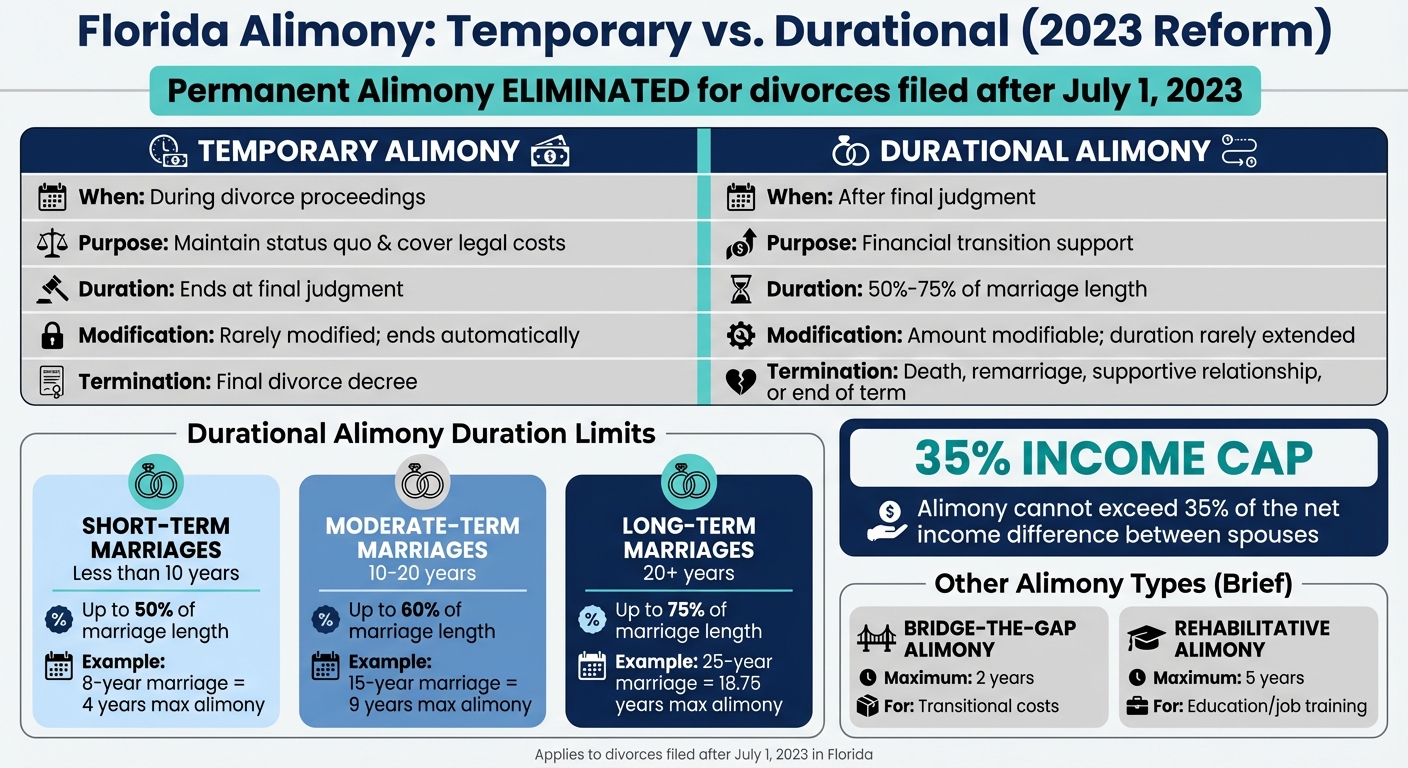
Florida Alimony Types Comparison: Temporary vs Durational Alimony After 2023 Reform
Temporary Alimony in Florida
What Temporary Alimony Means
Temporary alimony, also known as pendente lite support, provides financial assistance during divorce proceedings. It’s designed to help bridge the gap between the time a divorce is filed and the final judgment.
Divorces can take months, but everyday expenses don’t pause. Rent or mortgage payments, utilities, groceries, health insurance, and car payments all keep piling up. Temporary alimony ensures the lower-earning spouse has financial stability while waiting for the divorce to be finalized.
"Temporary alimony exists because divorce does not freeze the cost of living while the case moves forward."
This type of support is temporary and serves as a precursor to any long-term alimony decisions made later in the process.
When Courts Award Temporary Alimony
Florida courts typically address temporary alimony early in the divorce process, during a relief hearing. This hearing happens shortly after one spouse files a motion requesting immediate financial support. The judge makes a quick decision based on sworn financial affidavits and limited testimony – there’s no full trial at this stage.
If granted, temporary alimony begins right away and continues until the court finalizes the divorce. Once the final judgment is entered, temporary alimony ends automatically. There’s no need for a separate motion to terminate it. However, receiving temporary alimony doesn’t guarantee that long-term or durational alimony will be awarded later. These decisions are made independently.
What Courts Look at When Deciding
To qualify for temporary alimony, you need to prove two key things: that you have a financial need and that your spouse can afford to pay. Judges rely on financial affidavits detailing income, expenses, assets, and debts. They also review supporting documents like pay stubs, bank statements, and utility bills.
The court aims to maintain, as closely as possible, the standard of living both spouses had during the marriage until the divorce is finalized. Judges are experienced in identifying inflated expenses that don’t align with actual financial records. It’s crucial to prepare a realistic budget that reflects your true monthly costs.
Permanent Alimony in Florida: The 2023 Reform
How Permanent Alimony Worked Before 2023
Before July 1, 2023, Florida’s legal system allowed for permanent periodic alimony in cases involving long-term marriages. This type of alimony was meant to help the lower-earning spouse maintain the standard of living they had during the marriage. Payments continued indefinitely unless a specific event – like the recipient remarrying, the death of either party, or a court-ordered modification – brought them to an end. These lifelong commitments have now been replaced with new rules that emphasize time-limited support.
Alimony Options After the 2023 Reform
As of July 1, 2023, Senate Bill 1416 officially ended permanent periodic alimony in Florida. For divorces filed after this date, any awarded alimony must have a clearly defined end date, regardless of how long the marriage lasted.
"Permanent alimony no longer exists in Florida for divorces filed after July 1, 2023." – Divorce Law PLLC
The reform introduced three main types of alimony to replace permanent support:
- Durational Alimony: This is now the primary long-term option. The duration is tied to the length of the marriage: up to 75% of the marriage length for long-term marriages (20+ years), 60% for moderate-term marriages (10–20 years), and 50% for short-term marriages (3–10 years).
- Bridge-the-Gap Alimony: Designed for short-term needs, this type helps cover transitional costs like moving expenses or buying a vehicle. It is capped at a maximum of two years.
- Rehabilitative Alimony: Aimed at helping a spouse gain education or job training, this type of support is limited to five years and must follow a court-approved plan.
This reform reflects Florida’s shift toward alimony awards with clear time limits, ensuring they align with the length of the marriage and current financial circumstances. Additionally, the definition of a long-term marriage has changed, now requiring 20 or more years instead of the previous 17-year threshold. As a result, fewer divorces qualify for the longest alimony durations, and even those that do are subject to specific time restrictions rather than indefinite payments.
Main Differences Between Temporary and Long-Term Alimony
Temporary alimony acts as a financial bridge during divorce proceedings, while long-term (durational) alimony focuses on providing stability after the divorce is finalized. These differences are especially important under Florida’s 2023 alimony reforms.
Temporary alimony starts during the divorce process and automatically ends when the final judgment is issued. Its purpose is to maintain the current living situation and handle immediate expenses like mortgage payments, utility bills, and legal fees. On the other hand, durational alimony begins after the divorce is finalized and is designed to address income disparities between spouses. It helps the lower-earning spouse transition toward financial independence over a set period, which is determined by the length of the marriage.
Timing also plays a key role in how these types of alimony are modified. Temporary alimony is rarely adjusted because of its short-term nature; it simply ends when the divorce is finalized. Durational alimony, however, can be modified if there’s a significant, unexpected change in circumstances – like a job loss or serious illness. While the payment amount can be adjusted, the duration is typically fixed unless there are extraordinary reasons to extend it.
| Feature | Temporary Alimony | Long-Term Alimony (Durational) |
|---|---|---|
| Timing | During divorce proceedings | After final judgment |
| Purpose | Maintain status quo; cover legal costs | Assist with financial transition |
| Duration | Ends at final judgment | Limited to 50%–75% of marriage length |
| Modifiability | Rarely modified; ends automatically | Amount modifiable; duration rarely extended |
| Termination | Final divorce decree | Death, remarriage, supportive relationship, or end of term |
Understanding these differences is crucial, as each type of alimony serves a specific purpose during the shift from marriage to financial independence. Up next, we’ll dive deeper into durational alimony, including how marriage length influences its duration and the rules surrounding modifications.
Durational Alimony: The Primary Long-Term Option
With the 2023 reforms eliminating permanent alimony in Florida, durational alimony has emerged as the main form of structured spousal support. This type of alimony is awarded for a set period, determined largely by the length of the marriage.
Florida now classifies marriages into three categories: short-term (less than 10 years), moderate-term (10 to 20 years), and long-term (20 years or more). Each category has its own maximum limit on how long alimony can last.
"Durational alimony in Florida has become the primary form of spousal support for marriages of moderate to long length."
- Antonio G. Jimenez, Esq., Founder of Divorce.law
This system ensures that both the duration of the marriage and income disparities between spouses play a key role in determining alimony awards.
How Marriage Length Affects Duration
The length of the marriage is the primary factor in setting the maximum duration of alimony payments. Here’s how it works:
- Short-term marriages (less than 10 years): Alimony is capped at 50% of the marriage length. For example, if a couple was married for 8 years, the maximum alimony duration would be 4 years.
- Moderate-term marriages (10 to 20 years): Alimony can last up to 60% of the marriage length. A 15-year marriage could result in up to 9 years of payments.
- Long-term marriages (20 years or more): Payments are capped at 75% of the marriage length. For instance, a 25-year marriage might lead to 18.75 years of spousal support.
Income Limits and Modification Rules
The 2023 reforms also introduced caps on payment amounts and clarified rules for modifications. Alimony payments are now subject to a 35% income cap, meaning the recipient’s reasonable needs cannot exceed 35% of the difference between the two parties’ net monthly incomes.
While payment amounts can be adjusted in cases of significant life changes – like job loss or illness – the duration of alimony is typically fixed. Extending the duration requires proof of extraordinary circumstances. Additionally, the paying spouse can request a modification or termination of alimony upon reaching the standard retirement age defined by the Social Security Administration.
Alimony ends automatically upon the death or remarriage of the recipient. If the recipient enters a supportive relationship that provides financial benefits, the paying spouse can petition to reduce or terminate payments.
sbb-itb-bb7ced0
What Courts Consider When Awarding Alimony
When deciding on alimony, courts follow a two-step process. First, they evaluate whether the spouse requesting support has a legitimate financial need. Second, they determine if the other spouse has the resources to provide that support. The responsibility to prove both need and ability falls on the spouse seeking alimony.
"The party seeking support, maintenance, or alimony has the burden of proving his or her need for support, maintenance, or alimony and the other party’s ability to pay support, maintenance, or alimony." – Florida Statute 61.08
Once need and ability are established, courts take additional factors into account to ensure the decision is fair. This applies whether the alimony is temporary during divorce proceedings or more long-term after the final judgment.
Financial Need and Ability to Pay
To establish financial need, courts compare the requesting spouse’s income and assets to their monthly expenses. If their earnings fall short of maintaining a reasonable lifestyle – based on the marital standard of living during the marriage – then need is demonstrated.
For ability to pay, the court examines whether the paying spouse can meet their own reasonable living expenses while also providing support. Florida law prohibits leaving the paying spouse in financial hardship to support the other. Typically, alimony cannot result in the paying spouse having significantly less net income than the recipient, unless the court documents exceptional circumstances.
These foundational evaluations guide the court’s consideration of additional factors that help refine the alimony award.
Other Factors Courts Review
Beyond financial need and ability, courts weigh several other important elements. Florida Statute 61.08 outlines key considerations, such as the length of the marriage, calculated from the marriage date to the filing date for divorce. Courts also take into account the age, health, and emotional condition of both parties, especially if health issues limit earning capacity.
Earning potential is another critical factor. Courts review educational backgrounds, job skills, and the time required for a spouse to gain training or education to achieve self-sufficiency. Contributions to the marriage are also considered, including homemaking, childcare, and support for the other spouse’s career or education. Child-related responsibilities of each party are factored in as well.
Though Florida operates under no-fault divorce laws, courts may examine adultery if it directly impacted marital finances. For instance, if one spouse used marital funds on an affair partner, this misuse of assets could influence the alimony decision.
When to Seek Legal Guidance
Florida’s alimony decisions can be complex and hinge on specific details of each case. Early temporary relief hearings often set the tone for future negotiations, making it essential to consult a skilled family law attorney – especially if there’s a financial imbalance between spouses or one partner gave up their career to focus on homemaking or childcare.
"Neglecting temporary alimony can undermine future leverage." – The Virga Law Firm, P.A.
Legal guidance becomes even more critical when life circumstances change after the final judgment. An attorney can evaluate financial needs versus the other spouse’s ability to pay, gather key documents like tax returns, pay stubs, and bank statements, and collaborate with experts if necessary.
If a significant change occurs – such as job loss, a serious illness, or entering a new financially supportive relationship – an attorney can assist in filing for modification or enforcement. Florida law requires proof of a "substantial, material, and unanticipated change in circumstances", a process that calls for a well-crafted legal approach.
Law Firm Ocala provides family law services in Ocala, Florida, covering divorce and alimony cases. They offer a free initial consultation to explore your legal options and flat fees for uncontested divorces. Their experienced attorneys guide clients through both temporary relief hearings and final alimony rulings under Florida’s updated alimony laws.
Conclusion
As of July 1, 2023, Florida made significant changes to its alimony laws by eliminating permanent alimony for new divorces. For anyone navigating a divorce in Florida, understanding the differences between temporary and durational alimony is now more important than ever. This reform reshapes how temporary relief and structured support are handled during and after divorce proceedings.
Temporary alimony is designed to cover expenses until the divorce is finalized. Once the divorce is complete, durational alimony takes over, offering post-divorce support for a specific period based on the length of the marriage. While temporary alimony ends at the final judgment, durational alimony now serves as the primary option for long-term financial assistance, with strict limits tied to how long the marriage lasted.
Another key change is the presumption that alimony support for the recipient is capped at 35% of the net income difference between the parties. With every alimony award now having a defined end date, both parties must plan their finances carefully and adopt realistic budgets.
These reforms highlight the importance of strategic legal preparation. Whether you’re seeking temporary support during the divorce process or negotiating durational alimony, factors like your marital standard of living and earning capacity will play a critical role in determining the outcome. Getting timely legal advice can help ensure that temporary orders don’t set unfavorable precedents and that your financial affidavit accurately represents your situation.
FAQs
Do the 2023 alimony changes apply to my divorce?
Florida’s 2023 updates to alimony laws brought notable adjustments. Permanent alimony has been eliminated, and limits were introduced for durational alimony. These changes apply to divorces filed on or after July 1, 2023. However, agreements made before this date remain unaffected unless substantial changes arise that warrant modifications.
How is durational alimony calculated in Florida?
Durational alimony in Florida is based on two key factors: the length of the marriage and the financial needs of the spouse requesting support. Courts carefully assess these elements, considering how long the marriage lasted and the specific financial situation of the receiving spouse. Unlike permanent alimony, durational alimony is granted for a fixed period, providing temporary support rather than ongoing payments.
What changes can modify or end alimony in Florida?
Alimony in Florida can be adjusted – or even terminated – when there are major changes in the recipient’s financial circumstances. For instance, retirement or a noticeable increase in income might justify a modification. The 2023 alimony reform has also placed restrictions on durational alimony, aiming to make it more straightforward and adaptable when life situations shift. That said, these changes don’t apply to past agreements unless there’s a substantial financial shift that warrants a review.