
Florida’s alimony laws changed drastically on July 1, 2023, with the passing of Senate Bill 1416. This law eliminates permanent alimony and replaces it with time-limited options like durational, rehabilitative, and bridge-the-gap alimony. The goal? To create more predictable outcomes while requiring judges to follow strict guidelines and provide written explanations for their decisions.
Here’s what you need to know:
- Permanent alimony is gone. The law now focuses on temporary support options.
- Durational alimony is the main option for long-term support, but only for marriages lasting over 3 years.
- Judges must assess financial need, ability to pay, marriage length, health, age, and earning potential.
- Decisions must stay within statutory caps (e.g., alimony cannot exceed 35% of the income difference between spouses).
- Appellate courts are closely reviewing cases to ensure compliance with the new law.
These changes mean divorcing spouses must present detailed financial evidence to support their claims. Whether you’re seeking or contesting alimony, success now hinges on documentation and understanding the updated legal framework.
For those in Florida, especially in areas like Marion County, working with attorneys familiar with local court practices is key to navigating these reforms effectively.
Florida’s Legal Framework for Alimony
Florida Statute Section 61.08
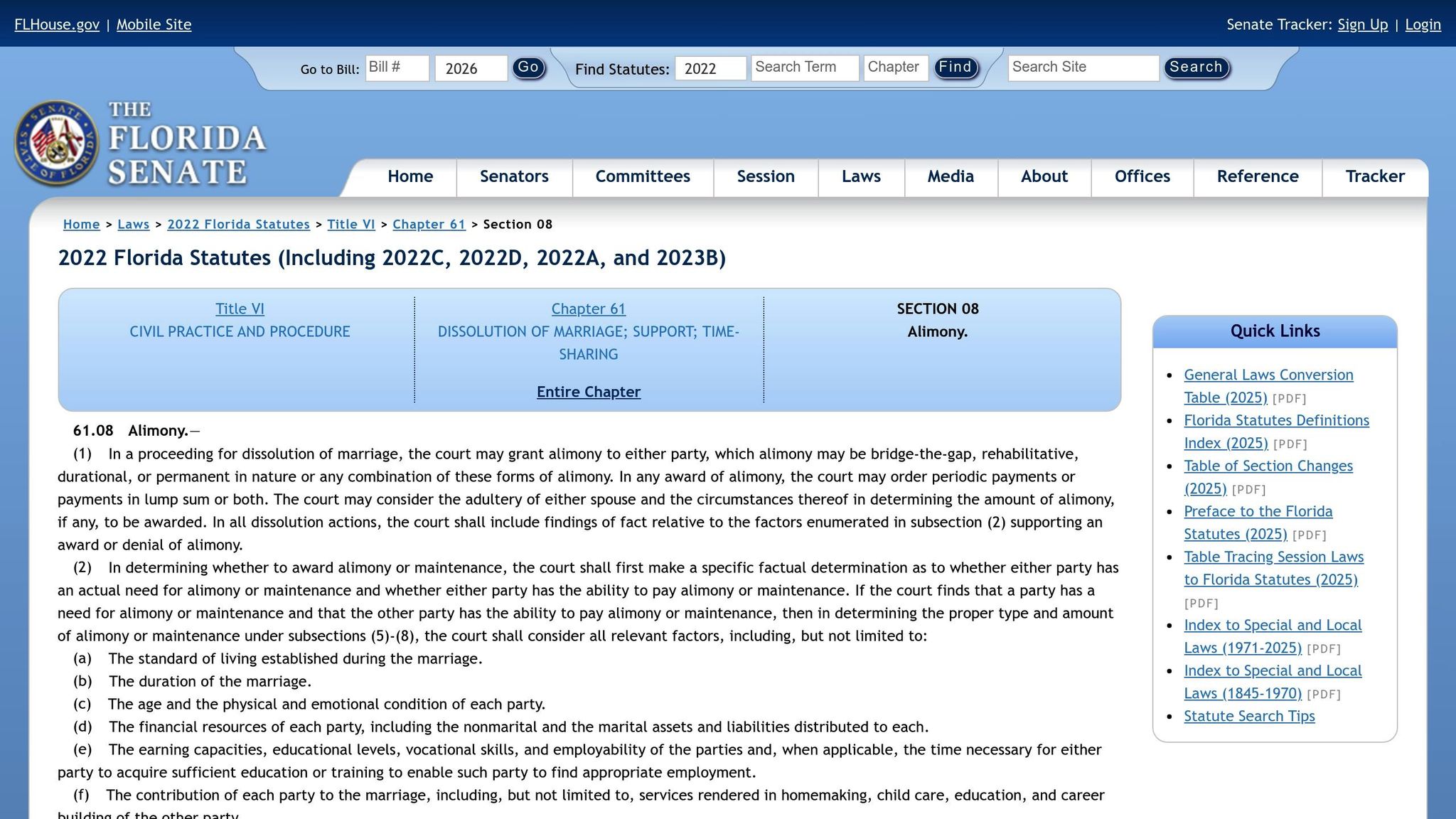
Florida’s Section 61.08 lays out the foundation for how courts handle alimony cases. Judges must first determine if one spouse has a genuine need for financial support and if the other has the ability to provide it. This analysis isn’t left to guesswork – judges are required to document their reasoning in writing, supported by evidence and statutory factors.
Key factors considered include the length of the marriage, the standard of living during the marriage, each spouse’s age and health, and their earning potential. Courts also weigh contributions made by both spouses, whether financial or non-financial, such as homemaking or childcare. The statute also allows judges to consider "any factor required for equitable relief", giving them the flexibility to address unique situations. However, every decision must be backed by clear documentation explaining how these factors influenced the outcome.
This legal framework set the stage for the changes to alimony categories introduced in 2023.
Types of Alimony After the 2023 Reform
The 2023 reforms brought sweeping changes, eliminating permanent alimony and replacing it with three time-limited options: bridge-the-gap, rehabilitative, and durational alimony.
- Bridge-the-gap alimony is designed for short-term support, helping a spouse cover immediate financial needs while transitioning to single life.
- Rehabilitative alimony focuses on enabling a spouse to become self-sufficient through education, training, or work experience.
- Durational alimony has become the primary option for long-term support. However, it comes with strict limits: it cannot be awarded for marriages lasting less than three years, and the amount is capped at 35% of the difference between the spouses’ net incomes.
Regardless of the type, judges carefully evaluate the recipient’s reasonable financial needs to determine both the amount and duration of support. The adherence to these statutory limits is closely monitored, especially during appeals.
How Appeals Courts Review Alimony Decisions
When reviewing alimony decisions, Florida’s appeals courts use an "abuse of discretion" standard. This means they will only overturn a trial judge’s decision if it was arbitrary, unreasonable, or outside the bounds of what the law allows. Even if an appellate court might have reached a different conclusion, it won’t interfere unless the original decision falls outside the range of reasonable outcomes.
This deference exists because trial judges are in the best position to evaluate testimony and make factual determinations. However, their decisions must be grounded in solid evidence and include detailed written findings. If a judge fails to clearly connect the evidence to the alimony awarded, an appellate court may rule that the decision was an abuse of discretion.
Recent appellate rulings in Florida highlight the importance of staying within statutory limits. These decisions reinforce the goal of the 2023 reforms: ensuring fairness and consistency in alimony awards while maintaining transparency in the decision-making process.
Factors Judges Consider When Awarding Alimony
Financial Need and Ability to Pay
In Florida, before any alimony can be awarded, judges must determine two key factors: whether the spouse requesting support has a legitimate financial need and whether the other spouse has the financial ability to provide it. This initial assessment sets the stage for every alimony case.
To make this determination, judges carefully review sworn financial affidavits, income records, and detailed monthly budgets that outline actual living expenses. For the paying spouse, financial evaluations include affidavits, federal tax returns (typically covering the past three years), and profit-and-loss statements for those who are self-employed. Judges also take into account existing financial obligations, such as child support or mortgage payments.
The documentation required in these cases is extensive. It often includes tax returns, bank statements, investment account records, credit card and loan information, proof of health insurance and medical expenses, and any prior court-ordered support. These records help confirm income levels and ensure that reported expenses align with actual spending habits.
Once the court establishes the financial need of one spouse and the ability of the other to pay, judges then apply statutory guidelines to determine the appropriate amount and duration of alimony.
Statutory Factors Under Section 61.08
After confirming financial need and ability to pay, judges consider several statutory factors under Florida law to decide how much alimony should be awarded and for how long. These factors are not ranked in importance but are weighed collectively, with each case evaluated on its unique circumstances.
Key considerations include the length of the marriage, the standard of living during the marriage, the age and health of each spouse, earning capacity, and contributions to the marriage. For example, marriages lasting less than three years generally do not qualify for durational alimony, as outlined in Florida Statute 61.08(8)(a). On the other hand, longer marriages, especially those with a traditional breadwinner and homemaker dynamic, may result in more substantial awards.
The standard of living during the marriage is a critical benchmark. Judges examine how the couple lived – looking at housing, travel, dining, and entertainment expenses – to help the lower-earning spouse maintain a lifestyle that closely resembles what they were accustomed to during the marriage.
Age and health are also significant factors. Older spouses or those with serious health issues may face challenges re-entering the workforce, which could justify a larger or longer alimony award. Conversely, younger, healthy spouses with marketable skills may receive smaller or shorter-term awards, especially if rehabilitative alimony can help them achieve financial independence.
Judges also evaluate earning capacity and employability, taking into account education, work history, professional licenses, current job market conditions, and whether a spouse has been out of the workforce for an extended period.
Non-financial contributions to the marriage are equally important. A spouse who sacrificed career opportunities to raise children or support the other’s education or career is often seen as having given up earning potential, which can justify a higher or longer alimony award. Judges also consider each spouse’s financial resources and assets, along with any other factors necessary to ensure fairness. These elements are weighed together to create a balanced and equitable outcome.
Judges may also adjust alimony awards if the recipient’s living situation changes significantly.
Cohabitation and Supportive Relationships
Alimony awards are not always set in stone. Under Florida Statute Section 61.14, judges can reduce or terminate alimony if the recipient enters into a supportive relationship, which refers to living with someone in a marriage-like arrangement without being legally married.
If cohabitation reduces the recipient’s financial need – such as through shared household expenses or joint finances – judges may modify the alimony arrangement. Courts don’t require evidence that the new partner is directly paying the recipient’s bills. Instead, they assess whether shared living arrangements significantly lower the recipient’s overall expenses. For example, one partner covering groceries while the other pays utilities could be enough to demonstrate reduced financial need.
Recipients should be mindful that moving in with a partner could impact their alimony. Likewise, paying spouses who suspect a supportive relationship should document evidence and seek legal advice before requesting a modification. Ultimately, judges have discretion in these cases and consider the full context rather than following strict rules.
Common Alimony Situations and How Judges Decide
Long Marriages with Large Income Gaps
In long-term marriages where one spouse earns significantly more than the other, judges take a close look at the roles each spouse played during the marriage. For example, they might consider whether one spouse focused on a career while the other dedicated time to homemaking or raising children. Using established numeric guidelines, courts aim to reflect both partners’ contributions and maintain the standard of living experienced during the marriage. Factors like the recipient spouse’s age, health, or employment limitations also weigh heavily in these decisions. In many cases, judges may award alimony near the higher end of the guideline range.
This approach differs from shorter or moderate-length marriages, where the focus shifts to helping the recipient transition rather than ensuring long-term financial support.
Short and Moderate-Length Marriages
For shorter marriages, alimony is more about helping the recipient adjust rather than maintaining a lifestyle. As outlined in Section 61.08, these awards are designed to fit the length of the marriage and the recipient’s ability to become financially independent. Temporary support options, such as bridge-the-gap alimony, are common in these cases. This type of alimony is meant to cover immediate needs and usually ends if the recipient remarries.
When the recipient needs time to gain new skills or education to rejoin the workforce, rehabilitative alimony is often the go-to option. Judges require a detailed plan for the proposed training or education, and the support is tailored to cover the associated costs. For marriages lasting around six years, durational alimony may be awarded but is typically limited to a fraction of the marriage’s length, emphasizing its temporary nature.
In moderate-length marriages – those lasting roughly 10 to 20 years – judges balance transitional support with the goal of fostering financial independence. They consider factors like the recipient’s earning potential, age, health, and ability to improve their financial situation over time.
Modification Requests and Retirement
Alimony awards aren’t set in stone. Changing circumstances, such as retirement or significant income shifts, can lead either party to request a modification. Retirement is a common reason for these requests. Judges evaluate whether the retirement was planned and reasonable, looking at factors like the retiree’s age, health, and work history. They also consider whether the original alimony arrangement accounted for this eventuality.
The main question is whether the change in circumstances – like a notable drop in income after retirement – makes it difficult for the paying spouse to continue providing the same level of support. Similarly, a modification might be appropriate if the recipient’s financial situation improves significantly or if the paying spouse experiences a substantial employment change.
To approve any modification, judges require updated financial records to verify the income changes. This ensures that alimony awards remain fair and reflect the current financial realities of both parties, while still aligning with statutory guidelines.
sbb-itb-bb7ced0
What Alimony Litigants Need to Know
Why Complete Financial Records Matter
Judges rely heavily on documented financial evidence when making alimony decisions. This makes maintaining thorough financial records absolutely crucial. In Florida, both parties in an alimony case must submit detailed financial affidavits. These affidavits outline income sources, assets, debts, and monthly expenses, forming the backbone of any alimony determination. They help answer two critical questions: Does the recipient genuinely need support? and Can the payor afford to provide it?
To support these affidavits, key documents like tax returns, pay stubs, bank statements, and detailed expense records are essential. For self-employed individuals or business owners, additional materials such as profit and loss statements, business tax returns, and corporate financial records are often necessary. Judges carefully review these documents to ensure all income is disclosed and expenses are accurately reported.
Monthly expense records also play a pivotal role. Recipients must back up their claims with receipts, bills, and bank statements showing costs like rent or mortgage payments, utilities, insurance, medical expenses, and other regular outlays. Courts tend to dismiss vague or poorly estimated numbers. On the other hand, payors who argue they cannot afford alimony must provide clear evidence of their financial obligations, such as child support payments, mortgages, and essential living expenses.
Property valuations are another important factor, especially in cases involving substantial marital assets. Appraisals of real estate, business interests, or valuable personal property help paint a complete financial picture. If one spouse received an inheritance or gift during the marriage, documentation showing whether those assets were kept separate or mixed with marital property can also influence the case.
Failing to provide complete records can have serious consequences. Judges may assume missing information is being hidden intentionally and could draw negative conclusions. In some cases, courts may even assign an income to a spouse who appears to be underemployed or hiding assets. The takeaway is clear: gather all relevant financial documents before filing and stay organized throughout the process.
Proper documentation not only supports a fair outcome but also ensures smoother navigation of local court procedures.
Local Court Practices in Florida
While Florida’s alimony laws apply statewide, the way judges interpret and apply them can vary significantly across the state’s twenty judicial circuits. Understanding these differences is key to setting realistic expectations and building a strong case. For example, in the Fifth Judicial Circuit, which includes Marion County and Ocala, judges have developed unique approaches to evaluating evidence and managing alimony hearings.
Some judges in this circuit prefer pre-filed, detailed exhibits, while others lean toward live testimony during hearings. Knowing the preferences of the specific judge assigned to your case allows attorneys to tailor their strategy effectively.
Local practices also influence procedural aspects. In some areas, judges routinely schedule temporary alimony hearings early in the divorce process to provide immediate financial support. Others are more cautious, requiring extensive financial discovery before awarding temporary support. The Fifth Circuit typically takes a balanced approach, requiring basic financial affidavits and some discovery before considering temporary alimony, but not demanding the full evidentiary record needed for permanent awards.
Modification cases, such as those involving retirement or other significant life changes, also highlight local variations. For example, some judges require detailed proof that retirement was reasonable, while others are more lenient if the payor has reached a typical retirement age. In the Fifth Circuit, judges often require a formal motion to modify alimony, along with updated financial documents and evidence of the change in circumstances. Disputed cases usually lead to evidentiary hearings.
Cohabitation cases are another area where local practices matter. Florida law allows for alimony reductions or termination if the recipient is in a supportive relationship with a new partner. Judges require clear evidence that the recipient’s financial needs have decreased due to cohabitation.
Understanding these local nuances is vital for attorneys to advocate effectively. Working with legal professionals familiar with the specific practices of your judicial circuit can make all the difference.
How Law Firm Ocala Handles Alimony Cases

Law Firm Ocala takes a strategic and thorough approach to alimony cases, aligning their methods with Florida’s legal requirements and the specific practices of judges in the Fifth Judicial Circuit. Their process begins with a detailed review of each client’s financial situation, including income, assets, debts, and expenses. This helps identify any gaps in documentation and ensures a strong evidentiary record.
For recipients seeking alimony, the firm focuses on demonstrating financial need and showing that the marital standard of living cannot be maintained without support. For payors contesting alimony or seeking modifications, the goal is to prove financial limitations or significant changes in circumstances since the original award.
Law Firm Ocala also emphasizes preparation beyond financial documentation. Their attorneys guide clients in addressing the statutory factors judges must consider under Section 61.08 of Florida law. These factors include the length of the marriage, contributions to the marriage (such as homemaking or childcare), earning potential, age, health, and the marital standard of living. By meticulously documenting and presenting evidence for each relevant factor, the firm builds a compelling case for their clients.
In modification cases – whether due to retirement or cohabitation – the firm prioritizes updated financial affidavits and concrete proof of changed circumstances. For retirement-related modifications, they gather evidence such as the payor’s age, work history, health, and retirement planning to demonstrate that retirement was reasonable. For cohabitation cases, they help clients compile the specific evidence judges in the Fifth Circuit expect to see.
The firm’s attorneys also stay up-to-date on local court practices, adapting their strategies to align with the preferences of judges in Marion County and surrounding areas. Whether it’s pre-filing exhibits, preparing for cross-examinations, or following local procedures for temporary support motions, Law Firm Ocala ensures that every detail is handled with precision.
Clients receive personalized legal support tailored to their unique circumstances. Whether navigating a divorce with complex alimony issues, seeking to modify an existing award, or defending against a modification request, the firm provides guidance every step of the way. They also offer free initial consultations, giving potential clients an opportunity to discuss their case, explore legal options, and understand how experienced attorneys can protect their interests.
For those facing alimony litigation in Ocala and Central Florida, partnering with a firm that understands both the statewide legal framework and local court practices is a distinct advantage. Law Firm Ocala combines this expertise with meticulous preparation and client-focused representation to handle the challenges of Florida’s alimony laws effectively.
Conclusion
In Florida, alimony decisions rely on a strict, evidence-driven process. Judges must first determine financial need and the ability to pay, then apply the statutory factors outlined in Section 61.08. These factors include considerations like the standard of living during the marriage, its length, the age and health of both parties, earning potential, and contributions to the marriage. This ensures decisions are grounded in clear legal standards.
The 2023 reforms brought significant changes, replacing permanent alimony with time-limited support. This shift aligns with a broader national trend, focusing on encouraging financial independence for both parties rather than imposing lifetime obligations. These reforms set clear limits on alimony awards but also introduce practical challenges for those navigating the system.
Comprehensive documentation – such as tax returns, pay stubs, bank records, and property valuations – plays a crucial role in influencing outcomes. Missing or incomplete records can lead judges to make negative assumptions, potentially resulting in unfavorable decisions.
Adding to the complexity, local court practices vary across Florida’s twenty judicial circuits. For example, in the Fifth Judicial Circuit, which includes Marion County and Ocala, judges often have specific preferences for how evidence is presented and procedural requirements are met. Understanding these local nuances enables attorneys to craft strategies that align with the expectations of the local courts, whether addressing initial alimony awards or modifications due to retirement or other changes.
While appellate courts generally defer to trial judges on factual and credibility matters, they will overturn decisions that lack required written findings, misapply statutory factors, or exceed legal limits. This highlights the importance of strict adherence to Florida’s alimony statutes for anyone involved in these cases.
Law Firm Ocala offers deep expertise in navigating both the statewide legal framework and the specific practices of local courts in Central Florida. They help clients set realistic expectations under the new laws and build strong cases tailored to the unique dynamics of the Fifth Judicial Circuit.
For those facing alimony cases or modifications in Florida, the next steps should include gathering thorough financial records, understanding how the statutory factors apply to their case, and consulting with attorneys familiar with local court practices. By working within Florida’s updated alimony system and partnering with knowledgeable legal counsel, litigants can achieve outcomes that balance fairness with financial practicality.
FAQs
How do Florida’s 2023 alimony law changes affect long-term marriages where one spouse has been a homemaker?
The 2023 updates to Florida’s alimony laws bring notable changes, especially for long-term marriages where one spouse has primarily taken on the role of a homemaker. These reforms provide judges with clearer criteria for awarding alimony, emphasizing factors such as the length of the marriage, the financial needs of the homemaker spouse, and the paying spouse’s financial capacity. For marriages lasting 17 years or more, there tends to be greater consideration for alimony. However, the revised laws aim to ensure a more balanced approach for both spouses.
If you’re facing alimony-related decisions, consulting a knowledgeable family law attorney, like the team at Law Firm Ocala, can help clarify your rights and guide you through these updated legal frameworks.
What financial documents should both parties gather for an alimony case under Florida’s updated laws?
When gearing up for an alimony case under Florida’s updated laws, it’s crucial for both parties to compile detailed and accurate financial records. These typically include:
- Income documentation: Pay stubs, tax returns, and records of any additional income sources.
- Bank account statements: Recent statements from checking, savings, and investment accounts.
- Expense details: Monthly bills, credit card statements, and receipts for major expenditures.
- Assets and debts: Records of property ownership, mortgages, loans, and other financial obligations.
Having well-organized financial documents allows the court to get a clear picture of each party’s financial standing, which plays a key role in determining fair alimony arrangements. If you’re feeling overwhelmed, the attorneys at Law Firm Ocala are ready to guide you through the process and help safeguard your rights.
How do local court practices in Florida, especially in the Fifth Judicial Circuit, affect alimony decisions?
In Florida, judges have a lot of leeway when it comes to deciding alimony cases. Local court practices can heavily influence the outcome, making it essential to understand how things work in your area. For instance, courts in the Fifth Judicial Circuit take a detailed approach, weighing factors like the length of the marriage, each party’s financial situation, and their contributions during the marriage. This ensures alimony decisions are adjusted to fit the specific details of each case.
If you’re dealing with an alimony case, knowing how these local practices might affect your situation is key. Reaching out to a seasoned family law attorney, like those at Law Firm Ocala, can offer valuable insight and help safeguard your rights throughout the process.