
In Florida, the statute of limitations sets deadlines for filing criminal charges, varying by the severity of the offense. Felonies generally have longer time limits than misdemeanors, and the most serious crimes, like murder, have no deadline at all. Key points include:
- Felonies:
- 1st-degree: 4 years
- 2nd/3rd-degree: 3 years
- Exceptions: Theft (5 years), crimes with DNA evidence, or capital/life felonies (no limit).
- Misdemeanors:
- 1st-degree: 2 years
- 2nd-degree: 1 year
- Exceptions: Petit theft or sexual cyberharassment (up to 5 years).
Timeframes may pause if the accused leaves Florida or cannot be located, with a maximum 3-year extension. Understanding these deadlines is vital for defending against charges or ensuring prosecution aligns with legal limits.
Statutes of Limitations for Felonies in Florida
Standard Time Limits for Felonies
In Florida, the statute of limitations for felonies depends on the severity of the crime. For first-degree felonies, the time limit is 4 years, while second- and third-degree felonies must be prosecuted within 3 years. The countdown begins the day after the offense occurs.
Here are a few examples: First-degree felonies, like manslaughter (without exceptions) or certain drug trafficking cases, fall under the 4-year window. Second-degree felonies, such as aggravated battery or some burglary offenses, have a 3-year limit. For third-degree felonies, crimes like possession of controlled substances or grand theft under $5,000 are included – though theft cases specifically have an extended 5-year statute of limitations that overrides the general rule.
Some felonies come with longer deadlines. Crimes like theft, abuse or neglect of elderly or disabled adults, Medicaid or insurance fraud, and violations of environmental laws under Chapter 403 have 5-year statutes of limitations, often starting from the date the crime is discovered. For felonies involving a destructive device that causes injury, the time limit extends to 10 years.
However, the most severe crimes operate under a different set of rules entirely.
Crimes Without a Statute of Limitations
For the gravest offenses, there’s no expiration date for filing charges. These include capital felonies (e.g., first-degree murder), life felonies (such as certain armed robberies or severe sexual battery), and any felony resulting in death (like DUI manslaughter or vehicular homicide). Human trafficking also has no statute of limitations.
Sexual battery cases have specific provisions. If a first- or second-degree felony sexual battery is reported to law enforcement within 72 hours of the crime, prosecutors can initiate charges at any time. Additionally, for sexual battery offenses committed on or after July 1, 2020, involving a victim under 18, there is no deadline for prosecution.
DNA evidence has reshaped prosecution timelines for violent felonies. Crimes like aggravated child abuse, carjacking, kidnapping, robbery, and burglary can be prosecuted at any time if the defendant’s identity is confirmed through DNA analysis. This holds true even if the original statute of limitations has expired, provided the evidence was properly preserved.
Statutes of Limitations for Misdemeanors in Florida
Standard Time Limits for Misdemeanors
In Florida, the time limits for prosecuting misdemeanors are shorter than those for felonies, depending on whether the charge is classified as a first- or second-degree misdemeanor.
- First-degree misdemeanors must be prosecuted within 2 years of the offense. Examples include simple battery, DUI (second offense), petit theft, indecent exposure, and restraining order violations.
- Second-degree misdemeanors have a 1-year prosecution limit. Common examples are simple assault, disorderly conduct, petit theft (first offense, under $100), and DUI (first offense).
For prosecution to officially begin, an indictment or information must be filed, and any related summons or arrest warrants must be promptly executed. These shorter timeframes highlight the less severe nature of misdemeanors compared to felonies.
However, there are exceptions. For instance, petit theft has a 5-year statute of limitations, and sexual cyberharassment (as outlined in Florida Statute 784.049) can be prosecuted within 5 years of the offense or 3 years after discovery, whichever comes later.
To put it in perspective, while third-degree felonies have a 3-year limit and first-degree felonies have a 4-year limit, most misdemeanors must be addressed within much tighter deadlines. This reflects the generally lower severity of misdemeanor offenses.
Felonies vs. Misdemeanors: A Direct Comparison
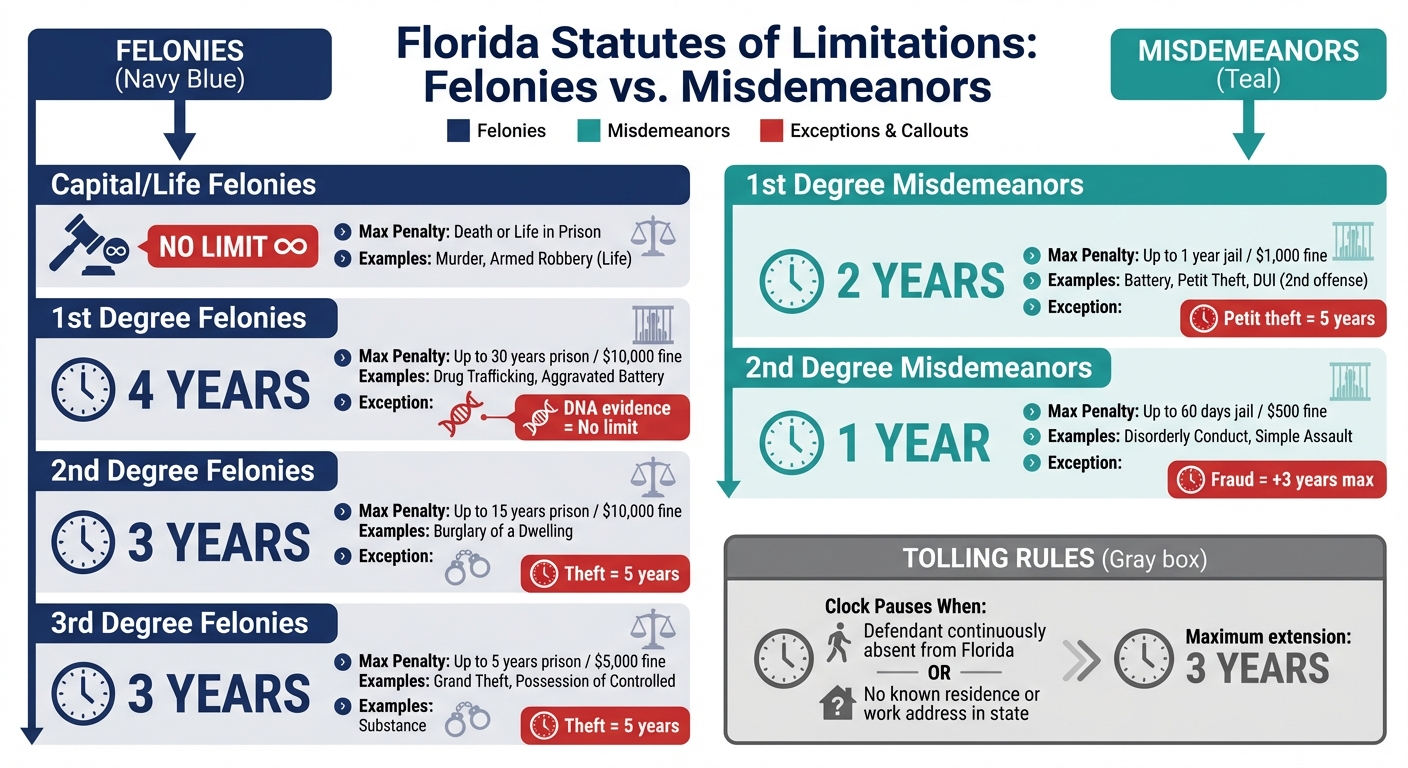
Florida Statute of Limitations: Felonies vs Misdemeanors Comparison Chart
To better grasp the differences between felonies and misdemeanors, let’s break it down. The key distinction lies in the severity of the offense and the corresponding penalties. Felonies are more serious crimes, typically resulting in more than a year in state prison. On the other hand, misdemeanors carry lighter penalties, with a maximum of one year in a county jail.
"Statutes of limitations set time limits for the government to bring criminal charges in a case. If the prosecution charges someone after the applicable time period has passed, the person charged can have the case dismissed." – Rebecca Pirius, Attorney
When it comes to time limits for prosecution, felonies and misdemeanors also differ. Misdemeanors generally have a statute of limitations of 1–2 years. Felonies, however, range from 3 to 4 years, with the most serious crimes, such as capital and life felonies, having no time limit for prosecution. This means these severe offenses can be pursued at any time.
Another important factor is tolling rules, which pause the statute of limitations under specific conditions. This applies equally to felonies and misdemeanors. For example, if a defendant is continuously absent from Florida or has no known place of residence or work in the state, the clock stops. However, this pause is capped at a maximum of 3 years. Prosecution officially begins once an indictment or information is filed, provided that arrest warrants or summonses are executed without delay.
Comparison Table: Felonies and Misdemeanors
Here’s a closer look at the key differences between these two categories:
| Offense Classification | Standard Time Limit | Maximum Penalty | Examples | Key Exceptions |
|---|---|---|---|---|
| Capital/Life Felony | None | Death or Life in Prison | Murder, Armed Robbery (Life) | Can be prosecuted at any time |
| 1st Degree Felony | 4 Years | Up to 30 Years Prison / $10,000 Fine | Drug Trafficking, Aggravated Battery | No limit if DNA confirms identity; no limit if sexual battery reported within 72 hours |
| 2nd Degree Felony | 3 Years | Up to 15 Years Prison / $10,000 Fine | Burglary of a Dwelling | 5 years for theft; no limit with DNA evidence |
| 3rd Degree Felony | 3 Years | Up to 5 Years Prison / $5,000 Fine | Grand Theft, Possession of Controlled Substance | 5 years for theft; 7 years for sexual cyberharassment |
| 1st Degree Misdemeanor | 2 Years | Up to 1 Year Jail / $1,000 Fine | Battery, Petit Theft | 5 years for theft or sexual cyberharassment |
| 2nd Degree Misdemeanor | 1 Year | Up to 60 Days Jail / $500 Fine | Disorderly Conduct, Simple Assault | Fraud or fiduciary breach (+3 years max) |
This table provides a quick overview of the main differences, from penalties to time limits and notable exceptions.
sbb-itb-bb7ced0
Exceptions and Tolling Rules
Florida law includes specific provisions that can pause or extend the deadlines for prosecuting certain crimes. While the standard time limits apply to most cases, these exceptions allow for adjustments in unique situations.
Tolling for Concealment or Fugitives
If a defendant is continuously absent from Florida or has no identifiable place of residence or work within the state, the statute of limitations is paused. However, this pause has a maximum extension of 3 years.
"The period of limitation does not run during any time when the defendant is continuously absent from the state or has no reasonably ascertainable place of abode or work within the state. This provision shall not extend the period of limitation otherwise applicable by more than 3 years." – Florida Statutes § 775.15
For instance, if someone commits a third-degree felony (which typically has a 3-year limitation) and then leaves Florida without providing a known address, prosecutors could have up to 6 years to file charges – the original 3 years plus the 3-year extension. Similarly, for a first-degree misdemeanor, the usual 2-year limit could be extended to 5 years under the same circumstances.
Now, let’s explore additional exceptions that apply to specific types of crimes.
Special Cases and Extended Time Limits
In some situations, Florida law provides alternative rules that go beyond the standard timeframes for prosecution.
- Fraud and fiduciary breaches: Prosecution must begin within 1 year of discovering the offense, with the possibility of extending the deadline by up to 3 years.
- Crimes involving victims under 18: The statute of limitations begins when the victim turns 18 or when the crime is reported, whichever occurs first. For felony sexual battery, if reported within 72 hours, there is no time limit for prosecution.
- DNA evidence: For violent crimes such as kidnapping, robbery, burglary, and aggravated child abuse, charges can be filed at any time after DNA analysis identifies the accused, regardless of how much time has passed.
- Public officials: Misconduct in office can be prosecuted at any time while the official is in service or within 2 years after leaving office.
Certain crimes have longer statutes of limitations than usual. For example:
- 5-year timeframes: Felony theft, insurance fraud, workers’ compensation fraud, and exploitation of elderly or disabled adults fall under this category. Environmental violations under Chapter 403 also have a 5-year window, starting when the offense is discovered rather than when it occurred.
- 10-year limit: Felonies involving destructive devices that result in injury carry an extended statute of limitations.
These exceptions ensure that justice can still be pursued in cases where circumstances or evidence make adhering to standard deadlines impractical.
Conclusion
The statutes of limitations for felonies and misdemeanors in Florida play a key role in determining how long prosecutors have to bring charges. Typically, felonies come with a 3- to 4-year window, while misdemeanors are limited to 1 to 2 years. However, exceptions exist – capital and life felonies, along with offenses involving death, have no time limit.
Certain factors can extend these deadlines. For instance, if the accused is absent from Florida, the clock may be paused for up to 3 years. Additionally, specific crimes like those involving DNA evidence, fraud, or misconduct by public officials may follow different timelines.
Understanding and asserting the statute of limitations is crucial for a strong defense. Since it’s an affirmative defense, it must be actively raised in court to seek dismissal of charges. This involves pinpointing the exact date of the offense, factoring in any tolling provisions, and identifying the correct limitation period. Ignoring this defense could lead to prosecution even after the deadline has passed.
If you’re facing criminal charges or suspect you’re under investigation for an older offense, it’s essential to act quickly. An experienced attorney can evaluate whether the statute of limitations applies to your case, calculate deadlines, and file motions to safeguard your rights. Law Firm Ocala specializes in criminal defense, offering the expertise needed to navigate Florida’s legal complexities and any exceptions that might impact your case. Reach out to ensure your rights are protected.
FAQs
What happens to the statute of limitations if the accused leaves Florida before it expires?
If someone accused of a crime leaves Florida before the statute of limitations expires, the countdown stops while they remain outside the state. The clock only starts ticking again once they return to Florida. This rule is in place to prevent individuals from dodging the statute of limitations by simply leaving the state.
Are there crimes in Florida that don’t have a statute of limitations?
In Florida, some serious crimes have no statute of limitations. These include capital felonies, life felonies, and any felony resulting in a death. Prosecutors can bring charges for these offenses at any point, no matter how much time has passed since the crime was committed.
Can DNA evidence impact the statute of limitations for a crime in Florida?
In Florida, the statute of limitations determines how long prosecutors have to file charges for a crime. DNA evidence can sometimes influence these time limits, depending on the specific laws and circumstances surrounding the case. For instance, in some serious offenses, newly discovered DNA evidence might allow charges to be brought even after the usual time frame has expired.
If you’re wondering how DNA evidence might impact the statute of limitations in your case, it’s wise to consult a seasoned criminal defense attorney. They can offer advice tailored to the laws and details of your situation.