
In Florida, property crime penalties can be severe, but there are ways to lessen the impact. Here’s how you can reduce penalties:
- Negotiate Plea Deals: Work with your attorney to reduce charges or secure lighter sentences by identifying weaknesses in the prosecution’s case.
- Diversion Programs: Programs like Pre-Trial Intervention (PTI) can help first-time offenders avoid convictions entirely.
- Pay Restitution: Early restitution shows accountability and may lead to reduced charges or alternative sentencing.
- Dispute Evidence or Property Value: Challenge inflated valuations or improperly obtained evidence to lower charges.
- Cooperate with Prosecutors: In some cases, assisting prosecutors can result in reduced penalties, though this carries risks.
- Modify Probation or Seek Post-Conviction Relief: Request early termination, administrative probation, or a reduction of felony charges to misdemeanors.
- Hire a Defense Attorney: A skilled lawyer can guide you through these steps, ensuring a stronger defense and better outcomes.
Acting quickly and strategically is crucial, especially if your case involves high sentencing points under Florida’s Criminal Punishment Code. With the right approach, you can significantly reduce the consequences of property crime charges.
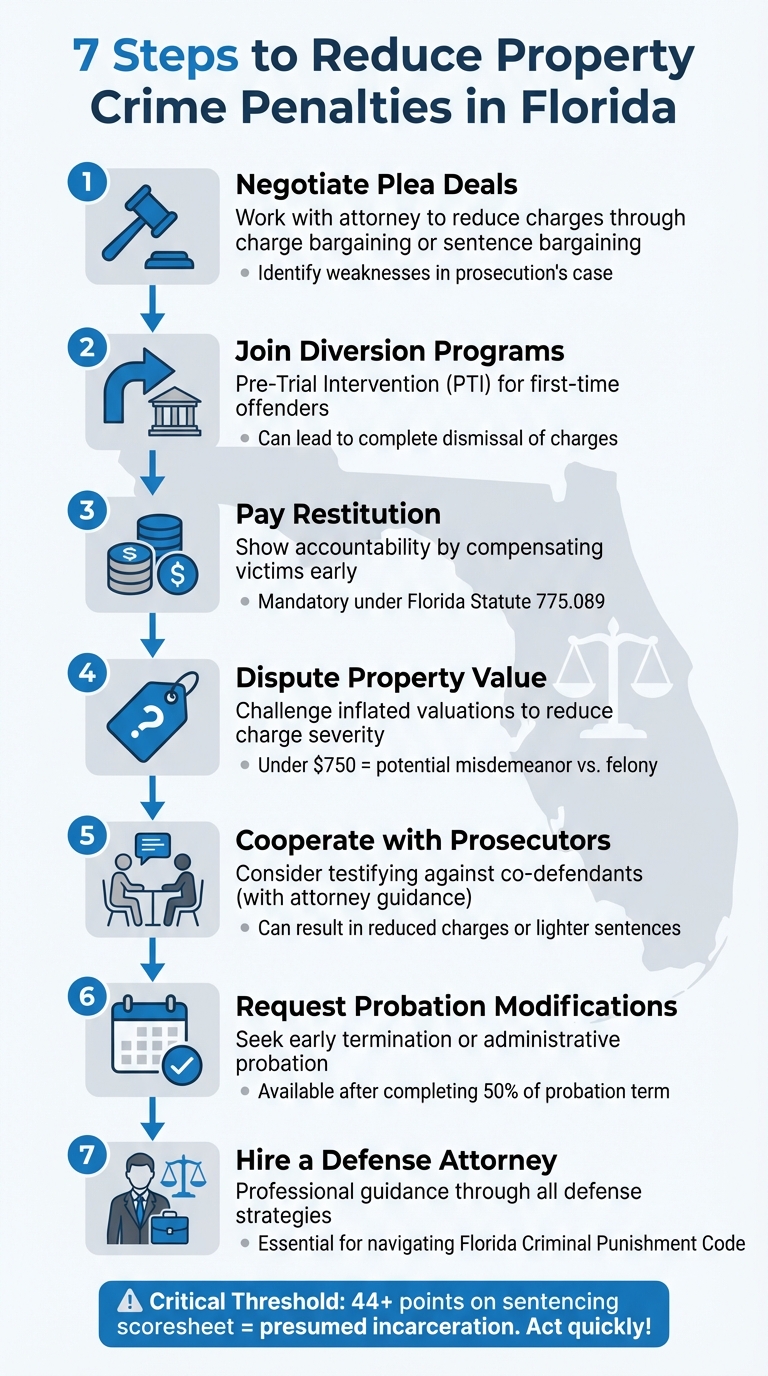
7 Steps to Reduce Property Crime Penalties in Florida
Negotiate a Plea Agreement
If you’re dealing with Florida property crime charges, negotiating a plea agreement could help reduce penalties. This process usually involves two main strategies: charge bargaining, where a more serious charge like grand theft is reduced to a lesser one like petit theft, or sentence bargaining, where you agree to a lighter punishment, such as probation instead of jail time. The success of these negotiations often hinges on identifying weaknesses in the prosecution’s case and leveraging those issues effectively.
A thorough review of the evidence is crucial. Your defense attorney should analyze items like digital recordings, witness statements, and custody logs to uncover procedural mistakes or constitutional violations. For instance, if law enforcement conducted an illegal search or failed to issue Miranda warnings, these missteps could provide a strong advantage during plea discussions. Additionally, challenging the valuation of the property involved is vital, as it directly influences the severity of the charges. Factors like depreciation, market value, and the item’s condition can be used to dispute the state’s assessment. As Criminal Defense Attorney Don Pumphrey, Jr. notes:
"Disputing that the stolen or damaged property was as valuable as the State claims can significantly reduce the penalties someone may face."
Highlighting mitigating factors can also make a difference. A clean record, evidence of rehabilitation, or personal circumstances that show remorse can all impact the prosecutor’s stance. First-time offenders, in particular, may have access to diversion programs or alternative sentencing options that could eventually lead to the dismissal of charges. It’s also important to emphasize the long-term consequences of a conviction, such as its effect on future employment or civil rights.
Never attempt to negotiate a plea without legal representation. A defense attorney can guide you through the process, helping you decide between a guilty plea or a no-contest (nolo contendere) plea, which resolves the case without admitting guilt. Keep in mind, a plea deal is a binding agreement – failing to meet its terms, like paying restitution, can void the arrangement.
If you’re facing property crime charges in Florida, consider contacting Law Firm Ocala for skilled legal support tailored to your situation.
Join a Diversion Program
In Florida, diversion programs offer a path to potentially dismiss property crime convictions, especially for first-time offenders. One of the most common options is Pre-Trial Intervention (PTI), designed for individuals facing misdemeanors or third-degree felonies such as petit theft or grand theft. Typically lasting at least a year, PTI involves requirements like community service, full restitution to victims, monthly check-ins, and random drug testing. As noted by the Office of Broward State Attorney Harold F. Pryor:
"The purpose of the PTI program is to afford first-time felony offenders the opportunity to avoid the stigma of a criminal conviction by diverting their case from the trial court process."
Diversion programs can work alongside other strategies, such as plea negotiations, offering a chance to avoid a conviction without going to trial.
Timing is key when applying for PTI. In some circuits, applications must be submitted within 45 days of arraignment. Additionally, engaging in actions like depositions or substantive motions could disqualify you in certain jurisdictions. The State Attorney’s Office typically takes 30 to 90 days to review applications, weighing factors such as prior offenses (usually limited to one nonviolent misdemeanor), the value of the property involved, and whether victims approve of your participation.
For cases involving substance abuse, Drug Court provides an alternative. It focuses on intensive treatment for nonviolent felony charges under Chapter 810, as long as the defendant has a documented substance abuse issue and a limited criminal history. Similarly, Mental Health Court and Veterans Court are designed to assist individuals dealing with mental health conditions or military-related challenges, provided both the victims and the State Attorney agree.
Completing a diversion program successfully leads to the dismissal of charges under Florida Statutes § 948.08. This means no criminal conviction and the possibility of sealing or expunging your record in the future. However, failing to meet program requirements – such as paying restitution or avoiding new arrests – results in removal from the program and prosecution of the original charges.
If you’re considering a diversion program, reach out to Law Firm Ocala for guidance on your eligibility and help with the application process.
Pay Restitution to Victims
Paying restitution early can help minimize penalties. According to Florida Statute 775.089, restitution is mandatory for crimes that cause damage or loss to a victim, unless the court identifies strong reasons not to require it. Taking the initiative to address restitution shows accountability and a willingness to compensate the victim, which can influence prosecutors to consider reduced charges or alternative sentencing options. This approach works well alongside other mitigation strategies.
In cases involving property crimes, restitution can act as a powerful negotiation tool. By compensating victims for their actual monetary losses, you may be able to avoid jail time. These agreements can often be formalized as part of a plea deal, carrying the same weight as any other court order.
That said, not all restitution demands are accurate or justified. In State v. Dixon (Dec 2020), a defendant challenged a restitution demand based on alleged losses. The court determined that a full evidentiary hearing was necessary to calculate the correct amount. This case highlights the importance of working with an attorney to dispute inflated claims. Florida law requires restitution to reflect the fair market value at the time of the loss, not the replacement cost, and the prosecution must prove the amount by a preponderance of the evidence.
Before offering restitution, consult an attorney. They can help ensure the demands are reasonable, negotiate manageable payment terms, and use restitution as part of a broader strategy to reduce charges. Structured payment plans may also be arranged. Keep in mind that failing to pay court-ordered restitution is considered a probation violation and could lead to imprisonment, so it’s crucial to agree to terms you can realistically meet. Properly addressing restitution can strengthen your overall defense.
Law Firm Ocala works with defendants to negotiate fair restitution terms as part of a well-rounded defense strategy.
Dispute Evidence or Property Value
In Florida, disputing the value of the property involved can significantly impact the charges you face. If the property’s value is proven to be below $750, a felony charge could potentially be reduced to a misdemeanor. For context, property valued between $100 and $749 typically results in a first-degree misdemeanor, which carries penalties of up to one year in jail and a $1,000 fine. On the other hand, property valued under $100 is often classified as a second-degree misdemeanor. This initial step of challenging the valuation can also pave the way for disputing the admissibility of evidence.
The burden of proof lies with the State, which must establish the property’s actual value. Prosecutors often rely on the replacement cost of the item, rather than its actual cash value, which factors in depreciation and wear. Courts, however, have consistently rejected speculative or subjective valuations. For example, in cases like Newland v. State (2013) and Sanchez v. State (2019), courts dismissed inflated valuations based on guesses or subjective measures, such as eBay prices. Similarly, in Gonzalez v. State (2019), the Florida 3rd District Court of Appeal ruled that using eBay "asking prices" to determine value was improper, stressing that valuations must be based on objective criteria like original cost and depreciation.
To counter inflated valuations, your attorney may bring in independent appraisers to provide a more accurate assessment. They can also challenge attempts to combine separate incidents into one case to artificially exceed the $750 threshold. Additionally, questioning the legality of searches that led to evidence collection can further weaken the prosecution’s case. By addressing both the value of the property and the legitimacy of the evidence, you build a stronger defense.
Law Firm Ocala meticulously examines property valuations and evidence collection processes to uncover weaknesses in the prosecution’s case and work toward reducing your charges.
sbb-itb-bb7ced0
Cooperate with Prosecutors When Appropriate
Working with prosecutors, such as testifying against co-defendants, can sometimes lead to reduced charges or lighter sentencing. For example, a grand theft felony might be downgraded to a lesser offense, or probation could be recommended instead of jail time. This approach is part of an overall strategy to minimize penalties by exploring every legal option available.
However, cooperating comes with serious risks that you need to weigh carefully. If you fail to meet the terms of a cooperation agreement, any leniency offered could be revoked. Additionally, even if prosecutors recommend a reduced sentence, the final decision rests with the judge. Cooperation often requires admitting guilt in open court, which creates a permanent criminal record.
"In some cases, cooperating with police or prosecutors (such as testifying against co-defendants) may result in a reduced sentence or lesser charge. This option isn’t for everyone, but it can dramatically reduce your exposure to prison time." – Michael White, P.A.
It’s critical to have an attorney by your side when considering cooperation. A skilled lawyer can help secure clear, enforceable terms and assess whether this route is truly in your best interest. For instance, Florida’s sentencing formula ((Total points – 28) x 0.75) highlights that even cooperative deals are subject to strict judicial review. An attorney can also present evidence of genuine remorse and your willingness to assist, which are factors that judges take into account when determining sentences.
Law Firm Ocala ensures that cooperation agreements are thoroughly evaluated to protect your rights while negotiating the best possible outcome for your case.
Request Probation Changes or Post-Conviction Relief
In addition to strategies like plea negotiations and diversion programs, seeking changes to probation terms can help reduce penalties even further. For those on probation for property crimes, Florida Statutes §948.04 provides a pathway to request early termination, a shift to administrative probation, or adjustments to overly restrictive conditions. If your probation began after October 1, 2019, the law includes a presumption in favor of early termination once you’ve completed at least 50% of your term and met all requirements – this includes paying restitution, court fees, and supervision costs in full.
Administrative probation offers a non-reporting status, meaning you’re no longer required to check in regularly with a probation officer, though your probation remains technically active. If the judge chooses this option instead of full termination, they must explain in writing how continued supervision benefits community safety or serves the "interests of justice." Additionally, your probation officer may recommend early termination if you’ve consistently complied with the terms. Adjusting probation conditions in this way aligns with broader efforts to reduce penalties while addressing both probation and conviction status.
For those seeking further relief, filing a post-conviction motion can help reduce a felony to a misdemeanor, particularly for "wobbler" offenses – property crimes that can be charged as either a felony or misdemeanor based on the circumstances. Success in these motions often depends on demonstrating rehabilitation. Evidence such as treatment program certificates, steady employment, educational accomplishments, or mental health evaluations can be pivotal.
"Successfully completing a substantial portion of your probation, maintaining good behavior, and showing evidence of rehabilitation can serve as grounds… to file a motion to modify the conviction from a felony to a misdemeanor." – Alec Waid, Attorney
The Law Firm Ocala can assist in filing these motions under the Florida Rules of Criminal Procedure. Their expertise ensures all necessary details – such as the nature of the offense, sentence length, and grounds for relief – are properly documented. Courts may hold evidentiary hearings where sworn witness testimony can support your case, making legal representation essential to improving your chances of success.
Hire a Criminal Defense Attorney
Adding a criminal defense attorney to your team can significantly strengthen your case. A skilled defense attorney often makes the difference between facing a felony conviction and achieving reduced charges – or even a dismissal. They know how to identify and challenge errors, such as incorrect point allocations, that could otherwise result in harsher penalties like a prison sentence.
As mentioned earlier, factors like accurate property valuation and procedural challenges are crucial in reducing charges. A local attorney uses their understanding of regional practices to contest inflated property values, a key point when determining the severity of charges.
Law Firm Ocala offers experienced legal representation in Marion County, Lake County, and nearby areas like Belleview and Silver Springs. Their attorneys are well-versed in local police protocols, prosecutor tendencies, and effective arguments for lighter sentences. For instance, they may highlight mitigating factors like remorse or a minor role in the alleged crime. They also specialize in disputing unlawfully obtained evidence, such as improper searches or violations of Miranda rights.
In addition to courtroom defense, a criminal attorney can negotiate plea deals to reduce charges. If a conviction is avoided, they can also help with record sealing, which protects future opportunities for employment and housing. As Law Firm Ocala emphasizes:
"The attorney you choose can make a significant difference in the outcome of your case."
Their free initial consultation provides an opportunity to explore your legal options and create a strategy tailored to your specific circumstances. This professional guidance complements other defense tactics, ensuring a well-rounded approach to minimizing penalties.
Conclusion: Steps to Lower Your Penalties
Facing property crime charges in Florida can feel overwhelming, but the right approach can make a big difference in reducing penalties. From negotiating pleas to reassessing property valuations, there are practical strategies that can help. For instance, paying restitution not only shows accountability but can also fulfill key probation requirements. Programs like the Misdemeanor Intervention Program or Felony Pre-Trial Intervention offer first-time offenders a chance to have their charges dropped entirely.
Disputing property valuations is another powerful way to reduce charges. Understanding the Florida Criminal Punishment Code scoresheet is crucial – it helps pinpoint opportunities for leniency, such as showing genuine remorse or proving a minor role in the crime. While property valuation is a key factor, other proactive steps are equally important.
By working with experienced legal counsel, you can explore options like alternative sentencing, record sealing, and avoiding unfavorable plea deals. An attorney can guide you through restitution efforts and strategic cooperation, both of which can significantly reduce penalties.
For cases where the sentencing score under Florida’s Criminal Punishment Code reaches 44 points or more, incarceration is typically the presumed outcome. This makes early intervention and a solid defense strategy absolutely critical. Acting quickly and decisively can mean the difference between probation and prison.
If you’re ready to take control of your case, reach out to Law Firm Ocala for experienced legal guidance.
FAQs
What are the advantages of participating in a diversion program for property crimes?
Diversion programs for property crimes come with some clear advantages. For starters, they often give participants the chance to sidestep a criminal conviction and avoid jail time altogether. If completed successfully, these programs can lead to dismissed charges, reduced fines, or even a clean or expunged record.
These programs also emphasize rehabilitation. Participants may be required to complete community service, restitution agreements, or educational courses. By fulfilling these obligations, individuals show accountability and can work toward a clean slate, free from the lasting impact of a criminal record.
Can disputing the property value help reduce my charges in a property crime case?
Yes, disputing the assessed value of the property in your case can play a crucial role in shaping the outcome. In Florida, property crime charges often hinge on the property’s valuation. Successfully challenging this valuation could mean a reduction in your charges – for instance, shifting from felony grand theft to misdemeanor petit theft. This kind of reduction can result in less severe penalties, such as smaller fines, shorter jail sentences, or, in some cases, even dismissal.
If you’re facing property crime charges, having an experienced attorney by your side can make all the difference. Legal professionals, like those at Law Firm Ocala, focus on criminal defense and are committed to helping clients achieve the most favorable results possible.
What should I think about before cooperating with prosecutors in a property crime case?
Before deciding to work with prosecutors in a Florida property crime case, it’s important to carefully consider both the potential upsides and the possible downsides. On the positive side, cooperating could lead to a reduced charge – like having a felony downgraded to a misdemeanor – or a lighter sentence. This is especially true if you don’t have a prior criminal record and provide meaningful assistance to the state. However, cooperation often involves pleading guilty or no contest, which can leave you with a permanent criminal record and limit your ability to appeal the case later.
At the same time, there are risks involved. You could inadvertently incriminate yourself, face additional investigations, or encounter disagreements over restitution amounts or property valuations. These issues could significantly influence the penalties you might face. To protect your rights and interests, it’s essential to consult an experienced criminal defense attorney, such as the team at Law Firm Ocala. They can review any agreements, address restitution concerns, and negotiate terms that are in your best interest.