
Florida’s mandatory minimum sentencing laws impose strict penalties for repeat offenders, leaving judges with little flexibility. These laws are designed to ensure consistent sentencing and prioritize public safety by keeping repeat offenders off the streets. Key points include:
- Prison Releasee Reoffender (PRR) status: Applies to individuals committing certain felonies within three years of release from prison, mandating harsher sentences.
- Mandatory minimum penalties: Examples include 30 years for first-degree felonies and 15 years for second-degree felonies. Firearm-related crimes under the "10-20-Life" statute carry additional mandatory terms.
- Recent changes in 2026: HB 1159 introduced stricter penalties, including higher offense rankings for fleeing law enforcement and aggravated animal cruelty.
Without legal representation, avoiding these rigid penalties is nearly impossible. Early action, such as challenging evidence or negotiating charges, is critical for defendants in Florida.
Mandatory Minimum Sentences for Repeat Offenders
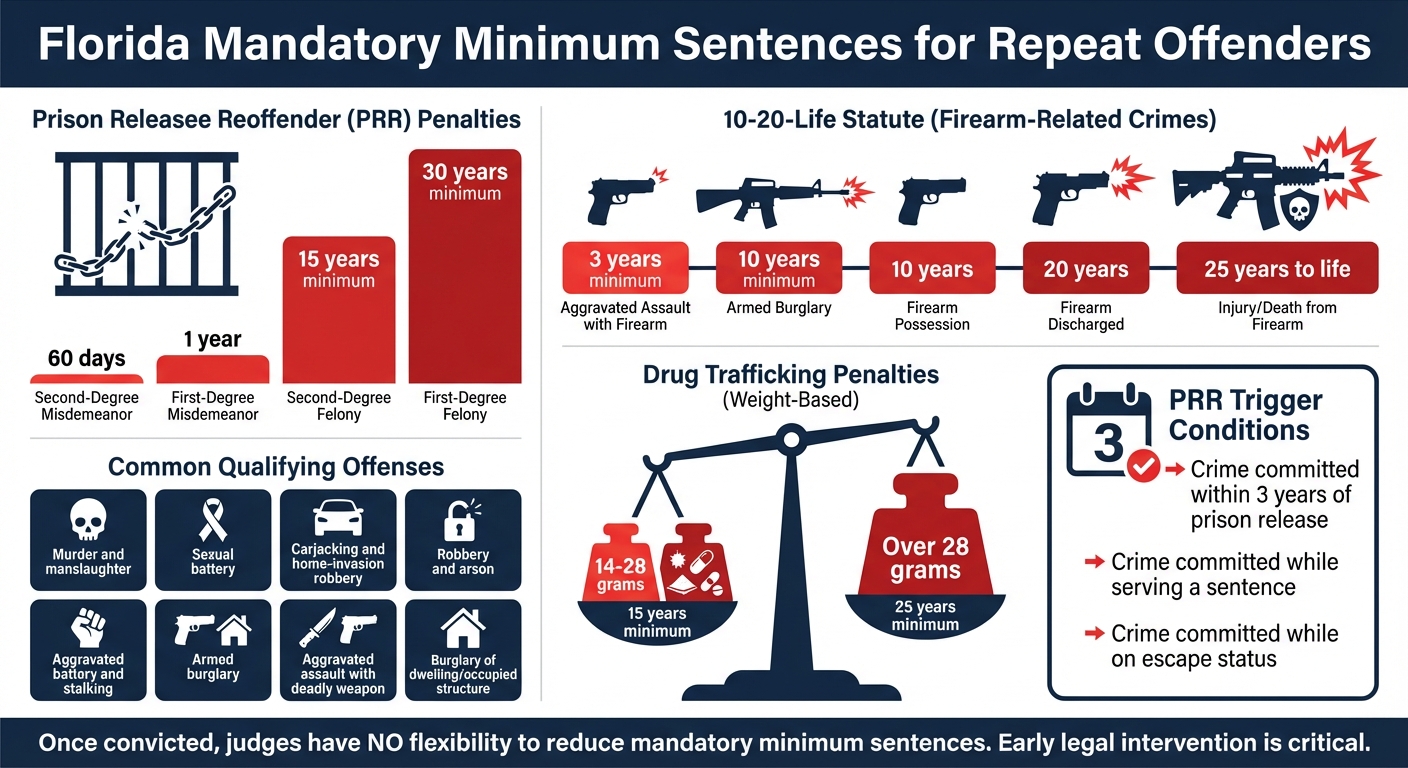
Florida Mandatory Minimum Sentencing Penalties for Repeat Offenders
Florida enforces tough mandatory minimum sentences for repeat offenders, with penalties that depend on the crime and the offender’s prior record. Understanding which offenses trigger these laws and how repeat offender status is determined is critical for anyone navigating Florida’s criminal justice system. Below, we break down the offenses and the mechanics of the Prison Releasee Reoffender (PRR) designation.
Common Offenses and Penalties
Florida’s mandatory minimums primarily target violent crimes, property crimes involving force, and drug trafficking offenses, with penalties increasing based on the felony level.
For those designated under the PRR statute, mandatory minimums align with the statutory maximum sentences for each felony degree. Even misdemeanors carry fixed penalties: one year for a first-degree misdemeanor and 60 days for a second-degree misdemeanor.
Certain crimes frequently lead to these enhanced penalties, including:
- Murder and manslaughter
- Sexual battery
- Carjacking and home-invasion robbery
- Robbery and arson
- Kidnapping
- Aggravated assault with a deadly weapon
- Aggravated battery and stalking
Property crimes like armed burglary, burglary of a dwelling, or burglary of an occupied structure also qualify. Additionally, any felony involving physical force or violence can trigger mandatory minimum sentencing.
Florida’s "10-20-Life" statute imposes additional mandatory minimums for crimes involving firearms. For example:
- Aggravated assault with a firearm carries a three-year minimum.
- Armed burglary requires at least 10 years.
- Drug trafficking penalties are weight-based:
- 15 years minimum for 14–28 grams of heroin, cocaine, or oxycodone.
- 25 years minimum for amounts over 28 grams.
How Repeat Offender Status Triggers Mandatory Minimums
The Prison Releasee Reoffender (PRR) designation is the key to activating mandatory minimums for repeat offenders. To qualify, a defendant must commit or attempt a qualifying felony within three years of being released from a state or federal correctional facility. PRR status also applies to crimes committed while serving a sentence or on escape status.
For previous out-of-state or federal convictions to count, the offense must be punishable by more than one year of imprisonment under Florida law. Defense attorneys often examine release dates and incarceration details to challenge PRR classification, as even a single day outside the three-year window can shift the case from mandatory sentencing to judicial discretion.
Once someone is classified as a PRR, judges lose the ability to consider alternatives like probation or drug treatment programs. The mandatory minimum sentence becomes unavoidable, regardless of mitigating circumstances or evidence of rehabilitation. This rigidity highlights the importance of a strong legal defense in these cases, as the stakes are incredibly high.
sbb-itb-bb7ced0
Recent Changes to Florida’s Mandatory Minimum Laws
What HB 1159 Changed
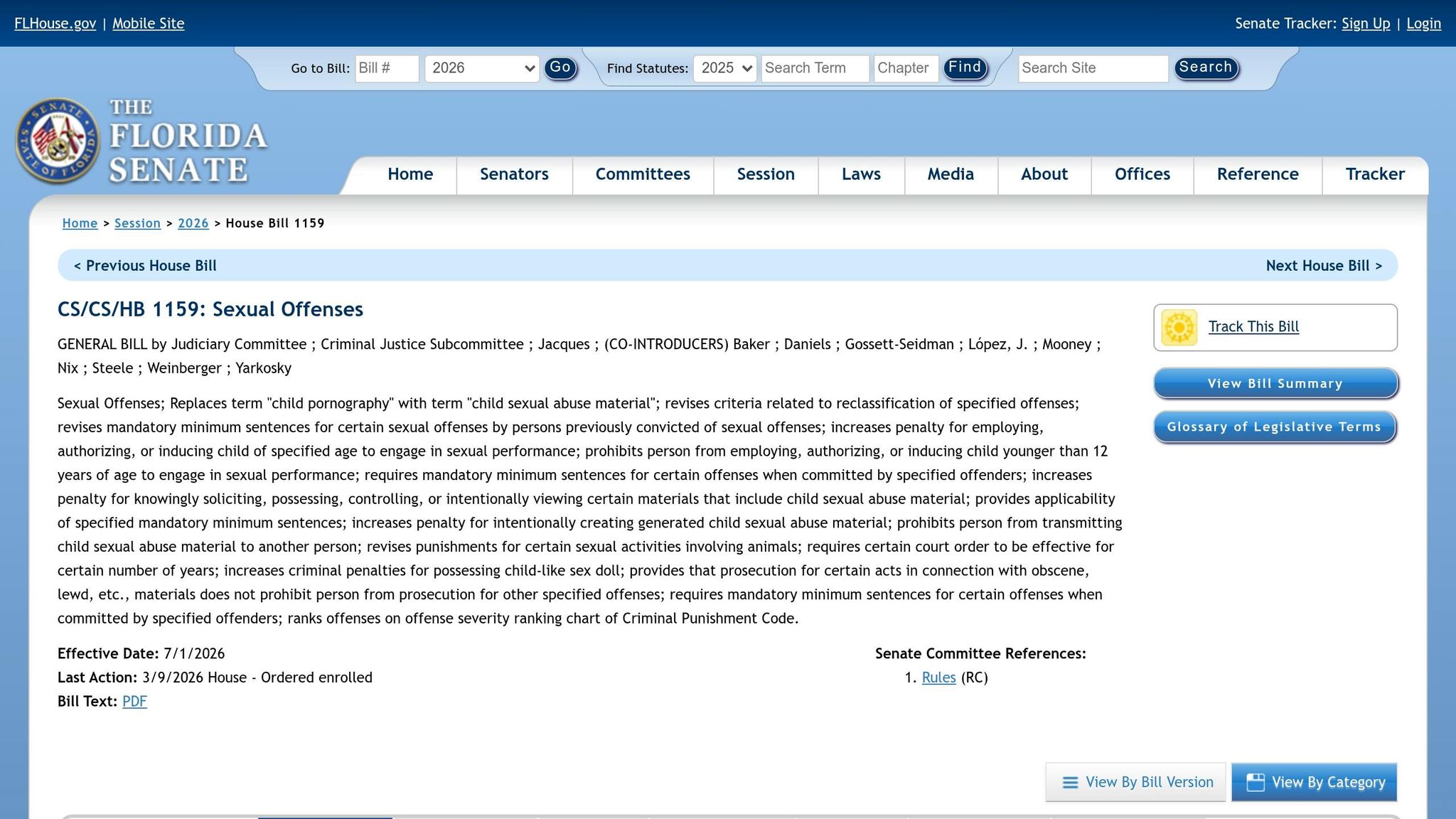
In 2026, HB 1159 brought stricter mandatory minimum penalties for repeat offenders in Florida. This law adjusted the Offense Severity Ranking Chart (OSRC), which plays a key role in determining sentences for individuals with prior convictions.
One significant update involves fleeing or eluding law enforcement. Under HB 113, the requirement to prove proper police insignia during a pursuit was removed. As a result, fleeing charges are now ranked higher on the OSRC, leading to longer mandatory minimum sentences and fewer chances for probation.
Additionally, the 2026 legislative session introduced Dexter’s Law and Trooper’s Law, targeting aggravated animal cruelty. These laws impose harsher penalties, including a sentencing multiplier for repeat offenders, which increases prison time. For example:
- Abandoning or restraining pets during disasters is now classified as a third-degree felony, carrying up to five years in prison.
- Aggravated cruelty involving torture, serious injury, or death results in mandatory fines in the thousands of dollars and potential lifetime bans on owning pets.
These changes have fundamentally altered how sentences are calculated across Florida.
How These Updates Affect Sentencing
The updates from HB 1159 have had a direct impact on sentencing practices statewide, including in Ocala and beyond. Amendments to Florida Rule of Criminal Procedure 3.992, implemented in late 2025, require judges to assign higher sentence points for crimes like fleeing or animal cruelty. This shift results in longer prison terms and fewer sentencing alternatives for repeat offenders.
These tougher guidelines apply universally to repeat offender cases. Florida’s "tough on crime" stance has grown even stricter, significantly limiting options for rehabilitation or sentence reductions. Probation and treatment programs that were once available are now largely off the table for individuals facing these enhanced charges. For anyone navigating these harsher penalties, having skilled legal representation is more important than ever.
How Mandatory Minimums Affect Offenders
Mandatory minimum sentences drastically alter how offenders serve their time in Florida. Unlike standard sentencing, where judges can collaborate with prosecutors and defense attorneys to consider alternatives like probation or treatment programs, mandatory minimums strip away this flexibility. Judges are bound by law to impose the prescribed sentence once a conviction is reached. This rigidity eliminates opportunities for early release or sentence adjustments.
Loss of Gain Time
Under mandatory minimums, offenders lose the opportunity to earn gain time. In most non-mandatory cases, Florida inmates can reduce their sentences through good behavior or participation in educational programs. However, mandatory minimums require offenders to serve their full sentences without the possibility of early release. For example, those convicted of capital felonies face life sentences without parole, regardless of any rehabilitation efforts.
Limited Options for Sentence Reduction
Options for reducing sentences are extremely limited under mandatory minimums. Adult offenders have virtually no chance of sentence review. The only exceptions apply to those who committed their crimes before turning 18, and even then, strict conditions must be met – such as whether the defendant killed, intended to kill, or attempted to kill the victim.
As Ferrer & Gonzalez explain:
For many types of offenses, Florida has minimum mandatory sentences that judges cannot override.
The only real path to sentence reduction is through extraordinary measures, like gubernatorial pardons, which are exceedingly rare. This highlights the importance of working with skilled legal counsel before a conviction. Negotiating charges or seeking alternative resolutions is often the only way to avoid the rigid sentencing structures imposed by mandatory minimum laws. These strict measures emphasize just how essential expert legal defense is when navigating Florida’s sentencing system.
Why Legal Representation Matters in Mandatory Minimum Cases
Challenges Defendants Face with Mandatory Minimums
Facing mandatory minimum sentences in Florida is no small matter. The state’s legal framework is unyielding, particularly under statutes like the 10-20-Life law (§775.087). This statute imposes strict penalties for firearm-related felonies: 10 years for possession, 20 years if discharged, and 25 years to life if someone is injured – all without allowing judges any flexibility.
For repeat offenders, the Prison Releasee Reoffender statute (§775.082(9)) further tightens the screws. If someone commits a qualifying felony within three years of being released, sentences range from 5 years to life, depending on the crime. As of September 2020, nearly 9% of Florida inmates were serving time under this law[1].
Without experienced legal representation, defendants often find themselves with no way to sidestep these harsh penalties after a conviction. The stakes are incredibly high, making skilled legal guidance a necessity, not a luxury.
How Law Firm Ocala Can Help

When mandatory minimums come into play, early and strategic legal action is crucial. At Law Firm Ocala, the defense team understands that the best chance to challenge these rigid sentencing laws is before a conviction. Their approach focuses on questioning evidence, negotiating charges, and leveraging legal exceptions to prevent mandatory sentences from taking effect.
The attorneys at Law Firm Ocala leave no stone unturned. They carefully examine the prosecution’s case, identifying issues like illegal stops, warrantless searches, or inadmissible evidence. They also explore specific exceptions, such as the youthful offender status outlined in §958.04. This exception, supported by rulings like Ruth v. State and Mendez v. State, can help eligible defendants avoid 10-20-Life penalties.
For repeat offenders – often facing mandatory sentences for crimes like drug offenses, DUI, or theft – the firm works proactively with prosecutors to reduce charges or eliminate sentence enhancements before they become binding.
Law Firm Ocala also offers consultations to evaluate the strengths and weaknesses of each case. Their deep understanding of Florida’s sentencing laws and their commitment to finding creative solutions give clients a fighting chance against some of the state’s toughest legal challenges.
Conclusion
Florida’s mandatory minimum sentencing laws are strict and leave little room for flexibility. Whether it’s 30 years for a first-degree felony, 15 years for a second-degree felony, or even life imprisonment for murder or homicide convictions, these penalties are set in stone once a conviction is secured.
Understanding these laws is important, but acting quickly is even more critical. The window to challenge evidence, negotiate charges, or explore legal exceptions closes fast. Without a skilled attorney, many defendants face the full force of Florida’s sentencing guidelines, making immediate legal action a necessity.
If you’re in Ocala, Florida, and dealing with mandatory minimum charges, don’t wait. Seek an attorney who can provide an honest evaluation of your case and has a deep understanding of both state and federal court systems.
Law Firm Ocala offers free consultations to review your case and outline your legal options. Their defense team has experience handling cases involving DUI, drug charges, theft, and domestic violence, all while navigating the complexities of mandatory minimum sentencing laws. Contact Law Firm Ocala today – early action can make all the difference.
With penalties this severe, having a knowledgeable legal defense is essential to protecting your future.
FAQs
How do I know if I qualify as a Prison Releasee Reoffender (PRR)?
Under Florida law, you may be classified as a Prison Releasee Reoffender (PRR) if you commit specific qualifying offenses after being released from prison. This classification falls under section 775.082(8)(d), and it’s up to the court to determine whether to treat you as a habitual offender.
Can PRR or 10-20-Life mandatory minimums be avoided before conviction?
No, avoiding PRR (Prison Releasee Reoffender) and 10-20-Life mandatory minimums before conviction is typically not possible. These laws impose mandatory sentences once certain charges are proven in court. If you’re dealing with these charges, it’s crucial to consult an experienced attorney. They can guide you through the legal process and help identify any potential defense strategies.
How did HB 1159 change sentencing for fleeing or animal cruelty in Florida?
HB 1159 has made notable changes to how animal cruelty is penalized. Under this law, such offenses are now classified as a third-degree felony, marking a significant step toward harsher consequences for those found guilty of harming animals.
Additionally, the bill includes amendments related to laws on fleeing offenses. However, specific details about these changes are not readily available in the sources reviewed.