
In Florida, child custody decisions focus on the "best interests of the child", guided by Florida Statute 61.13. While immigration status isn’t explicitly listed among the 20 factors judges consider, it often plays a role under the law’s "catch-all" provision, which allows courts to evaluate anything relevant to the child’s well-being. Here’s what you need to know:
- Immigration Status in Custody Cases: Judges may assess how a parent’s immigration status impacts their ability to provide a stable home and consistent care. This became more scrutinized after the introduction of SB4-C in 2025, which imposed harsh penalties on undocumented individuals before being blocked by federal courts.
- Key Legal Standards: Florida law generally favors joint parental responsibility unless it can be proven that shared decision-making harms the child. Parents seeking sole custody must provide strong evidence.
- Challenges for Immigrant Parents: Issues like fear of deportation, lack of legal representation, and tight timelines for filing dependency petitions often complicate custody cases. For minors, turning 18 can cut off access to certain legal protections.
- Legal Representation Matters: Statistics show that immigrant parents with legal counsel are far less likely to face removal compared to those without representation. Proper legal guidance can also help address misconceptions about a parent’s stability and involvement.
For immigrant parents, navigating custody disputes requires careful preparation, including documenting involvement in the child’s life, securing neutral witnesses, and working with attorneys skilled in both family law and immigration issues. These steps can improve outcomes and ensure decisions prioritize the child’s well-being.
Florida’s Legal Standards for Custody Decisions
The ‘Best Interests of the Child’ Standard
In Florida, custody decisions revolve around Florida Statute 61.13, which sets guidelines for determining parental responsibility and timesharing (the terms now used instead of "custody" and "visitation"). Judges are required to evaluate 20 factors that influence the child’s overall well-being. These include the stability of each parent’s home, their mental and physical health, and any history of domestic violence or child abuse. Another key consideration is whether each parent is willing to foster a strong relationship between the child and the other parent, as well as their ability to maintain a consistent and stable environment for the child.
Florida law typically leans toward joint parental responsibility, where both parents share decision-making authority on major aspects of the child’s life, such as healthcare, education, and extracurricular activities. As Winston Law, P.A. explains:
Florida law awards joint parental responsibility unless one party can prove it is not in the best interests of the child for parental responsibility to be shared.
If a parent seeks sole responsibility, they must provide evidence that shared decision-making would negatively impact the child. Alongside these statutory factors, courts may also consider how a parent’s immigration status affects their ability to provide a stable environment.
How Immigration Status Factors Into Custody Cases
Immigration status is not explicitly listed among the 20 factors in Florida Statute 61.13, but it is often considered under the statute’s broad catch-all provision (Section 61.13(t)), which allows courts to evaluate "any other factor" relevant to the child’s well-being. This means that a parent’s immigration status can play a role in assessing their stability and availability to care for the child consistently.
Federal court decisions, including those from the Eleventh Circuit and the U.S. Supreme Court, have clarified the limits of state enforcement under SB 4C while affirming a judge’s discretion to consider immigration status in custody cases. For instance, the Eleventh Circuit Court of Appeals ruled that SB 4C is preempted by federal law, curbing state-level enforcement. Furthermore, in July 2025, the U.S. Supreme Court declined Florida’s request to stay a preliminary injunction against SB 4C, reinforcing federal limits. Despite these rulings, judges in Florida retain the authority to weigh a parent’s immigration status when evaluating their ability to provide a stable and secure environment for the child.
Recent Florida Cases Involving Immigration Status
Case Examples and Judicial Patterns
Florida courts have seen cases where immigration status significantly influenced custody decisions. Take O.I.C.L. v. Florida Department of Children and Families (September 2016), for example. In this case, a 17-year-old minor from Guatemala filed a dependency petition after being placed with his uncle in Palm Beach County. The trial court denied the petition, stating the child was not dependent since the uncle was a "ready, willing, and able relative." However, the Florida Supreme Court later dismissed the case as moot because the petitioner turned 18 during the appeal process. Unfortunately, this is a common issue that prevents immigrant minors from qualifying for Special Immigrant Juvenile Status.
A different outcome emerged in In re T.J., where the Third District Court of Appeal overturned a trial court’s denial of a dependency petition. In this case, the minor lived with an aunt who did not have formal legal custody. The decision highlighted a recurring judicial trend: courts often place significant weight on whether a caregiver has formal legal custody, beyond simply providing care.
Another notable case is Florida Immigrant Coalition v. Uthmeier (April–July 2025), a federal class action challenging Florida’s SB 4-C. This law allowed state law enforcement to detain individuals for "illegal entry." A federal court issued a preliminary injunction, finding the law infringed on federal authority. Plaintiffs included immigrant parents with U.S. citizen children who feared family separations and the loss of parental care during custody disputes.
Obstacles Immigrant Parents Face in Custody Disputes
These judicial patterns reveal the hurdles immigrant parents face, especially in custody cases. Fear of deportation often prevents parents from engaging in court proceedings or reporting abuse. From April to July 2025, at least 27 people were arrested under Florida’s SB 4-C, even after a federal judge issued a restraining order against its enforcement.
Access to legal representation is another significant challenge. For instance, in May 2025, Juan Aguilar, an undocumented father of three, was arrested in St. Johns County after a minor traffic accident. Despite requesting legal counsel, his hearing moved forward without one. Aguilar accepted a rapid plea deal, leading to his conviction and deportation to Mexico within days. This happened before the unlawful charge could be corrected. As Duke University Law Professor Brandon Garrett noted:
It violates his due process to be prosecuted for an unconstitutional crime. That’s incredibly troubling.
Timing also creates unique problems, particularly for immigrant minors seeking dependency status. Florida courts lose jurisdiction once a child turns 18, which means petitions must be filed early. This narrow timeframe often leaves little room for legal remedies, further complicating custody and legal outcomes for immigrant families.
Research on Immigration Status and Custody Outcomes
Impact of Legal Representation on Immigrant Parent Custody Outcomes
Data on Custody Outcomes for Immigrant Parents
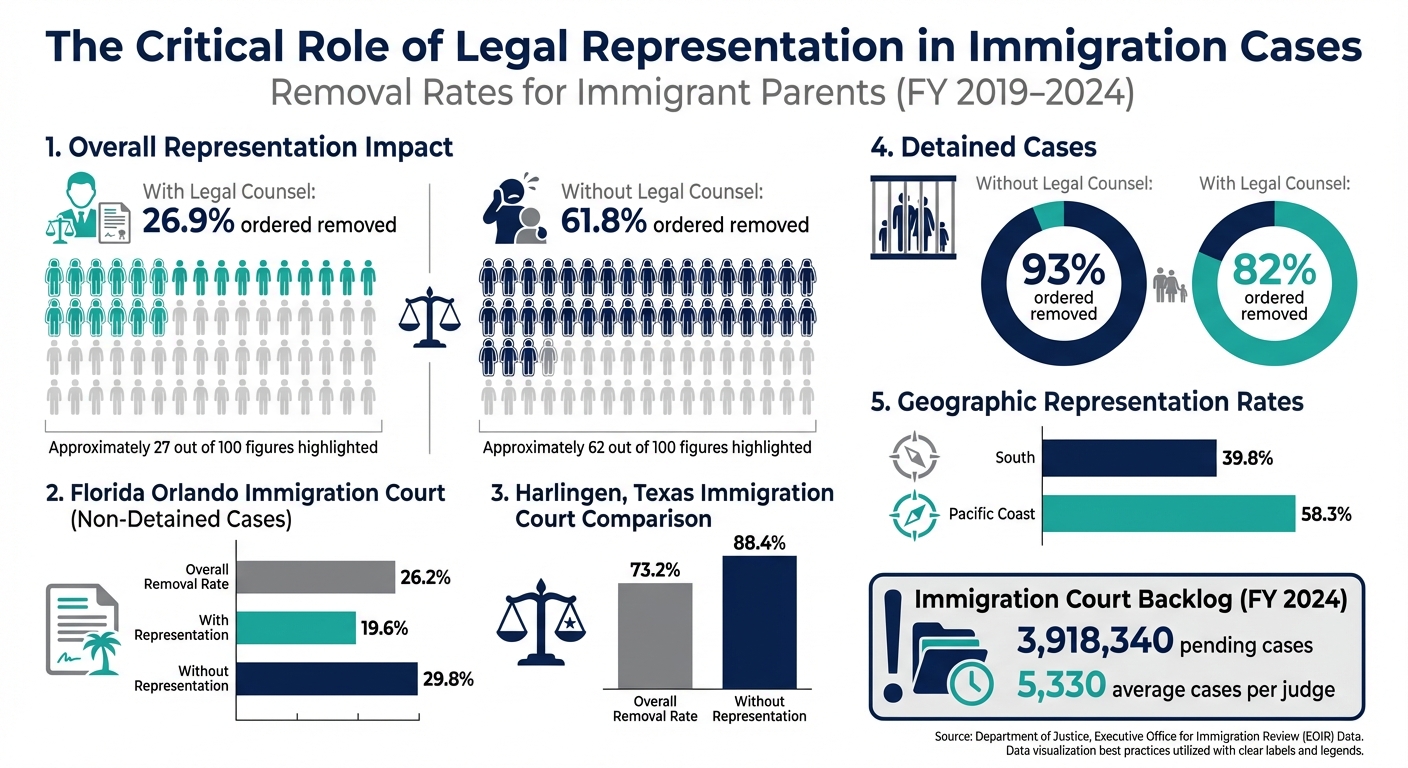
The challenges immigrant parents face in custody cases are evident in national statistics. Between fiscal years 2019 and 2024, access to legal representation emerged as the most critical factor influencing whether an immigrant parent could stay in the U.S. with their children. Among immigrants with legal counsel, only 26.9% were ordered removed, compared to a staggering 61.8% of those without representation.
Looking at specific courts highlights further disparities. In Florida’s Orlando immigration court, non-detained cases show a removal rate of 26.2%. This rate drops to 19.6% for those with legal representation but rises to 29.8% for those without an attorney. Harlingen, Texas, paints a much harsher picture, with an overall removal rate of 73.2% and unrepresented parents facing an 88.4% likelihood of removal.
For parents held in detention, the numbers are even bleaker. Among detained immigrants, 93% without legal counsel were ordered removed, compared to 82% of those with representation. As the American Immigration Council points out:
Detained and non-detained cases often operate as "two separate immigration court systems", each with distinct judges, courtrooms, and procedures.
These statistics underscore the critical role legal representation plays – not just in individual outcomes but in shaping the broader legal and social dynamics surrounding immigration cases.
Legal and Social Consequences
The disparities in custody outcomes ripple through families and the legal system. By FY 2024, immigration court backlogs reached an overwhelming 3,918,340 pending cases, with each judge managing an average of 5,330 cases. This backlog results in prolonged uncertainty for immigrant parents, leaving families in limbo for years.
Geography adds another layer of inequality, creating what some call a "geographic lottery." Legal representation rates vary widely across regions, with the South reporting 39.8% and the Pacific Coast at 58.3%. Parents in detention face even greater challenges, often enduring conditions described by the American Immigration Council as:
not only inhumane and deadly conditions, but geographic isolation and limited access to attorneys.
On top of these challenges, shifting policies between presidential administrations create further instability. Removal rates, for example, dropped from 79.6% in FY 2019 to 40% in FY 2024. Researchers have labeled this phenomenon "policy whiplash", as it complicates long-term planning and decision-making for immigrant families navigating an already complex system.
sbb-itb-bb7ced0
Legal Guidance for Parents in Custody Cases
Why You Need an Experienced Attorney
Custody disputes often come with heightened emotions, making it hard to think clearly. This is where an attorney steps in, offering an objective viewpoint and focusing on what’s best for the long term, rather than getting caught up in the heat of the moment. For immigrant parents, this guidance is especially critical, as they may sometimes face unfair accusations questioning their ability to provide a stable home.
In Florida, custody laws underwent a significant change in July 2023 with the introduction of CS/HB 1301. This law starts with the assumption that a 50/50 time-sharing arrangement is in the child’s best interests. If a parent believes this arrangement isn’t suitable, they must provide "clear evidence" to support their case. Navigating these legal standards can be challenging, especially when judges rely on Florida’s custody guidelines, which require careful interpretation by skilled attorneys.
For immigrant parents, finding a lawyer who understands both family law and immigration issues is key. Law Firm Ocala offers services tailored to these needs, including multilingual support like Spanish translation, ensuring parents fully understand their rights and the legal process. They also provide free initial consultations to help parents assess their situation and explore their options.
An experienced attorney plays a pivotal role in shaping custody outcomes. They can secure testimony from neutral professionals – like teachers and pediatricians – whose opinions hold more weight in court than statements from friends or relatives. Mediation is another area where attorneys excel, helping resolve disputes outside the courtroom while saving time, money, and stress. As Carlos Ramirez, a Supreme Court Certified Family Law Mediator, explains:
"The right attorney can help de-escalate conflict when emotions run high – keeping the focus on your child’s well-being."
While having legal representation is crucial, being well-prepared for custody proceedings can further strengthen your case.
How to Prepare for Custody Proceedings
Once you’ve secured experienced legal counsel, taking the right preparatory steps can make a big difference in custody cases.
Start by documenting your daily involvement in your child’s life. Keep detailed records of activities like school drop-offs, medical appointments, homework help, and meal preparation. Courts place a high value on parents who can demonstrate consistent engagement in their child’s physical, emotional, and developmental needs. For immigrant parents, this documentation is especially important to counter any doubts about their stability.
Identify and secure credible witnesses early on. Teachers, counselors, coaches, or pediatricians can provide neutral and reliable testimony about your role in your child’s life. These types of witnesses are often viewed more favorably than statements from family members, who may be seen as biased.
If you’ve faced challenges in the past, be proactive in addressing them. Show evidence of recovery or steps taken to improve, such as completing treatment programs. For immigrant parents, it’s important to demonstrate household stability and a strong commitment to staying in the community. Courts look for signs that you provide a safe, consistent home and encourage a healthy relationship between your child and the other parent.
Work with your attorney to create a detailed parenting plan. This should include decisions about healthcare, education, and extracurricular activities, as well as a realistic time-sharing schedule that reflects your availability and involvement. Be prepared to show the court that your focus is on your child’s well-being and that you’re committed to fostering a cooperative relationship with the other parent. This cooperative attitude can weigh heavily in custody decisions.
Conclusion
In Florida custody cases, everything revolves around one key principle: the best interests of the child. Judges weigh factors like the stability of the home, a parent’s active role in the child’s education and healthcare, and their ability to encourage a healthy relationship with the other parent. While immigration status might come into play under the statute’s broad provisions, the ultimate question is whether a parent can provide a secure and nurturing environment.
These custody standards intersect with real-world complexities, especially for immigrant parents. Shifting immigration policies and legal uncertainties can complicate custody evaluations, making it even more critical for parents to work with attorneys who have expertise in both family law and immigration issues. This dual knowledge can be invaluable in navigating the challenges unique to these cases.
Research consistently highlights the importance of legal representation in improving outcomes. Skilled attorneys can help parents build their case by documenting their involvement in the child’s life, presenting credible witnesses, and addressing any misconceptions about their ability to provide stability.
Experienced family law attorneys play a crucial role in guiding parents through these high-stakes proceedings. Their expertise ensures that parents can effectively demonstrate their dedication to creating a stable, supportive environment for their children, keeping the focus where it belongs: on the child’s well-being.
Judges, recent case trends, and data all point to one unchanging truth – decisions in custody cases are made with the child’s best interests at heart. With careful preparation and the right legal support, parents can make a strong case for custody, regardless of their immigration status, ensuring decisions that have a lasting impact on their children’s lives.
FAQs
Does a parent’s immigration status affect child custody decisions in Florida?
In Florida, a parent’s immigration status does not determine the outcome of child custody cases. Instead, judges prioritize the "best interests of the child" standard. This means they evaluate each parent’s ability to provide a stable and nurturing environment, maintain a healthy parent-child bond, and meet the child’s physical and emotional needs. Whether a parent is a U.S. citizen, a permanent resident, or undocumented, their immigration status alone is not a reason to deny custody.
That said, immigration-related challenges can impact certain practical aspects of custody arrangements. For example, if a parent faces the possibility of deportation or has travel limitations, the court might require contingency plans. These could include appointing a temporary guardian or modifying parenting schedules to ensure the child’s stability. For families dealing with mixed-status situations, having emergency plans and demonstrating their capacity to care for the child is crucial.
Seeking advice from a knowledgeable family law attorney can make navigating these complexities easier. Law Firm Ocala provides support tailored to Florida custody laws and immigration-related issues, helping parents safeguard their rights and their children’s well-being.
What obstacles do immigrant parents face in Florida custody cases?
Immigrant parents involved in custody cases in Florida often encounter challenges that go beyond the usual "best interests of the child" considerations. Immigration status can bring up concerns about deportation or detention, making it necessary to plan ahead with measures like temporary guardianship or power-of-attorney agreements to ensure the child’s stability if the parent is forced to leave the country.
Practical hurdles, such as limited work authorization, travel restrictions, or difficulties maintaining a stable home, can also influence custody outcomes. On top of that, language barriers and missing or outdated immigration paperwork can lead to delays in court proceedings and increased legal expenses. Misconceptions – such as the belief that undocumented parents automatically lose custody – can add another layer of complexity to these cases.
Because family law and immigration law often intersect in these situations, it’s essential for immigrant parents to work with an attorney who has experience in both areas. An experienced lawyer can help navigate these legal challenges, safeguard parental rights, and ensure that the child’s well-being remains at the forefront of custody decisions.
Why do immigrant parents need legal representation in custody cases?
Legal representation plays a crucial role for immigrant parents involved in custody disputes, as these cases often intertwine with immigration-related challenges that could affect a parent’s ability to retain custody. While Florida courts focus on the best interests of the child and do not automatically disqualify parents based on immigration status, other factors – like the potential for deportation, lack of work authorization, or missing documentation – can sway a judge’s decision. An experienced attorney can address these issues by helping parents develop contingency plans, such as temporary guardianship agreements or medical consent forms, to ensure the child’s care and stability remain uninterrupted.
Immigrant families face additional hurdles, including language barriers, limited access to interpreters, and unfamiliarity with the legal system. A knowledgeable lawyer can help overcome these challenges, advocate for the parent’s rights, and build a compelling case in court. Without proper legal guidance, immigrant parents may struggle to prove their ability to provide a stable, supportive environment, putting custody at risk. Partnering with an experienced attorney safeguards both the parent’s rights and the child’s well-being.