
Burglary in Florida is a serious crime with penalties ranging from 5 years to life in prison, depending on the circumstances. Florida Statute 810.02 defines burglary as entering or staying in a dwelling, structure, or vehicle with the intent to commit a crime. Key factors like the type of property, whether it was occupied, and the presence of weapons or violence determine the severity of charges.
Here’s a quick breakdown:
- First-degree burglary involves violence, weapons, or property damage over $1,000 and can result in life imprisonment.
- Second-degree burglary applies to serious offenses without violence, carrying up to 15 years in prison.
- Third-degree burglary is less severe and involves unoccupied properties or vehicles, with penalties up to 5 years.
Understanding these distinctions is crucial for anyone facing charges. Prosecutors must prove intent, and defenses often focus on lack of criminal intent, consent to enter, or mistaken identity. Legal representation is key to navigating these cases effectively, especially in Ocala, Florida.
How Florida Law Defines Burglary
Florida Statute 810.02 provides a clear definition of burglary:
"Burglary means entering a dwelling, a structure, or a conveyance with the intent to commit an offense therein, unless the premises are at the time open to the public or the defendant is licensed or invited to enter."
To secure a conviction, prosecutors must show that the person entered the property with the intent to commit a crime – whether theft or another offense.
Even if someone is initially allowed to enter, staying after permission is revoked or remaining to commit a forcible felony is still considered burglary. This applies to offenses committed after July 1, 2001. The law also separates different types of properties, which influences the severity of penalties.
Dwelling, Structure, and Conveyance: Key Differences
Florida law divides burglary into three main property categories. Penalties depend on the type of property and whether it was occupied at the time:
- Dwelling: This includes homes, apartments, or other living spaces. Burglary of a dwelling is always a second-degree felony, whether or not someone is inside.
- Structure: Refers to buildings with walls and a roof, like offices or warehouses. If occupied, burglary is a second-degree felony. If unoccupied, it is charged as a third-degree felony.
- Conveyance: Includes vehicles such as cars, trucks, or boats. Burglary of an occupied conveyance is a second-degree felony, while an unoccupied one results in a third-degree felony.
These distinctions are essential. For instance, breaking into a home in Ocala is a second-degree felony no matter what, but breaking into an empty warehouse or vehicle typically leads to a lesser charge.
Degrees of Burglary in Florida
Florida law defines burglary offenses based on specific circumstances surrounding the crime, assigning them to one of three degrees. These classifications depend on factors like whether the property was occupied, if a weapon was involved, or if violence occurred. Each degree comes with its own set of penalties, ranging from fines to life imprisonment.
First-Degree Burglary
First-degree burglary is the most severe type of burglary offense under Florida Statute 810.02. This charge applies when certain aggravating factors are present during the crime.
As outlined in Florida Statute 810.02:
"Burglary is a felony of the first degree… if, in the course of committing the offense, the offender: (a) Makes an assault or battery upon any person; or (b) Is or becomes armed… with explosives or a dangerous weapon." (Florida Statute 810.02)
This degree is triggered by factors such as committing assault, acquiring a weapon during the burglary, or causing property damage exceeding $1,000. For instance, if someone crashes a vehicle into a building to gain entry, it qualifies as first-degree burglary. Importantly, offenders don’t need to bring a weapon to the scene – picking up a weapon found inside the property is enough to escalate the charge.
First-degree burglary carries a penalty of up to life imprisonment, making it one of the harshest property crime penalties in Florida. Cases without these aggravating circumstances fall into lesser degrees.
Second-Degree Burglary
Second-degree burglary applies to crimes that lack the violent or armed elements of first-degree charges but still involve serious offenses. This classification also includes specific scenarios like breaking into emergency vehicles or entering a property to steal controlled substances. For example, breaking into a pharmacy to steal prescription drugs would result in a second-degree felony, even if the building was unoccupied.
The penalties for second-degree burglary include up to 15 years in prison and a fine of $10,000.
Third-Degree Burglary
Third-degree burglary is the least severe category and typically applies to cases where someone enters unoccupied structures or vehicles without aggravating factors. For instance, breaking into an empty warehouse or a parked car to steal items would fall under this classification. This charge applies as long as no weapons, violence, or other aggravating circumstances are involved.
The punishment for third-degree burglary includes up to 5 years in prison and a fine of $5,000. While it has the lightest penalties compared to the other degrees, a third-degree burglary conviction is still a felony and can have lasting consequences.
Penalties for Burglary Convictions
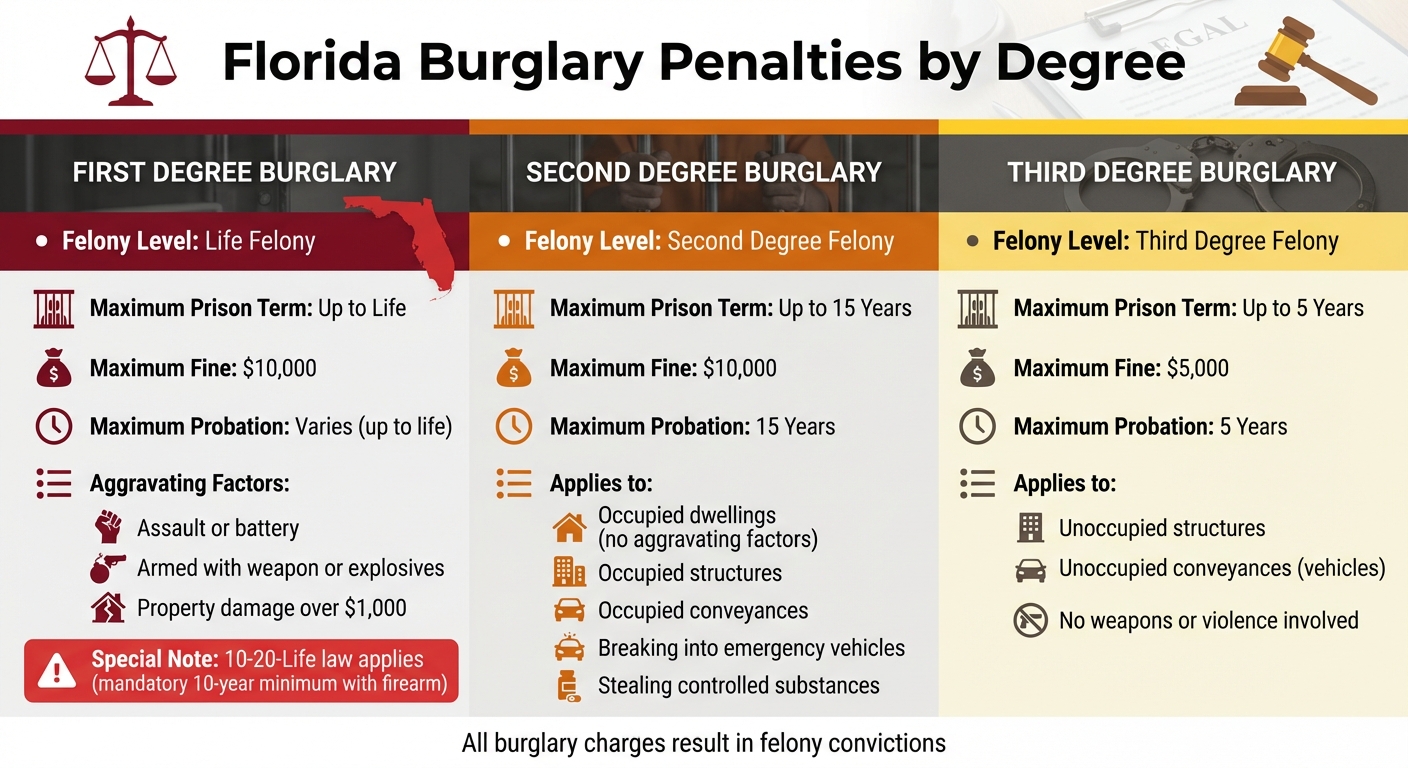
Florida Burglary Degrees: Penalties and Prison Sentences Comparison Chart
Florida takes burglary offenses seriously, with penalties that increase based on the severity of the crime and any aggravating factors. All burglary charges in the state lead to felony convictions, which come with long-lasting consequences like losing the right to vote or own firearms. The type of property involved and the circumstances surrounding the crime play a big role in determining the punishment.
First-degree burglary is considered a life felony and carries the most severe penalties under Florida Statute 810.02. According to the statute:
"Burglary is a felony of the first degree, punishable by imprisonment for a term of years not exceeding life imprisonment or as provided in s. 775.082, s. 775.083, or s. 775.084."
Florida’s 10-20-Life law enforces mandatory minimum sentences for crimes involving firearms. For example, if a firearm is used during a burglary, the law requires a minimum of 10 years in prison. Similarly, using any weapon in a burglary triggers the same 10-year minimum sentence.
Sentencing in Florida also involves a Criminal Punishment Code scoresheet system. This system assigns points based on factors like the severity of the offense, the defendant’s prior criminal record, and any harm caused to victims. The scoresheet helps determine the minimum sentence a judge can impose. For second-degree burglary, penalties can include up to 15 years in prison and probation, while third-degree burglary carries a maximum of 5 years for both imprisonment and probation.
Penalty Comparison by Degree
| Burglary Degree | Felony Level | Maximum Prison Term | Maximum Fine | Maximum Probation |
|---|---|---|---|---|
| First Degree | Life Felony | Up to Life | $10,000 | Varies (up to life) |
| Second Degree | Second Degree Felony | Up to 15 Years | $10,000 | 15 Years |
| Third Degree | Third Degree Felony | Up to 5 Years | $5,000 | 5 Years |
These penalties highlight the seriousness of burglary charges in Florida and emphasize the importance of understanding how aggravating factors or strong legal defenses can influence the final outcome in court.
sbb-itb-bb7ced0
Factors That Increase Burglary Charges
Under Florida Statute 810.02, certain actions or circumstances can make burglary charges more severe. While the penalties for burglary depend on the degree of the crime, specific factors can independently escalate the charges to a higher level. Here’s how certain actions during a burglary can lead to more serious consequences:
Use of force during a burglary automatically raises the charge to first-degree burglary. If someone commits assault or battery while inside the property or while escaping, the offense becomes punishable by up to life in prison. This applies regardless of whether the violence was planned or happened on the spot.
Being armed – or obtaining a weapon during the burglary – also results in first-degree charges. For example, if a firearm is stolen from the property during the crime, it qualifies as armed burglary under Florida law.
Causing property damage over $1,000 upgrades the charge to first degree. For instance, using a vehicle to break into a building – such as crashing through a storefront – can elevate the charge if it results in significant structural damage. However, simply using a vehicle to flee the scene does not have the same effect.
Targeting an occupied property or committing burglary during a riot or state of emergency can also increase the severity of the charge. If the crime occurs during a state of emergency declared by the Governor – especially in situations like power outages or reduced law enforcement presence – the charge is elevated by one level. This applies even if the property is occupied at the time of the crime.
These factors, combined with the statutory definitions of burglary, determine how serious the charges can become in Florida.
Defenses to Burglary Charges
Being charged with burglary doesn’t automatically mean a conviction. Under Florida Statute 810.02, prosecutors must prove specific elements beyond a reasonable doubt. Successfully disputing any of these elements can lead to reduced charges or even a dismissal.
One of the strongest defenses is the lack of criminal intent. For a burglary charge to stick, the accused must have entered or stayed on the property with the intent to commit a crime inside. For example, if someone entered a building to escape a storm, retrieve their own belongings, or simply went into the wrong property by mistake, the prosecution cannot establish intent. This intent must exist at the exact moment of entry.
Other defenses focus on the circumstances of the entry itself. Consent to enter, whether through a text, email, or even possession of a key, can invalidate a burglary charge. The law clearly states that entry isn’t burglary if the person was “licensed or invited to enter or remain.” Likewise, if the location was open to the public – like during a store’s business hours – the entry isn’t considered unlawful. Even if permission to stay is later revoked, prosecutors must prove that the individual remained with the intent to commit a crime. Additionally, if the entry was authorized, this undermines the burglary claim altogether.
Another common defense is mistaken identity, especially if the accused wasn’t apprehended at the scene. Defense attorneys often challenge the reliability of surveillance footage, DNA evidence, and fingerprints to dispute whether the right person has been identified.
Having skilled legal representation, such as the team at Law Firm Ocala (https://lawfirmocala.com), is crucial. They can challenge the evidence, address procedural errors, and negotiate for reduced charges. These defenses are critical, considering the harsh penalties outlined in Florida Statute 810.02.
Conclusion
Under Florida Statute 810.02, burglary charges are always classified as felonies. The law differentiates between burglaries involving dwellings, structures, or conveyances and considers whether they were occupied during the offense. These factors, along with circumstances like property damage exceeding $1,000 or committing the crime during a state of emergency, influence the severity of the charges. Penalties range from five years in prison for third-degree burglary to life imprisonment for first-degree offenses.
Effective defense strategies often focus on disproving criminal intent or challenging identity evidence. Prosecutors must establish unlawful entry or remaining with the intent to commit a crime. By demonstrating consent to enter, lack of intent, or flaws in identity evidence, defendants may significantly reduce or dismiss charges. The importance of proving every element of intent cannot be overstated, as it often determines the outcome of a case.
"In many instances this harsh penalty is completely out of line with reasonable maximum penalties for similar offenses, which makes hiring the right lawyer extremely important." – Benjamin Herbst, South Florida Criminal Defense Lawyer
Facing burglary charges can be overwhelming, but having skilled legal representation is essential. Law Firm Ocala specializes in criminal defense and has extensive experience navigating the complexities of Florida Statute 810.02. Their team is prepared to challenge evidence, build strong defenses, and fight for the best possible outcome. Visit Law Firm Ocala to schedule a free consultation and explore your legal options. Protect your rights and your future today.
FAQs
What are the main differences between first, second, and third-degree burglary under Florida law?
The degrees of burglary in Florida differ based on the circumstances of the crime and the penalties involved:
- First-degree burglary: This occurs when someone enters a structure or vehicle while armed, commits an assault or battery, or causes property damage over $1,000. It carries the most severe penalties, including the possibility of life imprisonment.
- Second-degree burglary: This typically involves unlawfully entering an occupied structure without using weapons, committing an assault, or causing major property damage. While the penalties are less harsh than first-degree burglary, they can still result in significant prison time.
- Third-degree burglary: This applies to entering or staying in an unoccupied structure or vehicle with the intent to commit a crime. The penalties are lighter compared to first and second degrees but vary depending on the specifics of the case.
Facing burglary charges is serious, and having an experienced attorney on your side is essential. Law Firm Ocala offers skilled legal representation to help defend your rights and guide you through the complexities of criminal cases.
How does Florida’s 10-20-Life law impact burglary sentences?
Florida’s 10-20-Life law imposes strict mandatory minimum sentences for specific crimes, including burglary. If a burglary involves a firearm, deadly weapon, or results in serious injury, the penalties become significantly harsher. For instance, simply possessing a firearm during a burglary carries a minimum sentence of 10 years in prison. If the firearm is discharged, the sentence increases to at least 20 years. In the most severe cases, where death or serious harm occurs, a life sentence may be applied.
These severe penalties highlight Florida’s focus on discouraging violent crimes. If you’re facing burglary charges, understanding how this law might affect your case is essential. Consulting an experienced defense attorney, like those at Law Firm Ocala, can help ensure your rights are protected while pursuing the best possible outcome.
What are some common defenses against burglary charges in Florida?
Defending against burglary charges in Florida often requires showing there was no intent to commit a crime, proving mistaken identity, or establishing that there was no unlawful entry into the property. Another potential strategy involves presenting an alibi, such as evidence that the accused was somewhere else when the alleged incident occurred.
Since every case is different, the most effective defense will depend on the details of your situation. If you’re dealing with burglary charges, working with an experienced attorney can help you explore your options and develop a defense strategy suited to your case.