
If your property – like a car, cash, or even a home – is seized in a Florida drug case, you can still fight to get it back. Florida law protects "innocent owners", meaning if you didn’t know or consent to illegal activity involving your property, you have a legal defense. But you must act fast. Here’s what you need to know:
- Key Deadlines: You have 15 days to request a hearing after receiving a seizure notice and 20 days to respond to a forfeiture complaint.
- Legal Standards: The government must prove your property’s connection to a crime with "clear and convincing evidence." You must show it’s more likely than not that you were unaware of the illegal activity.
- Evidence You’ll Need: Financial records, communication logs, lease agreements, and even forensic testing (like Touch DNA) can help prove your innocence.
Florida’s civil forfeiture laws allow authorities to seize property without a criminal conviction, so quick action and strong evidence are crucial. Missing deadlines could mean losing your property permanently. Legal help can significantly improve your chances of recovering your assets.
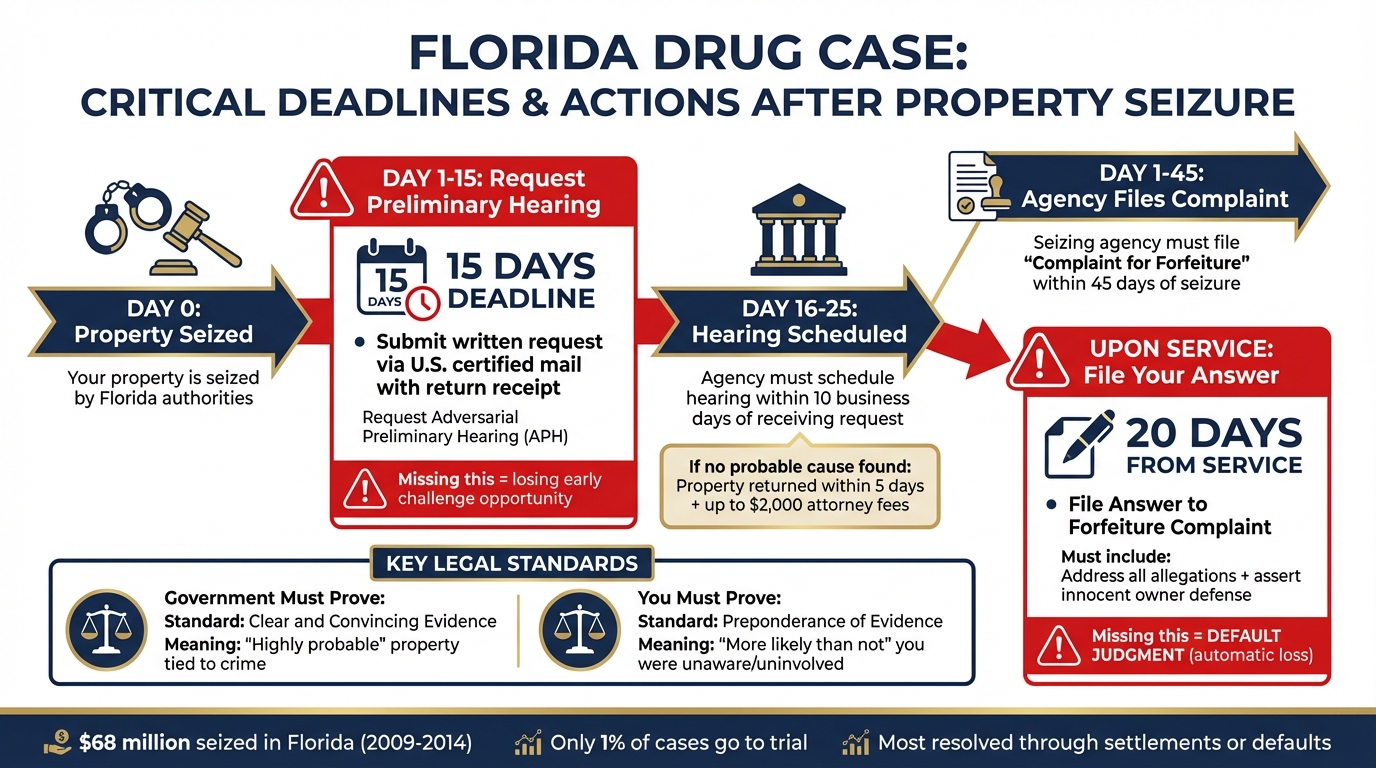
Florida Property Seizure Timeline: Critical Deadlines and Actions
Florida’s Property Forfeiture Laws
When the Government Can Seize Your Property
Under the Florida Contraband Forfeiture Act (FCFA), authorities can seize property linked to drug crimes. This includes items like vehicles, boats, aircraft, real estate (even your home), cash, securities, and drug-related items. Property can be seized if it was used in drug crimes, purchased with drug money, or intended for drug-related transactions.
The process happens in two steps: first, authorities take physical control of the property, and then a court decides if it should be forfeited. Since 2016, Florida law requires an arrest before seizing physical property. However, there are exceptions for cases involving unidentified owners, fugitives, deceased individuals, or when the property is cash or monetary instruments.
For instance, in June 2025, Circuit Judge J. Layne Smith in Wakulla County ordered the return of over $500,000 worth of Bitcoin shortly after an attorney requested an adversarial preliminary hearing.
It’s important to understand these seizure methods before diving into the differences between civil and criminal forfeiture. This knowledge can play a crucial role in building a defense, especially for innocent owners.
Civil vs. Criminal Forfeiture
Florida’s forfeiture laws take two distinct paths, each affecting property rights differently. Civil forfeiture targets the property itself, not the individual owner. Known as an "in rem" action, it doesn’t require the owner to be charged or convicted of a crime. Instead, the government must prove the property’s connection to illegal activities with "clear and convincing evidence."
Criminal forfeiture, on the other hand, is an "in personam" action against an individual. This type of forfeiture only occurs after a criminal conviction and is part of the sentencing process. Claims from third parties, like an innocent spouse or co-owner, are addressed in separate hearings after the conviction. In civil cases, all ownership claims are typically resolved in one trial, giving innocent owners a chance to assert their rights earlier.
| Feature | Civil Forfeiture | Criminal Forfeiture |
|---|---|---|
| Target | The property itself | The individual defendant |
| Conviction Needed? | No | Yes |
| Standard of Proof | Clear and convincing evidence | Beyond a reasonable doubt |
| Arrest Required? | Yes (for physical property) | Yes (as part of criminal case) |
| Primary Goal | Disrupting criminal financial bases | Punishing the convicted defendant |
Between 2009 and 2014, Florida law enforcement seized over $68 million worth of assets. Interestingly, only about 1% of civil forfeiture cases actually go to trial. Most are resolved through settlements or default judgments when owners fail to respond in time.
What to Do After Your Property Is Seized
Taking quick action is critical to protect your ownership rights. Knowing the required steps and deadlines can make all the difference in keeping your property.
Request a Preliminary Hearing
Once you receive a seizure notice, you have 15 calendar days to request an Adversarial Preliminary Hearing (APH). This deadline is non-negotiable – missing it, even by a single day, could mean losing your chance to challenge the seizure early on.
To request the hearing, submit a written request via U.S. certified mail with return receipt. This method ensures you have proof that your request was sent on time. Once the agency receives your request, they are required to schedule the hearing within 10 business days. At this hearing, a judge will decide whether there’s probable cause to believe your property was involved in a violation of Florida law. If the court finds no probable cause, they must return your property within five days, and you could also receive up to $2,000 in attorney fees.
In June 2025, Circuit Judge J. Layne Smith in Wakulla County ordered the return of over $500,000 worth of Bitcoin after an attorney promptly requested an adversarial preliminary hearing and provided proof of the client’s legitimate claim.
This case highlights how acting quickly within the 15-day window can lead to positive outcomes. However, requesting the preliminary hearing is just the first step – you’ll also need to respond to the formal forfeiture complaint if it’s filed.
File a Response to the Forfeiture Complaint
If the seizing agency files a "Complaint for Forfeiture" (which they must do within 45 days of the seizure), you have 20 days from the date you’re served to file your Answer. This document should address every allegation in the complaint, either admitting or denying the claims, and include any defenses, such as the innocent owner defense – asserting that you had no knowledge of or involvement in illegal activity.
Failing to meet this deadline results in a default judgment, allowing the government to keep your property without a trial. For example, in January 2025, the Ocala Police Department issued a formal notice requiring a claimant to respond by January 16, 2025, or face automatic forfeiture. Keeping track of service dates is crucial to avoid missing your chance to defend your property. Even if you’ve attended the preliminary hearing, filing this written response is still mandatory to prevent losing your property by default.
Evidence Needed to Prove Innocent Ownership
To reclaim seized property, you must demonstrate that you were not involved in the illegal activity linked to it.
Showing You Didn’t Know About or Approve the Illegal Activity
Your case depends on proving you had no knowledge of or consented to the illegal activity. In Florida, the law requires the government to provide concrete evidence of your involvement. Simply finding drugs on your property isn’t enough – they need additional proof, like incriminating statements, witness accounts, or scientific evidence.
Take the case of Evans v. State (2010) as an example. Police discovered MDMA in a duffel bag on the defendant’s bed in a shared home. Although the bag contained his passport, the Florida appellate court overturned the conviction. Why? The court ruled the passport only proved he owned the bag – not that he knew about the drugs or when they were placed there, especially since others had access to his room. This case highlights that proximity alone doesn’t prove knowledge or control.
Types of Supporting Evidence
To build a strong defense, you’ll need to gather evidence showing you were unaware of and uninvolved in the illegal activity. Here are some examples:
- Financial records: Bank statements and tax returns can show your income comes from legitimate sources.
- Communication logs: Emails or texts can demonstrate that you opposed any illicit use of your property.
- Property records: Documents like lease agreements or deeds can clarify shared access to the property.
Other helpful evidence includes digital alibis like Google Timeline or Apple Location Data, which can confirm you weren’t present during the alleged activity. Touch DNA testing on drug packaging can also help – if your DNA isn’t found but someone else’s is, it supports your case. Additionally, witness testimonies from neighbors, roommates, or character witnesses can reinforce your lack of involvement.
In shared spaces such as apartments or vehicles, keeping clear documentation of who has keys, access codes, or permission to use the property is vital. This helps establish that the area wasn’t solely under your control.
sbb-itb-bb7ced0
Legal Standards and Who Must Prove What
In forfeiture cases, understanding the legal standards and who carries the burden of proof is crucial. Florida’s 2016 Senate Bill 1044 significantly shifted the playing field by increasing the government’s burden of proof from "probable cause" to "clear and convincing evidence." Now, law enforcement must demonstrate it’s "highly probable" that your property was involved in or came from drug-related activity. Before this reform, they only needed probable cause, which required far less evidence.
How the Burden of Proof Works
Once the government establishes a connection between your property and drug crimes, the responsibility shifts to you. To defend your property, you must prove – by a "preponderance of the evidence" – that you were unaware of or did not consent to the illegal activity. This standard means showing it’s more likely than not that you had no knowledge or involvement. While this is a lower bar than the government’s "clear and convincing evidence", it still demands strong evidence to support your claim.
"Property owners must prove their innocence by a preponderance of the evidence (meaning it’s more likely than not they were unaware of the illegal activity)." – Matt Shafran, Managing Partner, Weinstein Legal Team
Here’s a breakdown of the two standards:
| Element | Government’s Requirement | Your Requirement (Innocent Owner Defense) |
|---|---|---|
| Legal Standard | Clear and Convincing Evidence | Preponderance of the Evidence |
| Definition | Must show it’s "highly probable" the property is tied to a crime | Must show it’s "more likely than not" you were unaware or uninvolved |
| Focus of Proof | The connection between the property and the criminal activity | Your lack of knowledge or consent |
This comparison highlights the challenges innocent owners face and underscores the need for a strategic and well-prepared defense.
Common Cases and Defense Strategies
Shared Vehicles or Family-Owned Property
Imagine this: drugs are found in a shared vehicle – maybe in the trunk, glove compartment, or under the seats. In Florida, just owning or driving the vehicle isn’t enough for the prosecution to convict you. They must prove two things: that you knew the drugs were there and that you had “dominion and control” over them. Take the case of Giza v. State, for example. A driver’s conviction was overturned because the passenger also had access to the car keys and trunk, making it impossible to prove the driver had exclusive control.
Defense strategies in these situations often focus on forensic evidence. One powerful tool is Touch DNA testing on drug packaging. If DNA from a passenger or another family member is found and yours is not, this could dismantle the prosecution’s argument. Digital evidence, like data from Google Timeline or Apple Location Services, can also provide an alibi, showing you weren’t even in the car when the drugs were discovered. Attorneys often lean on the joint occupancy rule, which requires the state to prove more than just proximity to the drugs. Evidence like fingerprints or surveillance footage is necessary to directly link you to the contraband.
Property owners face similar hurdles when unauthorized individuals, like tenants or employees, engage in illegal activities on their premises.
When Tenants or Employees Break the Law
For property owners in Ocala, dealing with tenants or employees involved in drug-related crimes can be a legal minefield. But there’s a way out: the innocent owner defense. This requires you to show, through documentation, that you were unaware of or didn’t consent to the illegal activity. Detailed lease agreements, management logs, and communication records can all help demonstrate your lack of involvement.
"The innocent owner defense allows property owners to contest forfeiture by proving they were unaware of or did not consent to the illegal activity associated with their property." – Leppard Law
If drugs are found on your property, act fast. File a formal claim contesting the seizure within the deadlines outlined in the government’s Notice of Seizure. Request Touch DNA testing to show you had no physical connection to the contraband. You can also argue that you lacked “dominion and control” over the property, especially if you didn’t have the ability to monitor or prevent the illegal activity.
For tailored advice and legal representation in these scenarios, visit Law Firm Ocala. Their team is ready to help you navigate these complex cases.
Protecting Your Rights with Legal Help
Navigating Florida’s forfeiture process without legal representation can be risky – you could lose your property. Statistics show that property owners with attorneys have a much higher chance of recovering seized assets compared to those who go it alone. The process has strict deadlines, and missing even one can result in losing your property by default. Attorneys ensure these critical timelines are met, giving you a fighting chance.
Beyond meeting deadlines, experienced legal counsel thoroughly examines every detail of the seizure process. They can challenge the legality of the search and seizure, identify violations of the Florida Contraband Forfeiture Act, and dispute the government’s claim that your property is tied to alleged criminal activity. By holding the government to its high burden of proof, attorneys can undermine their case. For example, they might use financial records to prove your funds came from legitimate sources or employ forensic tools to show you never handled illegal substances.
"Property owners represented by attorneys are significantly more likely to recover their property than those who attempt to navigate the process alone." – Matt Shafran, Managing Partner
This kind of strategic legal intervention is crucial for safeguarding your rights and strengthening your innocent owner defense.
Attorneys today have access to advanced tools, especially in Ocala, where modern forensic and digital methods are often used to build stronger defenses. For high-value assets like homes, lawyers may argue that forfeiture violates the Eighth Amendment by being grossly disproportionate to the alleged offense. Many cases are also resolved through negotiated settlements, where an attorney could recover part of your seized cash or property in exchange for waiving future claims.
Law Firm Ocala focuses on criminal defense, including drug crimes and property forfeiture cases. Their seasoned team knows the ins and outs of Florida’s forfeiture laws and can craft a defense strategy for both civil and criminal proceedings. Don’t face this process alone – reach out for a free consultation to protect your rights and your property.
FAQs
What if I missed the 15-day or 20-day deadline?
Missing the 15-day or 20-day deadline to prove innocent ownership in Florida drug cases can seriously affect your case. Delays might restrict your ability to present key defenses or evidence, which could influence the final outcome. Acting promptly is essential – consulting a lawyer early can help you understand your options and decide on the best course of action.
How can I prove I didn’t know drugs were in my car or home?
To demonstrate you didn’t know drugs were in your car or home, concentrate on proving two key points: lack of knowledge and lack of control over the substances. For instance, you can present evidence showing you were unaware of their presence, like proving the space was shared with others or that you never had physical possession of the drugs. Under Florida law, this defense is valid if you can clearly show you had neither awareness nor control over the drugs in question.
Can my property be forfeited if I’m never convicted?
If you’re not convicted, your property is generally protected from forfeiture – particularly if you can establish innocent ownership. This means proving that you had no knowledge of or connection to the criminal activity in question. To navigate this process effectively, it’s crucial to work with a skilled attorney who can guide you through the necessary legal steps and help gather the evidence needed to defend your rights.