
Florida’s child support laws changed significantly on January 1, 2026, with the introduction of House Bill 1014. These updates affect how child support payments are calculated and modified. Here’s what you need to know:
- Income Limits Increased: The combined net income limit rose from $12,000 to $50,000.
- Self-Support Reserve Adjusted: Now set at 180% of federal poverty guidelines to protect lower-income parents.
- Modification Thresholds: A 15% or $50 difference (10% or $25 for Title IV-D cases) is required to request changes.
- Time-Sharing Impact: Parents with at least 20% of overnights (73 nights) may see adjusted obligations.
- Key Factors for Modifications: Changes in income, child-related expenses, or time-sharing schedules.
Modifications only take effect from the filing date, not retroactively. If you’re in Ocala, Florida, and need help navigating these changes, consult local legal experts to ensure your obligations align with the new guidelines.
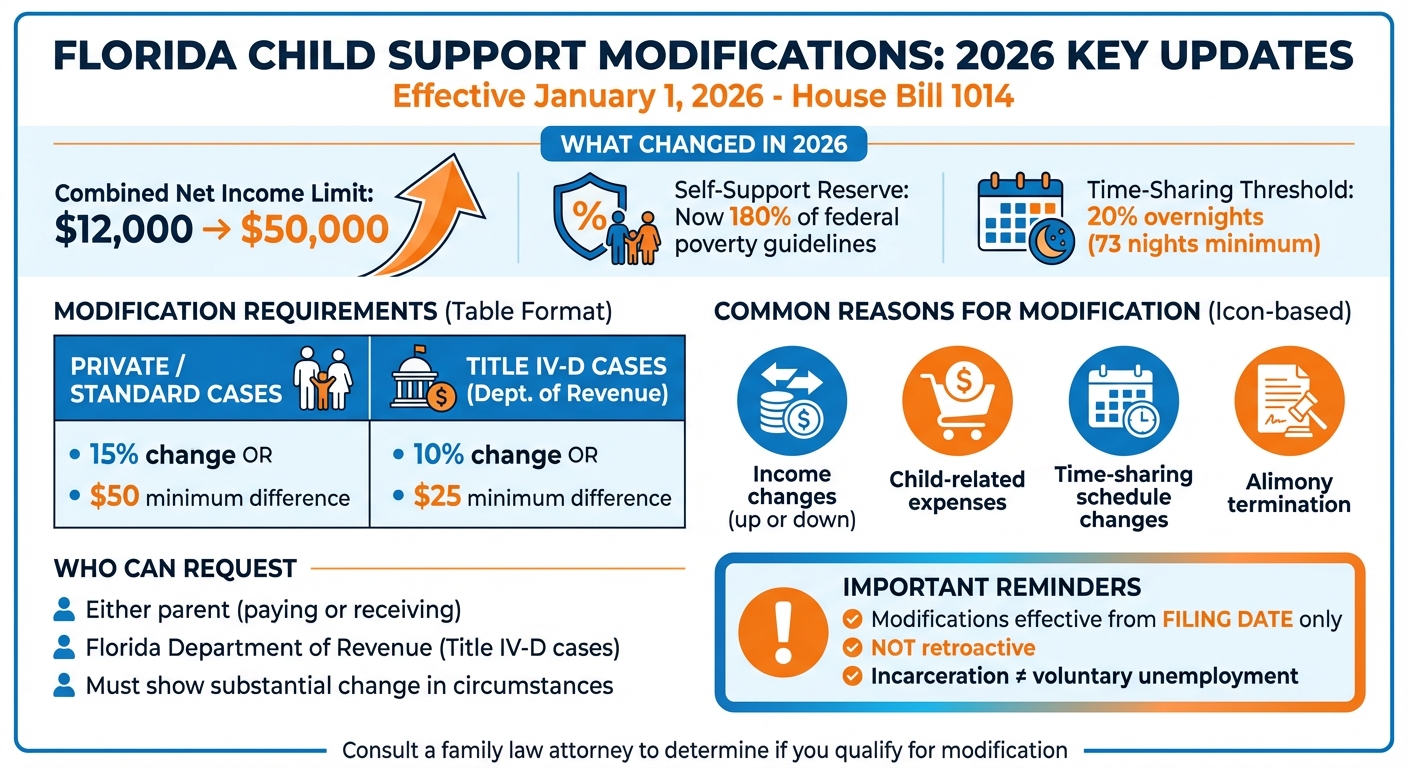
Florida Child Support Law Changes 2026: Key Updates and Modification Requirements
Who Can Request a Child Support Modification
If you’re wondering who can request a child support modification, the answer is straightforward: either parent involved in the child support order can make the request. This applies to both the paying parent and the receiving parent. Additionally, in Title IV-D cases, the Florida Department of Revenue has the authority to request modifications as well.
Modifications are relevant for minor children and high school students aged 18 to 19 who are actively working toward graduation. No matter where you reside in Florida – whether in Ocala or another city – you may qualify to adjust your support obligations. If you’re in Ocala, you can seek tailored legal advice from Law Firm Ocala.
Material Change in Circumstances
Florida law requires a substantial change in circumstances to justify a modification. This could mean a shift in your financial situation or your child’s needs since the last order. To proceed, the difference between your current child support amount and the recalculated amount under the new guidelines must meet specific thresholds:
| Case Type | Minimum Percentage Change | Minimum Dollar Change |
|---|---|---|
| Private/Standard Modification | 15% | $50 |
| Department of Revenue (Title IV-D) | 10% | $25 |
In Title IV-D cases, which are handled by the Florida Department of Revenue, the bar for modification is slightly lower – requiring only a 10% or $25 change.
Common Reasons for Modification
Several situations may qualify as a substantial change under Florida law. Here are some of the most common:
- Changes in Income: Whether you’ve experienced a pay raise, a reduction in earnings, or a job loss, any significant shift in income can be grounds for modification.
- Child-Related Expenses: Adjustments in costs like health insurance premiums or childcare expenses can also warrant a review.
- Time-Sharing Schedules: If a parent consistently fails to uphold their court-ordered time-sharing schedule, this could justify a retroactive modification dating back to when the missed overnights began.
Florida law also makes it clear that incarceration is not considered "voluntary unemployment" when establishing or modifying a support order. Additionally, if new children are born or adopted after the original order, this can serve as a defense against an increase in support but cannot be used to decrease an existing obligation.
Next, we’ll dive into the updated 2026 child support guidelines and how recalculations are performed.
sbb-itb-bb7ced0
Florida Child Support Guidelines in 2026
Florida’s child support guidelines, first set in 2025, remain the standard for calculating support in 2026. Whether you’re establishing a new order or modifying an existing one, these guidelines rely on the Income Shares Model, which calculates support based on the combined net income of both parents and the number of children involved.
The process begins by determining each parent’s gross income. This includes wages, bonuses, commissions, and Social Security benefits. From this, courts subtract allowable deductions like federal and state taxes, FICA, mandatory union dues, health insurance premiums for the parent, and any court-ordered child support payments already being made. The remaining monthly net income becomes the foundation for calculating support.
For families with combined net incomes exceeding $10,000, the base obligation increases incrementally – adding 5% of the excess for one child and 7.5% for two children. Additionally, reasonable child care costs related to work or education, as well as health insurance premiums for the child, are added to the base amount. Once calculated, the responsibility is divided proportionally between the parents. This structure sets the groundwork for understanding how deviations and modifications are handled.
Deviation Rules and Requirements
Judges have the discretion to adjust child support amounts by up to 5% without needing to provide written justification. This flexibility allows them to account for the unique needs of the child and the financial circumstances of the parents.
For deviations exceeding 5%, however, Florida law requires a written explanation. As outlined in Florida Statute 61.30:
"The trier of fact may order payment of child support in an amount which varies more than 5 percent from such guideline amount only upon a written finding explaining why ordering payment of such guideline amount would be unjust or inappropriate."
Courts may consider various factors, including extraordinary medical or educational expenses, the child’s age, seasonal income variations, or cases where the obligation would exceed 55% of a parent’s gross income for a single support order. If you’re navigating a complex modification case in Ocala, Law Firm Ocala can help clarify how these rules might apply to your situation.
How Support Amounts Are Recalculated
When modifications are requested due to substantial changes in circumstances, recalculating support starts with updated financial information. Both parents must provide detailed financial affidavits, and the court applies the current guidelines to determine the updated obligation.
Time-sharing arrangements are a key factor in recalculations. If a parent spends at least 20% of annual overnights (73 nights) with the child, a "substantial time-sharing" formula is applied. This formula multiplies the obligation by 1.5 before dividing it between the parents. Keeping accurate records of overnight stays is crucial, as falling below the 20% threshold could lead to immediate modifications.
For parents who are voluntarily unemployed or underemployed, courts may assign income based on recent work history and qualifications. However, there are limits: income cannot be imputed based on records older than five years or at a level the parent has never earned unless they recently acquired a relevant degree or license. It’s also worth noting that incarceration is not considered voluntary unemployment when adjusting a support order.
How to File for a Child Support Modification
Filing the Required Petition
To start the process, file a Supplemental Petition for Modification of Child Support in the circuit court where the original order was issued or in your current county. This petition is the official document that begins the modification process under Florida Statutes §61.14 and §61.30.
Your modification request must meet the minimum requirement of either a 15% or $50 difference between the current and recalculated support amounts, as explained in the material change criteria. Use the Florida Child Support Guidelines Worksheet to estimate the new amount before paying filing fees to ensure you meet these requirements.
You’ll need to include the following documents with your petition:
- Family Law Financial Affidavit, outlining your income, expenses, assets, and liabilities
- Notice of Social Security Number
- Certificate of Service, confirming the other parent has received copies
- Three months of pay stubs, your most recent federal tax return, and any updated childcare or health insurance records
Once filed, the other parent must be legally served with the petition. They have 20 days to respond in writing. If you’re in Ocala and need help with the paperwork, Law Firm Ocala offers assistance to ensure your petition is properly prepared and submitted.
After filing, it’s important to understand how the modification timeline works.
When Modifications Take Effect
Timing plays a key role in Florida child support modifications. The updated support amount becomes effective on the filing date – modifications cannot apply retroactively to a period before that date.
If you delay filing, you’ll still owe the previous support amount until the petition is filed. The Florida Department of Revenue explains:
"The court may make the modification retroactive to the date the petition was filed."
Filing promptly after a major change in circumstances protects you from falling behind on payments and ensures the updated amount applies as soon as possible.
2026 Legal Updates
Child-Centered Adjustments
Florida courts are placing greater emphasis on the unique needs of children when modifying support arrangements, as outlined in Florida Statute 61.08. Instead of focusing solely on income, courts now consider additional factors like childcare costs, extracurricular activities, medical expenses, and educational needs to determine what’s in the child’s best interest. For parents in Ocala, it’s crucial to keep detailed records of these expenses to strengthen their case for modification. These child-specific considerations now work alongside broader financial changes, such as updates to alimony laws.
Impact of Alimony Law Changes
The 2023 alimony reform under SB 1416 continues to shape child support cases in 2026. With permanent alimony no longer an option, spousal support now has a set end date. This creates a clear point for revisiting child support obligations when durational alimony ends. Additionally, the 35% income cap on alimony awards plays a role in child support calculations. Courts assume that the receiving spouse’s needs generally won’t exceed 35% of the income difference between the two parties. Alimony payments also directly affect net incomes – raising the recipient’s and lowering the payer’s – further influencing child support adjustments.
For instance, in marriages lasting 10 to 20 years, alimony is capped at 60% of the marriage’s duration. In a 15-year marriage, this means alimony could last up to 9 years. When that support ends, the resulting change in net incomes often prompts a recalculation of child support. Law Firm Ocala can assist in navigating these modifications, ensuring child support orders reflect current financial circumstances. These updates aim to bring child support arrangements in line with the evolving financial dynamics of families.
Conclusion
Florida’s upcoming 2026 reforms bring notable changes to child support modifications, focusing on clearer guidelines and a child-centered approach. The combined monthly net income limit will rise to $50,000 starting January 1, 2026, offering more precise standards for higher-income parents and reducing reliance on court estimations. Courts will also prioritize factors like medical expenses and educational needs when assessing child support.
It’s crucial to stay informed about these updates, as court-ordered child support obligations don’t automatically pause during financial hardships or job loss. Delaying a request for modification could lead to arrears, interest, and potential legal issues. If you’ve experienced a substantial, long-term change in income, filing promptly is essential to safeguard your financial position. However, keep in mind that requesting a modification can be a double-edged sword – if your income has increased, the court may reassess and raise your support obligations.
Remember, modifications only take effect from the filing date and are not retroactive. These reforms aim to ensure that child support orders reflect current financial realities and prioritize the child’s best interests.
For parents in Ocala navigating these changes, Law Firm Ocala provides expert assistance with family law matters, including child support modifications. Their team can help determine if your situation meets the legal requirements for a modification, ensure compliance with the 2026 guidelines, and handle the filing process to avoid costly errors. Schedule a free consultation to better understand how these updates may affect you and plan your next steps effectively.
FAQs
What counts as a “substantial change” to modify child support in Florida?
A “substantial change” in Florida when it comes to modifying child support generally means a shift in circumstances that results in at least a 15% difference in the support amount or a change of at least $50. This rule applies if the child support order was issued, reviewed, or modified within the past three years.
How do I prove I meet the 20% (73 overnights) time-sharing threshold?
To show that you meet Florida’s 20% time-sharing threshold (at least 73 overnights per year), you’ll need to provide clear and detailed evidence. This could include logs, calendars, or records that track overnight stays with your child. Make sure your documentation is consistent and accurate, as this will be key in proving you meet the required number of overnights.
Can my child support change when alimony starts or ends?
Child support adjustments are not automatically linked to changes in alimony. Even if alimony is modified, child support remains a separate matter that requires its own legal process. Any updates to child support must be approved through a court order or administrative action.