
If you’re a medical marijuana patient in Florida, you’re navigating conflicting laws. While Florida law protects registered patients, federal law still classifies marijuana as a Schedule I drug, creating challenges for firearm ownership, employment, and travel. Here’s what you need to know:
- Florida Law: Patients with qualifying conditions can use medical marijuana legally through licensed dispensaries, but home cultivation is banned.
- Federal Law: Marijuana remains illegal, impacting firearm ownership, federal property access, and interstate travel.
- Firearms: Federal law prohibits marijuana users from owning guns, even if state law permits it.
- Employment: Federal regulations allow employers to enforce zero-tolerance policies, though Florida courts are starting to require accommodations for off-duty medical use.
- Travel: Carrying medical marijuana onto federal property or across state lines is a federal offense.
Understanding these restrictions is essential to avoid legal issues. Stay informed, follow Florida’s program rules, and consult legal experts if complications arise.
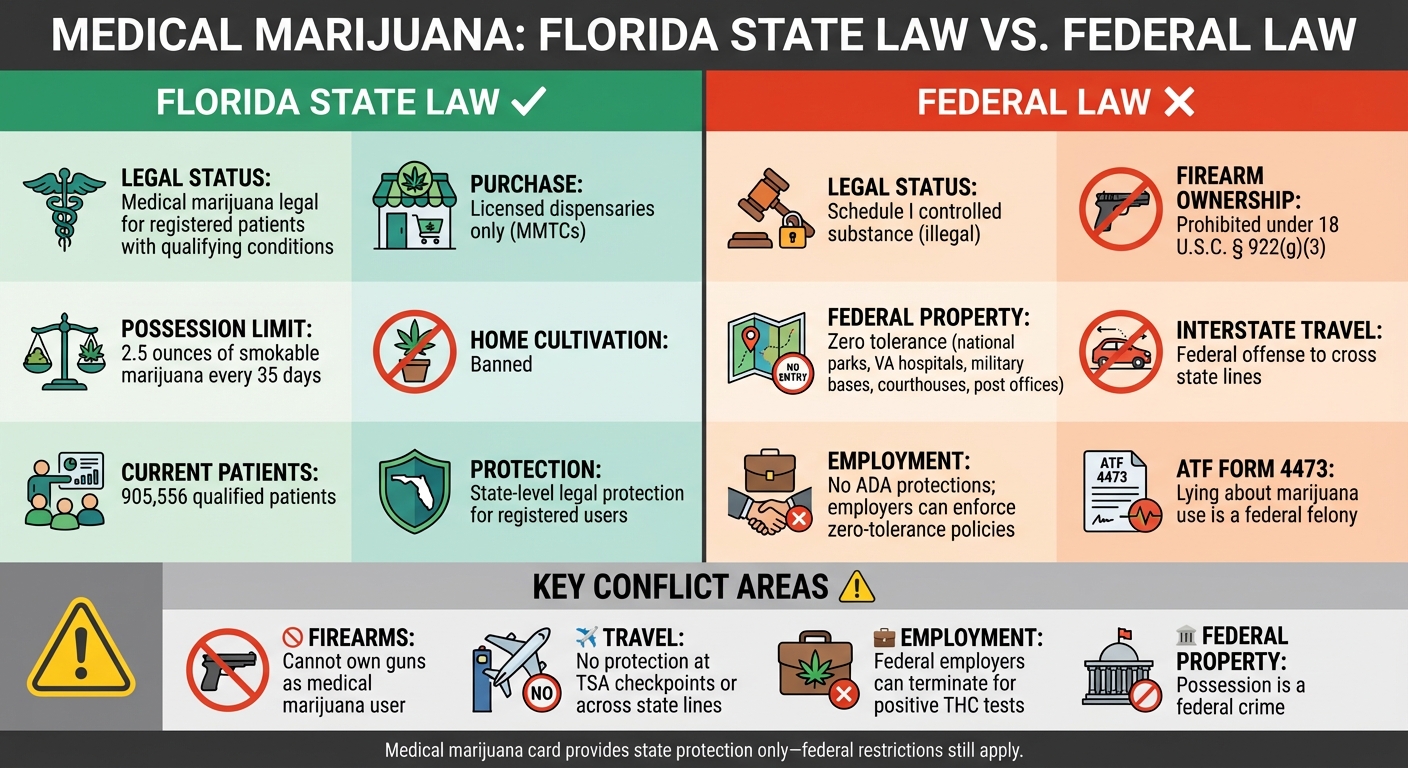
Florida vs Federal Medical Marijuana Laws: Key Differences for Patients
Federal Restrictions on Medical Marijuana Users
Even with a valid Florida medical marijuana card, federal restrictions can significantly impact your day-to-day life. These rules apply regardless of your compliance with state laws, creating challenges in areas like firearm ownership, travel, and employment.
Firearm Ownership Restrictions Under Federal Law
One of the most significant limitations involves firearm ownership. Under 18 U.S.C. § 922(g)(3), federal law prohibits anyone classified as an "unlawful user of or addicted to any controlled substance" from owning firearms or ammunition. Since marijuana remains a Schedule I drug under federal law, this restriction applies to state-authorized medical marijuana patients.
When purchasing a firearm, you’ll encounter ATF Form 4473, which includes Question 21.f asking about marijuana use. Answering truthfully as a medical marijuana user results in denial of your application. Lying on this form is a federal felony, carrying the risk of prosecution.
Even if you’re compliant with Florida law, federal law still labels you as an "unlawful user." A lawsuit filed by medical marijuana patients and former Agriculture Commissioner Nikki Fried challenges this restriction, arguing it violates the Second Amendment. The Eleventh Circuit recently sent the case back to trial court, stating the government failed to justify the restriction under historical firearm regulations. Despite this, the federal prohibition remains in place, and possessing both firearms and marijuana could lead to federal charges if investigated.
Risks on Federal Property and During Travel
Your Florida medical marijuana card provides no protection on federal property, where marijuana laws are strictly enforced. Locations like national parks, VA hospitals, military bases, federal courthouses, and post offices maintain a zero-tolerance policy for cannabis. Possessing even small amounts of marijuana in these areas can lead to federal charges, fines, and the confiscation of your medication.
Traveling with medical marijuana adds another layer of risk. TSA screenings are conducted under federal authority, and if marijuana is discovered in your luggage, agents may involve law enforcement. Depending on local policies and the amount found, this can result in anything from confiscation to criminal charges.
Additionally, transporting marijuana across state lines is a federal offense, even if both states allow medical marijuana use. For Florida patients, the safest option is to keep your medication within state borders and avoid carrying it in federally regulated transportation areas.
Employment Issues and ADA Protections
Employment poses another challenge for medical marijuana patients. The Americans with Disabilities Act (ADA) does not shield medical marijuana users from workplace discrimination. The ADA explicitly excludes protections for individuals "currently engaging in the illegal use of drugs" under federal law, which includes marijuana – even when used for medical purposes.
Employers operating under the Drug-Free Workplace Act or DOT regulations often uphold zero-tolerance policies. This means a positive THC test, even for off-duty use, can result in disciplinary action or termination.
However, Florida state law is beginning to evolve in this area. In a recent Florida circuit court case (currently under appeal), the court ruled that employers must consider reasonable accommodations for off-duty medical marijuana use under the Florida Civil Rights Act (FCRA). The case involved a qualified patient with anxiety, PTSD, and insomnia who was terminated after failing a drug test, despite having a valid medical marijuana card and using cannabis outside of work. The court recognized Florida’s constitutional and statutory protections for medical marijuana patients, emphasizing the need to accommodate off-site use for those with conditions that significantly impact daily activities. These protections, however, are rooted in state law and do not extend to the federal ADA, leaving the issue in a state of legal flux.
Staying Compliant as a Florida Medical Marijuana Patient
Navigating the legal landscape of medical marijuana in Florida requires careful attention to state rules and federal restrictions. Here’s how to stay on the right side of the law and protect your rights as a patient.
Buy Only from Licensed Treatment Centers
Florida law requires all medical marijuana purchases to be made through licensed Medical Marijuana Treatment Centers (MMTCs). These transactions are tracked in the Medical Marijuana Use Registry (MMUR) to ensure patients adhere to legal possession limits. Buying from unlicensed sources – whether it’s a friend or a black market dealer – violates Chapter 893 of the Florida Statutes. Such actions could lead to suspension or even revocation of your medical marijuana registration.
To verify a dispensary’s legitimacy, check the Florida Office of Medical Marijuana Use (OMMU) website or log into the MMUR portal, which lists all approved MMTCs. Only these licensed centers can legally provide products like smokable flower, edibles, and oils, ensuring they meet strict safety and quality standards. Purchasing outside this system not only puts your legal status at risk but also exposes you to unregulated products that may not meet health and safety guidelines.
Avoid Federal Property and Interstate Travel
Federal laws still classify marijuana as illegal, so it’s critical to follow specific precautions when it comes to travel and federal property. Never bring your medication onto federal property, such as government buildings, national parks, or airports, as possession there is a federal crime – even with a valid Florida medical card.
Additionally, avoid taking your medication across state lines. Transporting marijuana into another state or onto federally regulated areas, such as TSA checkpoints at airports, could result in arrest or seizure. To stay safe, use your medication only within Florida and in private residences, leaving it at home when traveling.
Stay Informed About Legal Changes
Medical marijuana laws are constantly evolving, and staying updated is key to maintaining compliance. For instance, Chapter 2025-204, which goes into effect on July 1, 2025, mandates that the OMMU revoke MMUR registrations for patients convicted of trafficking, sale, manufacture, or possession with intent under Chapter 893. Patients facing these charges will have their registration suspended until the case is resolved. If convicted, they’ll need to undergo physician recertification and reapply for an ID card to regain eligibility.
To stay ahead of changes, regularly check the OMMU website for updates. Use the MMUR app or portal to monitor your purchase history, possession limits, and registry status in real time. Keeping yourself informed ensures that you can adapt to new regulations and avoid accidental violations that might jeopardize your legal standing. These steps not only help you stay compliant but also prepare you to handle any legal challenges that may arise.
sbb-itb-bb7ced0
How Law Firm Ocala Can Help Medical Marijuana Patients

Navigating the tricky waters between federal marijuana laws and Florida’s medical marijuana program can be overwhelming. That’s where Law Firm Ocala steps in, providing expert legal support to help patients safeguard their rights and handle compliance or legal challenges with confidence. Here’s how they address both criminal defense and compliance matters for medical marijuana patients.
Defense Against Marijuana-Related Charges
If you’re facing charges under Chapter 893 – like trafficking, possession with intent, or unlicensed purchases – Law Firm Ocala’s criminal defense team is ready to build a solid case for you. Starting July 1, 2025, these charges come with even harsher consequences, such as automatic suspension from the Medical Marijuana Use Registry (MMUR). A conviction could mean permanent removal from the registry, regardless of adjudication. The firm has already successfully defended over 160 patients against similar revocations under these strict enforcement standards.
Their attorneys meticulously gather evidence, challenge the charges, and work toward resolutions that could help reinstate your MMUR status. The firm also tackles federal charges, such as possession on federal property or issues arising during interstate travel. Whether you’re dealing with state-level violations or federal prosecution, their goal is to reduce or dismiss charges and protect your future access to medical marijuana. In a legal landscape filled with contradictions, their defense services act as a crucial safeguard for your rights.
Legal Compliance Consultations
Staying compliant isn’t just about avoiding trouble – it’s about securing your peace of mind. Law Firm Ocala offers consultations that break down the complexities of medical marijuana laws, ensuring patients understand their rights and obligations. These sessions cover essential topics like possession limits (2.5 ounces of smokable marijuana every 35 days), the ban on home cultivation, and the legal risks of being on federal property or crossing state lines with marijuana.
Their team also provides guidance on verifying certifications, maintaining proper documentation, and staying updated on legislative changes. With enforcement tightening and patient growth slowing, staying informed is more critical than ever. Law Firm Ocala’s consultations are designed to help you steer clear of compliance pitfalls and maintain your registry status without unnecessary stress.
Conclusion
Florida’s medical marijuana program currently supports about 905,556 qualified patients, but the clash between state laws and federal prohibition continues to create legal hurdles. This tension leaves patients navigating a tricky legal landscape where compliance is key.
To stay on the right side of the law, make sure to purchase products exclusively from licensed Medical Marijuana Treatment Centers (MMTCs) and steer clear of federal lands, where possession remains illegal. Violations tied to Chapter 893 could impact your Medical Marijuana Use Registry (MMUR) status, so it’s crucial to follow the rules closely, especially as enforcement becomes stricter.
Protecting your access to medical marijuana requires staying on top of your legal obligations. Keep your registration and recertification up to date, and regularly check the OMMU for any updates or changes to the program. Knowing your state’s possession limits and carrying proper documentation can help you avoid unnecessary complications.
If legal challenges arise – whether related to marijuana charges, registry issues, or workplace conflicts – having skilled legal representation can make all the difference. Law Firm Ocala specializes in drug crimes and criminal defense, offering the expertise needed to navigate the complex intersection of state and federal laws. Reach out to Law Firm Ocala today to safeguard your rights and ensure uninterrupted access to your treatment.
FAQs
Are Florida medical marijuana patients allowed to own firearms?
Under federal law, anyone using medical marijuana, including residents of Florida, is barred from owning or buying firearms. This restriction exists because marijuana is still classified as a Schedule I controlled substance at the federal level, even if Florida permits its use for medical purposes.
When purchasing a firearm, buyers must complete a federal background check, which includes a question about illegal drug use. Since medical marijuana is federally illegal, answering honestly would disqualify a medical marijuana patient from firearm ownership. Lying on this form is a federal crime. It’s crucial for patients to understand these rules to avoid serious legal issues.
Can I travel with medical marijuana as a Florida patient?
Traveling with medical marijuana as a Florida patient can be tricky and potentially risky. While Florida permits medical marijuana use, it’s important to remember that federal law still considers marijuana illegal. This creates a major issue when crossing state lines – even if you’re heading to a state where marijuana is legal – because federal charges could apply.
If you’re traveling within Florida, make sure to keep your medical marijuana in its original packaging and always have your state-issued medical marijuana card with you. However, exercise extra caution around airports or federal properties since federal authorities don’t acknowledge Florida’s medical marijuana laws. To steer clear of any legal trouble, the safest option is to leave your medical marijuana at home when traveling.
How do federal laws affect Florida medical marijuana patients in the workplace?
Although medical marijuana is permitted under Florida law, federal regulations still classify marijuana as a Schedule I controlled substance. This creates a tricky situation for patients, especially in the workplace. Employers are within their rights to maintain drug-free workplace policies, which often involve drug testing and disciplinary measures – even if the marijuana use is for medical reasons.
For Florida medical marijuana patients, this means a positive drug test could lead to losing a job or being denied employment, despite their compliance with state law. It’s crucial to familiarize yourself with your employer’s policies and, if needed, consult a legal professional to navigate any conflicts between state and federal laws.