
Rule 3.190 motions, part of Florida’s criminal procedure rules, allow defendants to challenge charges pretrial. However, these motions are often mishandled, leading to an 82% reversal rate on appeal for Rule 3.190(c)(4) dismissals. Mistakes can waste time, expose defense strategies, and harm cases. Common errors include:
- Ignoring procedural rules: Missing deadlines or filing improperly formatted motions leads to automatic denial.
- Vague fact statements: Courts require detailed, undisputed facts; general or ambiguous claims fail.
- Relying on conclusions: Motions must present specific, evidence-backed facts, not just legal arguments.
- Misusing the motion: Rule 3.190(c)(4) applies only when facts are undisputed but fail to establish a crime.
- Traverse confusion: Misunderstanding the State’s traverse (fact disputes) vs. demurrer (legal disputes) risks denial.
- Mixing dismissal types: Using Rule 3.190(c)(4) for unrelated defenses like double jeopardy or statute of limitations creates legal complications.
To succeed, motions must meticulously follow rules, present precise facts, and avoid procedural traps. Legal guidance is crucial to navigate these complexities and protect your case.
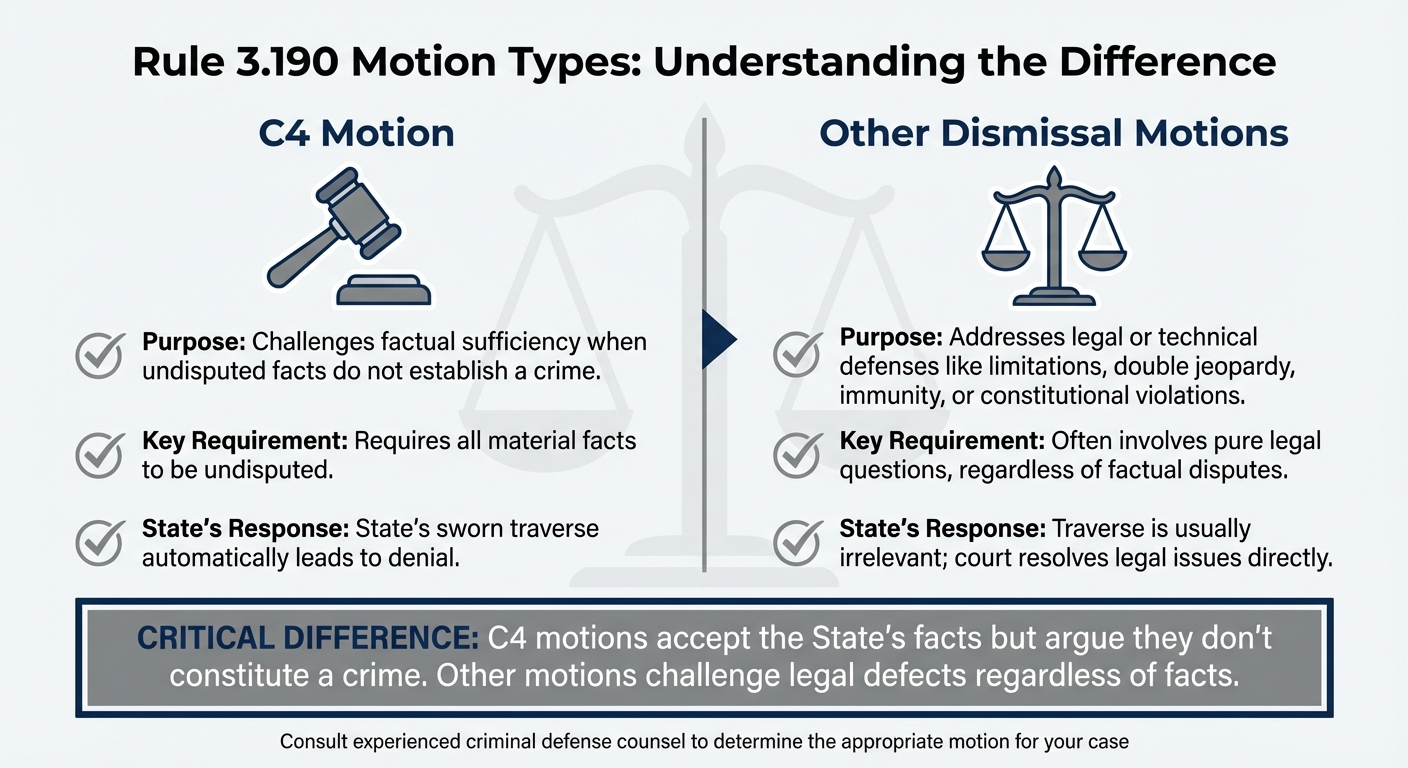
Rule 3.190 Motion Types: C4 vs Other Dismissal Grounds Comparison
1. Failing to Follow Procedural Requirements
When filing Rule 3.190 motions, every procedural rule must be followed to the letter. Florida courts are unwavering in their enforcement of these requirements, and appellate courts frequently overturn decisions when even a single step is missed. Simply put, if you don’t meet all procedural standards, your motion is destined to fail.
For starters, all pretrial motions must be both written and signed. If they aren’t, they’re automatically denied. Courts have been clear on this: trial judges must reject motions that fail to meet procedural standards without even considering the argument. Moreover, appellate courts won’t hesitate to reverse trial court decisions that ignore these rules.
The same strict standards apply to the state’s traverse. For example, in State v. Burnison (1975), the state filed its traverse after the deadline set by the trial court. The trial judge dismissed the case, ignoring the late filing. However, the appellate court reversed the decision, emphasizing that the trial court couldn’t disregard procedural deadlines. Similarly, in State v. Terrell (1977), the Third District Court of Appeal reversed a dismissal after finding that the trial court hadn’t adhered to the rule’s requirements. In this case, the state’s traverse raised disputes over material facts, which the trial court failed to address properly. These cases highlight the critical importance of following procedural rules to the letter.
To succeed, procedural accuracy is non-negotiable. This means adhering strictly to deadlines, formatting, and service requirements. Beyond avoiding immediate dismissals, flawless procedural compliance strengthens your legal position. If you’re unsure about any aspect of the process, consult Law Firm Ocala’s experienced criminal defense team. Their deep understanding of Florida’s legal system and local court practices can help ensure you maintain procedural integrity and support your overall defense strategy.
2. Using Vague or General Fact Statements
Factual precision is just as critical as meeting procedural requirements. One common misstep in Rule 3.190(c)(4) motions is relying on vague or overly general statements when describing undisputed facts. Florida courts require you to explicitly list the material undisputed facts that support your motion for dismissal. Simply claiming that the undisputed facts fail to establish a prima facie case is not enough and will likely lead to denial. This makes clear, detailed facts absolutely essential.
When facts are "ambiguous and susceptible to multiple meanings", trial courts have little choice but to deny the motion. For instance, using phrases like "minimal contact" or "resistance" without further explanation opens the door to misinterpretation. In one case highlighted by the Florida State University Law Review, an appellate court overturned a granted motion because the defendant failed to provide specific facts, instead vaguely asserting that the undisputed facts didn’t prove guilt.
Consider the difference between these two statements:
- Weak statement: "The defendant had minimal contact with the alleged victim and did nothing criminal."
- Strong statement: "On May 3, 2025, at approximately 2:00 p.m., in the parking lot of 123 Main Street, Ocala, Florida, the defendant stood approximately 20 feet from the complainant, did not approach her, did not touch her, did not speak to her, and made no gestures toward her."
The second example provides concrete, verifiable details that allow the court to assess the facts against the legal elements of the offense.
To strengthen your motion, draft numbered, specific statements of fact that include dates, times, locations, and detailed actions. Avoid using vague or conclusory language – stick to neutral, descriptive terms. Each fact should directly address an element of the charged offense, demonstrating why the facts, even if accepted as true, do not establish a prima facie case. Base your statements on evidence like police reports or recorded witness accounts, and make sure to reference these sources in your motion.
Using vague facts can lead to a traverse, where the prosecution introduces additional details to bolster their case. With appellate courts reversing 82% of granted 3.190(c)(4) motions upon review, precision isn’t just helpful – it’s essential. Whether in Ocala or elsewhere, Law Firm Ocala’s criminal defense attorneys can help ensure your fact statements meet Rule 3.190’s stringent requirements.
3. Relying on Conclusions Without Supporting Evidence
One common mistake in Rule 3.190(c)(4) motions is leaning on legal conclusions instead of backing them up with clear, detailed facts. It’s not enough to simply claim that the undisputed facts fail to establish a prima facie case. To be effective, a motion must lay out the specifics: who, what, when, where, and how, all supported by solid evidence.
For instance, a statement like "the defendant did not touch or threaten the victim" won’t cut it unless it’s accompanied by precise details about actions, locations, and times. Without this level of specificity, the motion essentially asks the court to accept a legal interpretation rather than evaluate concrete, undisputed facts in light of the charges. In State v. Terrell, the Third District Court of Appeal highlighted this issue, pointing to numerous reversals of orders granting (c)(4) motions where defense attorneys relied on vague conclusions instead of presenting carefully crafted factual narratives.
Many reversals happen because motions fail to meet the rule’s requirement of presenting specific, undisputed facts. Instead, they rely on broad or ambiguous statements that don’t hold up under scrutiny.
To avoid this pitfall, separate your facts from your legal arguments. Start with a numbered list of undisputed facts that clearly outlines the details – who was involved, what occurred, when and where it happened, and how it unfolded. Support these facts with evidence from police reports, depositions, or recorded statements. Save your legal conclusions for the argument section, where you can explain how the facts don’t meet the elements of the offense. This approach not only ensures compliance with Rule 3.190 but also strengthens your motion’s credibility, especially since it must be sworn to by someone with firsthand knowledge.
If your motion relies on broad claims, the prosecution can easily counter with a traverse, adding details that undermine your case. Florida defense attorneys know that precision and evidence-based arguments are essential to meeting the rule’s strict standards and avoiding appellate reversals.
4. Misunderstanding Rule 3.190(c)(4) Motion Purposes
A Rule 3.190(c)(4) motion serves one clear purpose: to dismiss charges when there are no disputed material facts and those facts fail to establish a prima facie case of guilt. In other words, even if the State’s version of events is accepted as true, the alleged conduct doesn’t meet the legal definition of the crime. This is very different from other dismissal motions, which might focus on technical issues like the statute of limitations, double jeopardy, or unconstitutional laws.
One common mistake attorneys make is using these motions to address factual disputes or question witness credibility. For example, if multiple witnesses contradict a police officer’s testimony and your case appears strong, a Rule 3.190(c)(4) motion is the wrong approach. Courts are not allowed to weigh evidence or decide which witnesses are more believable – that’s a jury’s job during trial. Filing such a motion in this situation is a dead end, as the prosecution can simply file a traverse, leading to an automatic denial. This distinction is key to understanding when this motion is appropriate and when it’s not.
A proper application of this motion occurs in cases where the facts are undisputed, but the legal interpretation is in question. Take, for instance, a charge of Exposure of Sexual Organs under Section 800.03. If the undisputed facts show public nudity but lack the required lascivious intent, the conduct doesn’t meet the crime’s legal definition. Here, the motion is appropriate because the issue is strictly legal, not factual.
On the flip side, an improper use arises when there’s a factual disagreement. For example, if the defendant claims they never touched the victim, but the State asserts otherwise, this is a factual dispute that must be resolved by a jury. Filing a Rule 3.190(c)(4) motion in such a case will fail because the prosecution can counter it with a traverse, resulting in immediate denial.
To streamline your defense strategy, reserve Rule 3.190(c)(4) motions for situations where the facts are not in dispute, but the conduct doesn’t legally amount to the charged crime. For all other issues – factual disagreements, witness credibility, or procedural technicalities – turn to other motions or trial strategies.
5. Filing or Responding to a Traverse Incorrectly
When the State decides to challenge the facts in your Rule 3.190(c)(4) motion, it must submit a traverse – a sworn, written response that either denies key facts or introduces new ones to establish a prima facie case. Mistakes in preparing or responding to a traverse can significantly impact the motion’s outcome for both prosecutors and defense attorneys.
For prosecutors, the traverse must meet specific requirements: it must be sworn, filed on time, and directly address each material fact with clear denials. A common error is submitting a document labeled "traverse" that contains only legal arguments without addressing factual disputes. For instance, a statement like, "The State denies that the defendant committed no crime and demands trial", is inadequate because it fails to contest any specific fact in the motion. According to Rule 3.190(d), if the State submits such an insufficient traverse, the court is required to treat the motion’s factual allegations as admitted.
On the defense side, there’s a common misconception that any document titled "traverse" automatically defeats their motion. This isn’t the case. If the State’s traverse only challenges the legal interpretation of the facts rather than the facts themselves, it doesn’t create a factual dispute. For example, if your motion states, "the defendant lightly touched the complainant’s shoulder", and the traverse responds, "this conduct still constitutes battery", the State is accepting your facts but disputing their legal significance. Defense counsel should identify and challenge such responses as inadequate and push for a ruling based on the undisputed facts. Missteps in addressing these issues can lead to further complications, particularly with filing deadlines.
Timing is another frequent source of problems. While Florida courts interpret "reasonable time" with some flexibility, prosecutors who file traverses just minutes before a hearing risk having them struck if the defense can show prejudice. On the other hand, courts may accept slightly late filings if a continuance can address any harm caused. Defense attorneys should be ready to move to strike truly late submissions and document any timing violations. However, not every late filing will automatically be rejected, so assumptions in this regard can backfire.
If the State files a legally sufficient traverse that denies material facts under oath, the trial court is required to deny the Rule 3.190(c)(4) motion. At that point, any factual disputes must be resolved at trial, not during the motion process. This highlights the importance of precision in drafting motions for the defense – ensuring the State cannot credibly dispute the facts – and the need for prosecutors to avoid relying on generic denials. Accuracy and attention to detail in every procedural step are critical for both sides.
sbb-itb-bb7ced0
6. Confusing Rule 3.190(c)(4) with Other Dismissal Motions
A Rule 3.190(c)(4) motion – commonly referred to as a "C4 motion" – is not a one-size-fits-all tool for dismissing charges. Its purpose is specific: it applies only when all material facts are undisputed, and even if those facts are accepted as true, they fail to establish a crime or a prima facie case. This motion is not intended for challenges like questioning witness credibility, raising statute of limitations defenses, arguing double jeopardy, or addressing constitutional issues. Those matters fall under other subsections of Rule 3.190, such as 3.190(b) or 3.190(c)(1)–(3) and (5)–(7).
Combining unrelated dismissal arguments in a C4 motion can lead to procedural complications. For instance, if you file a C4 motion but include claims that witnesses are lying or evidence should be suppressed, you introduce factual disputes. In such cases, the State can file a sworn traverse disputing those facts, and under Rule 3.190(d), the court must deny your motion. The Third District Court of Appeal, in State v. Terrell, highlighted frequent reversals of improperly granted C4 motions, emphasizing their narrow applicability.
The key takeaway is that each dismissal motion under Rule 3.190 serves a distinct purpose, with specific procedural rules. For example, a statute of limitations defense focuses solely on timing and does not rely on undisputed facts. Similarly, a double jeopardy claim examines whether the defendant was previously prosecuted for the same offense, independent of the current facts. Mislabeling these legal defenses as C4 motions can weaken your case, giving prosecutors an easier path to dismiss the motion through a traverse rather than addressing the actual legal issues.
Here’s a quick comparison to clarify the roles of C4 motions versus other dismissal motions:
| Rule 3.190(c)(4) Motion | Other Rule 3.190 Dismissal Grounds |
|---|---|
| Challenges factual sufficiency when undisputed facts do not establish a crime | Addresses legal or technical defenses like limitations, double jeopardy, immunity, or constitutional violations |
| Requires all material facts to be undisputed | Often involves pure legal questions, regardless of factual disputes |
| State’s sworn traverse automatically leads to denial | Traverse is usually irrelevant; court resolves legal issues directly |
Before filing any dismissal motion, it’s critical to understand these distinctions. If you’re using a C4 motion, ensure you accept the State’s facts and argue that those facts fail to establish a crime. For claims involving legal defects, time limitations, or constitutional violations, a different subsection of Rule 3.190 is the proper avenue. Filing the correct motion from the outset can save time, resources, and frustration. For guidance tailored to your case, consult experienced criminal defense attorneys at Law Firm Ocala to navigate the procedural requirements effectively.
7. Writing Unclear or Ambiguous Fact Statements
When drafting fact statements for a motion, being vague or ambiguous can seriously undermine your case before it even reaches legal review. The rule requires you to "specifically allege and list the material, undisputed facts" that support dismissal. If your statements lack precision, the prosecution can take advantage of this by filing a traverse that disputes your facts. This automatically forces the court to deny your motion under Rule 3.190(d).
Ambiguous language opens the door for the State to argue that the facts are not truly undisputed. For instance, a statement like "the defendant did not touch or make any threatening gestures" without providing clear context can be easily misinterpreted. Florida appellate courts have overturned motions when fact statements were unclear, overly general, or failed to pinpoint which facts were undisputed.
To avoid these issues, focus on precision. Write your facts in concise, numbered statements that clearly outline who did what, when, where, and how. Keep conclusions separate from raw facts. Instead of making broad assertions, detail the specific actions and circumstances that, even if accepted as true, fail to meet an element of the offense. Avoid using uncertain terms like "probably", "apparently", or "it seems", as these suggest doubt and give the State room to argue that factual disputes exist.
Using clear and precise language reduces the likelihood of the prosecution filing a successful traverse. Under Rule 3.190(d), factual matters in your motion are considered admitted unless the State specifically denies them in a sworn traverse. Vague statements make it easy for the State to craft a traverse that "specifically denies" material facts, which leads to an automatic denial of your motion. By ensuring your fact statements are concrete, well-supported by the record, and free of contradictions, you make it harder for prosecutors to create artificial disputes and sidestep the legal issue. Always review your motion carefully to confirm that every fact is clear, specific, and backed by evidence.
8. Failing to Understand Demurrer vs. Traverse
One of the common pitfalls in Rule 3.190 practice is mixing up a demurrer with a traverse. These are two distinct tools the State can use to counter a motion, and each serves a unique purpose with specific consequences. A traverse disputes the factual claims in a motion and, when filed properly, leads to an automatic denial. On the other hand, a demurrer accepts the facts as true but argues that those facts still legally justify the charge.
Confusion often arises when the wrong response is used or its purpose is misunderstood. For instance, if the State questions whether you actually made physical contact with the alleged victim, this is a factual dispute that requires a sworn traverse. However, if the State concedes there was no physical contact but argues your actions still meet the legal definition of assault, that’s a legal argument suited for a demurrer. Misusing these responses can lead to procedural errors and even reversals on appeal.
| Feature | Traverse | Demurrer |
|---|---|---|
| Purpose | Challenges the facts alleged in the motion | Accepts facts but disputes their legal implications |
| Form | Must be sworn and filed in a timely manner | Focuses solely on legal arguments, not new facts |
| Effect | If sufficient, motion is automatically denied | Court determines legal sufficiency – no automatic denial |
| When to Use | When evidence contradicts "undisputed" facts | When facts are accurate but still constitute the offense |
Understanding these distinctions is critical. A valid traverse needs to be sworn and must directly deny material facts, not merely challenge legal interpretations. If the State’s response only disputes your legal conclusions without addressing the facts, it’s a demurrer. Recognizing this distinction helps predict how the court will likely proceed.
To prepare an effective Rule 3.190 motion, ensure every factual claim is backed by evidence, affidavits, or discovery references. This minimizes room for factual disputes. For the State, the key is to file a sworn traverse for factual conflicts and a demurrer for purely legal issues. Blurring these lines risks procedural mistakes and potential appellate reversals.
When to Seek Legal Guidance
Understanding when to seek legal guidance is crucial, especially after considering the common pitfalls in Rule 3.190 motions. These motions require a high level of technical accuracy, and even minor errors can lead to serious consequences. In fact, 82% of appellate decisions have overturned Rule 3.190(c)(4) motions, highlighting the importance of precise legal handling. Experienced legal counsel becomes essential – not only to determine if a motion is viable but also to avoid procedural missteps that could weaken your defense.
If you’ve been arrested or charged, consulting a criminal defense attorney immediately is critical. An attorney can identify potential dismissal grounds before your arraignment, such as issues with the statute of limitations, double jeopardy, or flaws in the charging document. They’ll also review discovery materials to pinpoint undisputed facts that could support a Rule 3.190(c)(4) motion. Beyond that, they can evaluate whether filing such a motion strengthens your case or risks revealing your defense strategy too early. Early legal intervention not only reduces drafting errors but also sets a strong foundation for your case – something that past mistakes have shown to be invaluable.
Defendants representing themselves often fall into traps that experienced attorneys can help avoid. Common errors include filing a (c)(4) motion when material facts are clearly disputed, relying on vague or conclusory language instead of specific facts, or mistaking legal defenses for factual disputes. This is where skilled legal counsel makes all the difference. For example, Law Firm Ocala stands out by crafting motions that align perfectly with Rule 3.190’s stringent requirements while anticipating potential responses from the prosecution, such as traverses or demurrers.
"Our attorneys at LAW FIRM OCALA have the expertise to help you understand your charges, gather necessary evidence, and protect your rights in court."
Law Firm Ocala focuses on criminal defense and integrates pretrial motions into a thorough defense strategy. Their team conducts in-depth investigations, analyzes relevant Florida appellate rulings, and drafts motions with the precision courts demand. Whether you’re dealing with charges related to DUI, drug offenses, theft, or domestic violence, their attorneys ensure your Rule 3.190 motion is grounded in solid, undisputed facts, safeguarding your rights every step of the way.
Conclusion
Rule 3.190 motions demand strict attention to detail and an unwavering commitment to procedure. Even the most compelling legal arguments can falter if the formal rules aren’t followed. Florida appellate courts have emphasized this, reversing trial court decisions in 82% of reviewed Rule 3.190(c)(4) cases – often due to avoidable technical errors. From ensuring proper oaths to meeting deadlines and service requirements, every aspect must be executed flawlessly, as courts show little leniency for procedural missteps.
Equally important is presenting the facts with absolute clarity. A motion under Rule 3.190(c)(4) must outline each material, undisputed fact in straightforward, specific terms. Avoid vague statements or mere legal conclusions. This type of motion is only suitable when both parties agree on the facts, and those facts, even when accepted as true, fail to establish guilt under the law. If there’s any disagreement on the facts, it opens the door for a traverse. It’s also critical to use the correct subsection of Rule 3.190, as each serves a distinct purpose. For instance, while a (c)(4) motion addresses pure legal questions based on undisputed facts, other subsections cover issues like double jeopardy, charging document defects, or the statute of limitations. Misusing these motions can jeopardize your defense.
Given the complexity of these motions, having experienced legal support is essential. A knowledgeable attorney can evaluate whether filing a Rule 3.190 motion strengthens your case or unintentionally reveals your defense strategy. They’ll ensure your motion adheres to the rule’s strict requirements, anticipate the prosecution’s counterarguments, and safeguard your constitutional rights throughout the process. Engaging professional legal counsel early can make the difference between a dismissal and a trial.
For personalized guidance through these intricate legal procedures, reach out to the experienced attorneys at Law Firm Ocala.
FAQs
What are the most frequent mistakes made when filing Rule 3.190 motions?
When submitting Rule 3.190 motions, certain mistakes tend to crop up frequently. These can seriously impact the motion’s success, so it’s essential to know what to watch out for:
- Missing deadlines: Filing outside the required timeframe can cause the motion to be dismissed or denied outright. Timing is everything here.
- Improper service: Failing to correctly serve the motion to all necessary parties can create procedural headaches that are entirely avoidable.
- Incomplete documentation: Forgetting to include required forms or supporting evidence weakens your case and may lead to rejection.
- Weak legal or factual basis: If the motion doesn’t clearly present its legal arguments or factual grounds, it’s unlikely to hold up.
To steer clear of these pitfalls, make sure you meet all deadlines, follow proper service procedures, and double-check every document for accuracy and completeness. And if you’re unsure about any step, reaching out to an experienced attorney – like the team at Law Firm Ocala – can make all the difference in ensuring your motion is handled properly.
Why is it important to avoid vague factual statements in a Rule 3.190(c)(4) motion?
Using vague or unclear factual statements in a Rule 3.190(c)(4) motion can seriously weaken your argument. These motions hinge on presenting clear and specific facts to show there’s no material dispute that requires a trial. If your statements are too general or lack critical details, the court may find them insufficient, which could lead to your motion being denied.
To strengthen your motion, focus on including precise and well-supported facts that directly address the legal elements of the charges you’re facing. If you’re unsure how to structure or draft a compelling motion, seeking advice from an experienced attorney can make a significant difference. Law Firm Ocala specializes in criminal defense and offers the expertise needed to help you protect your rights and navigate the process effectively.
When should you file a Rule 3.190(c)(4) motion instead of other types of dismissal motions?
A Rule 3.190(c)(4) motion is used when there are no significant facts in dispute, and the agreed-upon facts don’t support a basic case of guilt. In other words, this motion argues that even if the prosecution’s version of events is entirely accurate, it still doesn’t provide enough legal grounds for the charges.
To make your motion persuasive, you need to clearly present the facts that everyone agrees on and demonstrate why those facts don’t justify the charges. Many errors happen when defendants or attorneys miss important details or fail to clearly explain the legal weaknesses in the case. If you’re uncertain about how to proceed, seeking guidance from seasoned legal professionals, such as those at Law Firm Ocala, can help you navigate the process effectively and avoid missteps.