
When a restraining order (called an "injunction for protection" in Florida) is filed, it can immediately affect child custody arrangements. Judges may grant one parent full custody temporarily, often without the other parent being heard first. These orders prioritize child safety and can include supervised visitation, no-contact rules, and restrictions on decision-making rights for the restrained parent. Violating these orders carries serious penalties, including jail time and loss of parental rights. Navigating this process requires strict compliance and often legal guidance to protect your parental role.
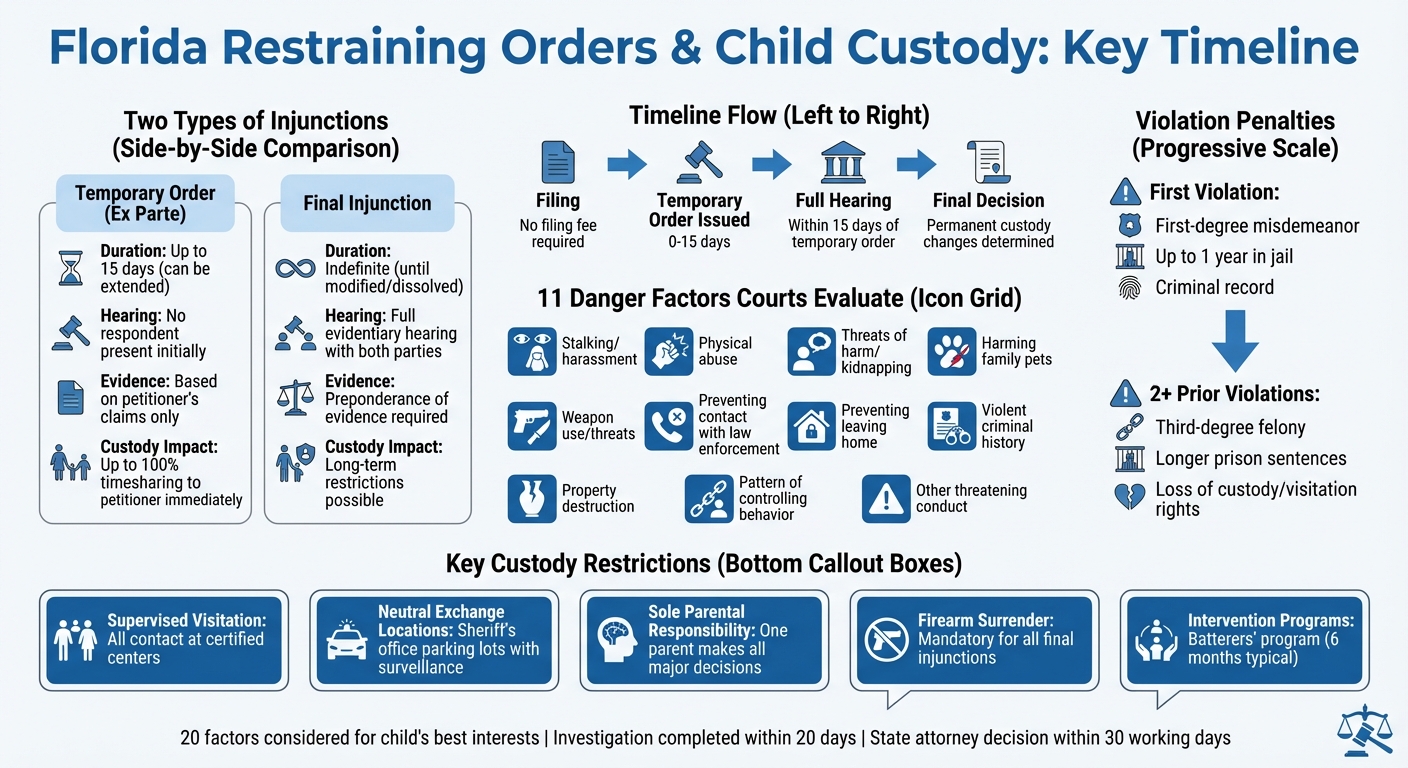
Florida Restraining Order Process and Custody Impact Timeline
What Is a Restraining Order in Florida?
In Florida, what people often refer to as a "restraining order" is officially called an injunction for protection. This is a civil court order issued by a judge that requires one person (the respondent) to avoid contact with and stay away from another person (the petitioner). Its main goal is to provide immediate safety for victims of domestic violence or those who have a reasonable belief that they are at immediate risk of harm. These legal distinctions play a crucial role in shaping custody decisions.
Injunctions come with strict no-contact rules, prohibiting communication through phone calls, emails, texts, or letters. They also establish stay-away zones around homes, workplaces, vehicles, or schools. Filing for an injunction is straightforward under Florida law – there’s no filing fee, and court clerks cannot require a bond to process the petition.
Violating an injunction carries serious consequences. Under Florida law, breaking the terms of a final injunction is considered a first-degree misdemeanor, punishable by up to one year in jail. If the violation involves stalking, the charge may escalate to aggravated stalking, which is a third-degree felony. Injunctions may also include temporary child custody orders, require supervised visitation, and mandate that the respondent surrender any firearms or ammunition. To better understand these protections, let’s look at the differences between temporary and final orders.
Temporary vs. Final Restraining Orders
Florida law recognizes two types of injunctions, each with distinct procedures and durations.
- Temporary orders (ex parte): These provide immediate protection based solely on the petitioner’s claims and typically last up to 15 days, though they can be extended if necessary.
- Final injunctions: These require a full hearing where both sides can present evidence, call witnesses, and testify. At this hearing, the petitioner must prove their case by a "preponderance of the evidence", meaning it’s more likely than not that domestic violence occurred or is likely to occur. Once issued, final injunctions remain in effect until a judge modifies or dissolves them. They also include mandatory restrictions on the respondent’s possession of firearms or ammunition.
Legal Grounds for a Domestic Violence Injunction
To issue an injunction, Florida courts require solid evidence of domestic violence or credible threats. According to Florida Statute 741.30, a person can request an injunction if they are a victim of domestic violence or have reasonable cause to believe they are in immediate danger.
Judges take several factors into account when determining whether someone is at immediate risk. These include a history of threats, stalking, or harmful behavior involving family or household members. The law defines family or household members as spouses, ex-spouses, individuals related by blood or marriage, people who currently or previously lived together, or those who share a child.
Florida offers several types of protective injunctions beyond domestic violence, including those for sexual violence, dating violence, repeat violence, and stalking. Domestic violence injunctions are most commonly used in custody cases because they focus on family relationships and can include provisions related to children. These legal tools play a significant role in how courts handle child custody in domestic violence cases.
If you’re wondering how a restraining order might affect your custody or visitation rights, it’s a good idea to consult an experienced attorney at Law Firm Ocala.
How Restraining Orders Affect Child Custody Decisions
When a restraining order is issued in Florida, the courts place the child’s safety above all else. According to Florida Statute §61.13, updated by HB301 in 2023, judges generally start with the assumption that a 50/50 timesharing arrangement is beneficial. However, this presumption changes if evidence of domestic violence shows that such an arrangement could harm the child. Judges must consider 20 specific factors to determine what serves the child’s best interests, with the top priority being protection from abuse or neglect. While a restraining order doesn’t automatically revoke a parent’s custody rights, it creates a legal record that courts take into account when deciding where the child should live and how much time they should spend with each parent. The court then carefully evaluates any evidence of domestic violence to decide whether custody arrangements need to be adjusted.
How Courts Evaluate Domestic Violence Evidence
Under Florida Statute §741.30(b), judges look at 11 specific factors to assess whether a parent or child is in immediate danger. These factors include behaviors such as stalking, harassment, physical abuse, threats of harm or kidnapping, harming family pets, using or threatening to use weapons, preventing someone from leaving the home or contacting law enforcement, a history of violent criminal activity, and destruction of personal property.
Judges focus on patterns of harmful behavior when deciding custody changes. If immediate danger is found, the court can issue a temporary injunction that grants the petitioner up to 100% of timesharing immediately. This effectively removes the other parent from the child’s daily life until a full hearing takes place.
The impact goes beyond physical custody. Courts often require supervised visitation when there’s a risk of harm, meaning all parent-child interactions must take place at certified supervised visitation centers. Additionally, judges may mandate that child handoffs occur at neutral, secure locations – such as sheriff’s office parking lots with video surveillance – to prevent direct contact between the parents. These measures significantly influence parenting plans and decision-making authority.
Effects on Parenting Plans and Decision-Making Rights
Restraining orders can dramatically change how parents interact and share responsibilities. For instance, they can make shared parental responsibility – where both parents jointly make decisions about the child’s health, education, and welfare – impractical or unsafe.
When shared responsibility poses a risk to the child, the court may grant sole parental responsibility to one parent. This gives that parent full authority to make major decisions about the child’s life, including schooling, medical care, and religious upbringing, without needing input from the restrained parent. The parent subject to the restraining order may lose both physical custody time and the ability to participate in these important decisions.
In some cases, final injunctions may also require the restrained parent to complete intervention programs or surrender firearms. These requirements not only limit their rights further but also add financial and logistical challenges to their situation.
Custody Changes That Result from Restraining Orders
Restraining orders can immediately change how parents share time with their children, depending on whether the order is temporary or final. These measures aim to prioritize the safety and well-being of the child.
Temporary Custody Adjustments During an Active Restraining Order
When a judge issues a temporary ex parte injunction, custody arrangements can change on the spot. In some cases, the petitioner may receive up to 100% of time-sharing before the respondent even has an opportunity to present their side. This often means the restrained parent may lose all contact with their child during this period.
Temporary orders are short-term solutions. During this time, the court may require that any contact between the restrained parent and the child occurs through a supervised visitation program. The petitioner may also be granted temporary, exclusive use of the shared home, which can result in the respondent being removed from the residence where the children live. Additionally, all child exchanges are often mandated to happen at neutral, secure locations – such as a sheriff’s office parking lot equipped with video surveillance – to avoid direct interaction between the parents. Judges can also include temporary child or spousal support in these orders to ensure the children’s needs are met while the restraining order is active.
These temporary adjustments can become permanent if the court determines, after reviewing all evidence, that long-term measures are necessary.
Permanent Custody Changes Based on Domestic Violence Findings
When a restraining order becomes final, more lasting custody decisions are made based on thorough evaluations of domestic violence allegations. After a full evidentiary hearing, a judge may impose long-term restrictions on parenting time, which can last for a specific duration or, in some cases, indefinitely. The court examines the respondent’s history, including prior criminal records, past restraining orders, and any documented controlling behaviors, such as interfering with the other parent’s access to the children.
If the evidence of domestic violence is compelling, the court may grant one parent full custody. The restrained parent might also be required to complete and pay for a batterers’ intervention program before being allowed any contact with the child. Additionally, all final injunctions in Florida include a provision that prohibits the respondent from owning or possessing firearms or ammunition, adding further limitations to their parental rights.
A notable example is the 2014 case of Kunkel v. Stanford, where the Florida Fourth District Court of Appeals overturned a domestic violence injunction. The injunction had been issued after a grandfather was accused of being "verbally abusive" and causing a grandchild to become "hysterically" upset. The appellate court ruled that verbal abuse and emotional distress alone did not meet the legal standard for domestic violence or the "imminent danger" required under Florida law. This case highlights the importance of basing permanent custody restrictions on evidence of actual or imminent physical violence, rather than on general emotional concerns.
sbb-itb-bb7ced0
Penalties for Violating Custody Terms in a Restraining Order
In Florida, violating a restraining order – especially provisions related to custody or visitation – comes with serious legal consequences. A willful violation is typically classified as a first-degree misdemeanor, which can lead to jail time, fines, and a criminal record. If law enforcement witnesses or verifies the violation, they can make an immediate arrest.
The stakes get even higher for repeat offenses. If someone already has two or more prior convictions for violating an injunction involving the same victim, any further violation is upgraded to a third-degree felony. This can result in longer prison sentences, steeper fines, and a permanent criminal record, which can have lasting effects on employment, housing opportunities, and future custody arrangements.
In addition to criminal charges, violators may face contempt of court proceedings, which can also lead to jail time. Courts often require attendance in a batterers’ intervention program, typically lasting six months. Financial penalties are another layer of consequence. The court may order the violator to pay economic damages to the petitioner, covering any injuries, losses, enforcement costs, or attorney’s fees. If an arrest isn’t made at the scene, the petitioner can file an affidavit, prompting a state attorney investigation. Law enforcement must complete this investigation within 20 days, and the state attorney has 30 working days to decide on charges.
These violations don’t just bring legal and financial consequences – they can also severely impact parental rights. Courts see violations as evidence of a parent’s inability to follow court orders, which can weigh heavily in custody decisions. Even if the other parent suggests ignoring certain terms of the order, the restrained parent is fully responsible for compliance. Ignoring these terms can lead to the complete loss of custody or visitation rights, making adherence to the order absolutely critical.
How to Protect Your Parental Rights After a Restraining Order
Once a restraining order is in place, protecting your parental rights involves careful adherence to the court’s terms and proactive steps to demonstrate responsibility.
Start by fully complying with the restraining order. This means avoiding any direct or indirect contact with the petitioner and steering clear of restricted locations, such as their home, workplace, or your child’s school. If the court has mandated temporary child or spousal support, ensure payments are made on time without fail. Consistent compliance not only shows respect for the court’s authority but also supports your standing in custody-related matters.
Taking it a step further, actively work on rehabilitation efforts if required. For instance, if the court has ordered you to attend a batterers’ intervention program or counseling sessions, complete them promptly and keep detailed records of your participation. Always have a certified copy of the injunction handy in case you need to verify your compliance.
If time-sharing with your child is still permitted, use neutral and safe locations for exchanges to avoid conflicts. If any part of the order seems unclear, don’t hesitate to file a motion for clarification to prevent accidental violations.
Preparing for Final Hearings and Custody Evaluations
The final hearing, typically held within 15 days of a temporary injunction, is your chance to present your case and protect your parental rights. Missing this hearing can result in a default judgment, which might include permanent changes to custody or visitation. If an emergency prevents you from attending, contact the court clerk immediately to request a continuance, though these are rarely granted without a valid reason.
To strengthen your case, work with an attorney to gather evidence that highlights your role as a responsible parent. This could include witness testimony, records of your involvement in your child’s life, and proof of completing any court-ordered programs. During the hearing, both parties will present evidence and testify. Judges will consider factors such as past threats, use of weapons, or other harmful behaviors when deciding custody arrangements.
"Sole parental responsibility will be given to one parent if the judge decides that shared parental responsibility would be harmful (‘detrimental’) to the child." – WomensLaw.org
Being prepared and presenting a strong case can significantly influence the court’s decisions regarding custody and visitation.
Requesting Changes to a Restraining Order or Custody Agreement
If circumstances change, you may have the option to request modifications to the restraining order or custody agreement. This process begins by filing a formal motion with the circuit court. Once a hearing is scheduled, both sides will have the opportunity to present evidence supporting their case.
For respondents, demonstrating compliance with court-ordered programs is crucial. Keep records such as attendance certificates or progress reports from counseling or anger management classes. If your living situation has improved or other significant changes have occurred, document these as well. Certified copies of the original injunction and any updates should always be on hand to ensure law enforcement has the latest court orders.
Conclusion
Restraining orders in Florida can have a major impact on custody arrangements and bring serious legal consequences. A temporary injunction typically lasts for 15 days until a full hearing is held, while a final injunction can remain in place indefinitely. These details highlight just how complex and far-reaching the effects of restraining orders can be on custody matters, a topic explored throughout this article.
Violating an injunction comes with severe repercussions, including immediate arrest and potential loss of parental rights. Florida’s injunction process is governed by strict legal standards, tight deadlines, and procedural rules that leave little room for mistakes. Since public defenders aren’t available for these civil cases, hiring private legal counsel is often essential to effectively navigate the Florida Family Law Rules of Procedure.
"Quality legal representation will often be critical to the outcome whether you are requesting or opposing the injunction." – Conti Moore Law Divorce Lawyers, PLLC
Given the high stakes, having experienced legal representation is crucial. The right attorney can make all the difference in protecting your custody rights. If you’re dealing with a restraining order that could affect your relationship with your child, Law Firm Ocala offers skilled guidance to safeguard your rights. With a free initial consultation, you’ll have the chance to discuss your case and develop a plan to protect your parental role. Understanding and navigating Florida’s legal processes around restraining orders is vital, as these situations demand careful attention to both child safety and parental rights.
FAQs
Can a restraining order change my child custody arrangement in Florida?
If you’re dealing with a restraining order in Florida, it can directly affect your current child custody arrangement. When a restraining order – formally called an injunction for protection – is issued, the court might grant temporary custody of the child to the petitioner or place restrictions on the respondent’s visitation rights. These steps are taken to prioritize the child’s safety.
The court’s main focus is the child’s well-being. Depending on the details of the case, the custody agreement might be adjusted to limit or require supervision for the respondent’s interactions with the child. If this situation applies to you, reaching out to a family law attorney is crucial. They can guide you through your rights and help you explore your legal options.
How can I protect my parental rights if a restraining order affects child custody in Florida?
If a restraining order is issued in Florida, it might temporarily restrict your ability to see or have custody of your children. To safeguard your parental rights, start by thoroughly reviewing the order to understand the specific limitations. If you feel the order unfairly affects your rights, you have the option to file a motion to modify or challenge it in court. Be sure to attend all scheduled hearings and present evidence – such as school records or character references – that supports your ability to provide a safe and stable environment for your child.
It’s also essential to document your compliance with the order and report any violations by the other party. Consulting with an experienced family law attorney, like the team at Law Firm Ocala, can guide you through the legal process. They can help you advocate for your rights while ensuring your child’s safety and well-being remain the focus.
What do I need to modify a restraining order or child custody agreement in Florida?
To adjust a child custody agreement in Florida, you need to show there’s been a major and unforeseen change in circumstances. This could involve presenting evidence like medical records, school performance reports, financial statements, or testimony from witnesses to back up your case. The court’s main focus will always be what’s in the child’s best interests when considering these changes.
When it comes to restraining orders, you can request a modification at any time by filing a motion with the court. Unlike custody agreements, you’re not required to prove specific allegations to seek a change. However, the court will carefully review the situation to decide if the modification is warranted.