
Facing burglary charges in Florida? Here’s what you need to know:
Burglary is defined under Florida Statute § 810.02 as entering or staying in a property (home, building, or vehicle) with the intent to commit a crime. It’s a felony, with penalties ranging from fines to life imprisonment, depending on the severity.
The legal process involves several stages:
- Arrest and Booking: Law enforcement needs probable cause, such as evidence or witness testimony, to make an arrest. Booking includes fingerprinting and holding until a first hearing.
- First Appearance: Within 24 hours, a judge reviews probable cause, sets bail, and informs you of your rights.
- Formal Charges and Arraignment: The State Attorney decides whether to proceed. At arraignment, you enter a plea (guilty, not guilty, or no contest).
- Pre-Trial Proceedings: Your attorney reviews evidence, files motions, and negotiates plea deals. Programs like Pretrial Intervention (PTI) may be available for first-time offenders.
- Trial: If unresolved, the case goes to trial where the prosecution must prove guilt beyond a reasonable doubt.
- Sentencing: Penalties depend on the degree of burglary. First-degree charges can result in life imprisonment.
- Appeals: If convicted, you can appeal based on legal errors or insufficient evidence.
Key takeaway: Burglary charges are serious, but you have rights and options. A defense attorney can challenge evidence, negotiate outcomes, and guide you through the process.
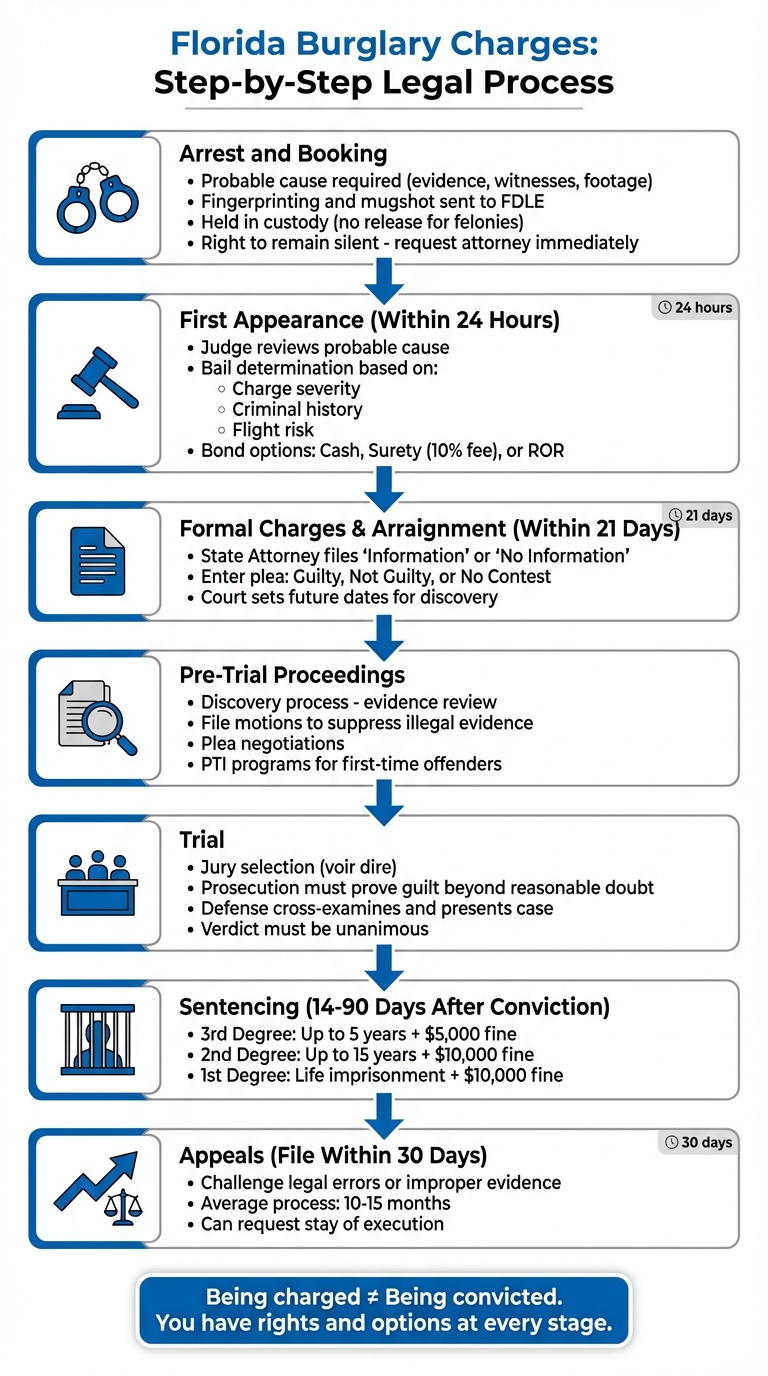
Florida Burglary Charges: 7-Step Legal Process from Arrest to Appeal
Step 1: Arrest and Booking
An arrest typically happens when law enforcement has probable cause – evidence suggesting you entered a structure or vehicle with the intent to commit a crime. This evidence could include security footage, fingerprints at the scene, or witness statements placing you at the location. The standard for probable cause is that a reasonable person would believe a crime occurred based on the facts. After the arrest, you’ll be taken to the county jail to start the booking process.
Requirements for Arrest in Burglary Cases
To justify an arrest in burglary cases, officers depend on solid evidence like eyewitness testimonies, surveillance videos, or physical proof tying you to the alleged crime.
"Arrests for burglary in Florida generally follow reasonable suspicion that an individual illegally entered a building with intent to commit an offense therein." – Musca Law, P.A.
At this point, it’s crucial to exercise your right to remain silent. Anything you say can be used against you in court. Politely request an attorney before answering any questions. This doesn’t imply guilt – it’s about safeguarding your constitutional rights during a critical stage of the legal process.
Once probable cause is confirmed and evidence is gathered, the process quickly moves to booking.
Booking Procedures and Initial Holding
Upon arrival at the police station, the booking process officially begins. This step formally enters you into the criminal justice system. Officers will take your fingerprints and mugshot, which are then sent to the Florida Department of Law Enforcement (FDLE) to check for any outstanding warrants. Your personal belongings will be inventoried and held securely until you’re released or transferred.
"A police officer will take your fingerprints and mugshot during the booking process and these will be sent to the Florida Department of Law Enforcement to determine whether there are any outstanding warrants in the Florida system." – Hanlon Law
Since burglary is always classified as a felony in Florida, you won’t be released with just a notice to appear. Instead, you’ll remain in a holding cell until your first appearance hearing, which must occur within 24 hours of your arrest. If the arrest happened during a riot or a declared state of emergency, Florida law requires you to appear before a magistrate before any release is considered. Be mindful of phone conversations while in custody – these calls are recorded, and anything you say can be used as evidence by prosecutors.
After booking, the next step is your first appearance, where decisions about bail and bond will be made.
Step 2: First Appearance and Bail Hearing
After being booked, the next key step is your first appearance hearing. Under Florida law, this must happen within 24 hours of your arrest. During this hearing, a judge will officially inform you of the burglary charges, outline your legal rights, and determine if law enforcement had enough probable cause for the arrest.
"This is your initial court appearance, which must occur within 24 hours of the arrest, as stipulated by Florida law." – Jeffrey Higgins, Attorney, Ocala Defense
The main focus of this hearing? Bail determination. The judge will decide if you can be released before trial and what conditions might apply, taking several factors into account.
Setting Bail and Bond Options
When determining bail, the judge evaluates the seriousness of the burglary charge, your criminal record, and whether you might flee or pose a danger to the community. For example, if the charge involves burglary of a residence, the bail amount is often higher. Factors like stable employment or strong family ties can work in your favor.
If bail is granted, there are a few ways to secure your release:
- Cash bond: You pay the full bail amount upfront to the court, which is refundable if you attend all required hearings.
- Surety bond: You work with a bail bondsman, typically paying a non-refundable 10% fee.
- Release on recognizance (ROR): In rare cases, especially with serious charges, the judge might allow release based solely on your written promise to appear in court.
"The Judge decides whether the defendant can be released and if so, what conditions are necessary to protect you and the witnesses and the public." – Office of the State Attorney, Fifth Judicial Circuit
Having a defense attorney at this hearing is critical. Your attorney can argue for a lower bail amount or request another hearing if the bail is set too high or denied. It’s also worth noting that victims have the right to attend this hearing and may provide input that influences the judge’s decision.
Timeline for First Appearance
The 24-hour rule ensures you won’t face extended detention without judicial review. For instance, if you’re arrested late on a Friday, you’ll appear before a judge by Saturday evening. If you can’t post bond right away, you’ll remain in county jail until bail is arranged or your case moves to the next phase.
This hearing is not just about bail – it’s the official starting point for your legal journey, setting the tone for everything that follows. Having legal representation early on can make a significant difference in how your case unfolds.
Step 3: Formal Charges and Arraignment
Once your first court appearance is behind you, the State Attorney’s Office steps in to decide the next move – whether to prosecute or drop the charges against you.
Filing of Charges by the State Attorney
The State Attorney’s Office carefully examines the arrest report, evidence gathered by law enforcement, and sometimes even interviews witnesses to determine if there’s enough proof to pursue the case. From there, they have a few options: stick with the original charges, file different ones, or dismiss the case entirely.
"The review of the case will determine if there is sufficient evidence to pursue criminal prosecution, and if so, the attorney will file the formal charging document, called an ‘Information’ with the court." – Office of The State Attorney, Twelfth Judicial Circuit, Florida
If they decide to move forward, the State Attorney files a formal charging document, known as an "Information", within 21 days of your arrest. For more serious cases, they might involve a grand jury to seek an indictment instead. On the flip side, if the evidence doesn’t hold up, they’ll file a "No Information Notice", effectively dropping the charges and releasing you from further legal action. It’s worth noting that the charges filed by the State Attorney can sometimes be more severe than those listed at the time of your arrest. This step serves as the transition from the arrest phase to your official court proceedings.
Arraignment and Entering a Plea
After the State Attorney files charges, the next step is your arraignment. This typically happens within two weeks of their charging decision and sets the stage for what’s to come in your case.
During the arraignment, you’ll need to enter one of three pleas: guilty, not guilty, or no contest (nolo contendere). A "not guilty" plea is often the safest option early on, as it allows your attorney time to review the evidence and build your defense.
For felony burglary cases, judges in Florida are generally hesitant to accept guilty or no contest pleas at this stage due to the seriousness of the charges. In some situations, you might not even need to appear in person if your attorney files the necessary paperwork on your behalf. If you plead not guilty, the court will set future dates for discovery and pre-trial motions, marking the next phase of your legal journey.
Dealing with burglary charges? Reach out to Law Firm Ocala for skilled criminal defense support.
Step 4: Pre-Trial Proceedings
Once the arraignment is complete, your attorney takes charge of reviewing the evidence, challenging the prosecution’s case, and working toward a resolution that avoids a trial.
Reviewing Evidence and Filing Motions
The pre-trial phase kicks off with the discovery process. Your attorney files a "Notice of Discovery" under Florida Rule of Criminal Procedure 3.220. This legal step compels the prosecution to hand over all the evidence they’ve gathered. That includes police reports, witness statements, surveillance footage, damage appraisals, and search warrants.
"In a criminal court, there are no surprises – each side always knows what evidence the other side has."
- Howard Iken, Attorney
Your attorney meticulously examines this evidence, searching for inconsistencies or procedural missteps. For example, they may uncover contradictions in witness statements or determine whether law enforcement violated proper protocols during searches. They’ll also verify details like damage appraisals – key in determining whether charges meet the $1,000 threshold necessary for a first-degree felony. If any evidence was obtained unlawfully, such as through a warrantless home search, your attorney can file a Motion to Suppress to exclude it from the trial.
"Evidence that is excluded cannot be used against an accused at any time during the criminal case. In essence, excluded evidence is the same as if it never existed."
- Musca Law
Getting critical evidence thrown out can dramatically shift the case in your favor, possibly resulting in reduced charges or even a dismissal. Your attorney may also depose witnesses and victims to uncover additional weaknesses in the prosecution’s case. Once the evidence is thoroughly reviewed, the focus turns to negotiating a resolution.
Plea Negotiations and Possible Resolutions
Pre-trial hearings often involve plea negotiations, where both sides discuss potential agreements. These negotiations can lead to reduced charges or lighter sentences. For first-time offenders, options like Pretrial Intervention (PTI) programs or Early Resolution Programs may offer a chance to have charges dismissed or penalties reduced.
"Plea bargaining is the process in which the prosecution and defense negotiate an agreement in which the defendant pleads guilty to a lesser charge or receives a reduced sentence."
- Jeffrey Higgins, Attorney
Your defense strategy during this stage plays a huge role in shaping the outcome. If your attorney successfully suppresses key evidence or highlights major flaws in the prosecution’s case, the state may be more willing to offer favorable terms. Facing burglary charges? Law Firm Ocala can guide you through pre-trial proceedings and work to achieve the best possible outcome for your case.
sbb-itb-bb7ced0
Step 5: The Trial Process
When plea negotiations don’t lead to an agreement, the next step is trial. At this stage, a "Demand for Jury Trial" is filed to secure your right to have the case heard by a jury of your peers. This marks the transition from pre-trial preparations to courtroom proceedings.
Jury Selection and Opening Statements
The trial kicks off with voir dire, a process where both the prosecution and defense question potential jurors to ensure impartiality. Once the jury is selected, the trial begins with opening statements. These statements provide an overview of each side’s case, but they aren’t considered evidence.
Evidence Presentation and Burden of Proof
The prosecution carries the burden of proving your guilt “beyond a reasonable doubt.” They present their case first, using both physical evidence – such as fingerprints, DNA, or surveillance footage – and testimony from witnesses like victims, neighbors, or law enforcement.
"The prosecution goes first, showing how the evidence supports their case and proves the defendant’s guilt."
- Perlman & Cohen
Your defense attorney has the opportunity to cross-examine the prosecution’s witnesses, aiming to challenge their credibility and expose inconsistencies. After the prosecution rests, your defense can present its case. This might include evidence like an alibi, proof that you had permission to be on the property, or testimony that shows you lacked criminal intent. The judge will then instruct the jury on important legal concepts, including how they may interpret criminal intent.
"A jury is allowed to infer criminal intent based on the way in which the person entered or remained in the property."
- Musca Law
Verdicts and Their Consequences
Once closing arguments are made, the jury deliberates. Their decision must be unanimous. A "not guilty" verdict means you are released immediately. A "guilty" verdict, however, leads to a sentencing hearing, typically scheduled 14 to 90 days later. If the jury cannot reach a unanimous decision, it results in a hung jury, which may lead the state to retry the case or explore a plea agreement.
Step 6: Sentencing and Penalties
Once a guilty verdict is reached, the process moves to sentencing. At this stage, a hearing is scheduled to determine the punishment. In Florida, burglary is classified into three degrees, with penalties depending on factors like whether the property was occupied, if a weapon was involved, or the extent of property damage.
Degrees of Burglary and Their Penalties
Third-degree burglary refers to entering an unoccupied structure or conveyance without permission. It carries the lightest penalties: up to 5 years in prison and a fine of up to $5,000.
Second-degree burglary involves more severe circumstances, such as breaking into any dwelling (occupied or not), entering an occupied structure or conveyance, accessing an emergency vehicle without authorization, or intending to steal controlled substances. This felony can result in up to 15 years in prison and a fine of up to $10,000.
First-degree burglary is the most serious. It applies if the offender commits assault or battery during the burglary, uses explosives or dangerous weapons, or causes more than $1,000 in property damage. Using a vehicle to ram into a building also falls under this category. Penalties include life imprisonment and a fine of up to $10,000.
Here’s a breakdown of the degrees and their maximum penalties:
| Degree | Criteria | Maximum Prison Term | Maximum Fine |
|---|---|---|---|
| Third Degree | Unoccupied structure or unoccupied conveyance | 5 Years | $5,000 |
| Second Degree | Dwelling (any), occupied structure/conveyance, emergency vehicle, or theft of controlled substances | 15 Years | $10,000 |
| First Degree | Assault/battery, armed with weapons/explosives, or >$1,000 property damage | Life Imprisonment | $10,000 |
What Can Increase Sentences?
Certain factors can lead to harsher penalties. For instance, if another person is present in the building during the burglary, charges can escalate from third-degree to second-degree. The type of property also matters – a "dwelling" (where people sleep) is treated more severely than a "structure" (any other roofed building).
Committing burglary during a riot or state of emergency raises the charge by one degree. For example, a third-degree felony becomes a second-degree felony. This rule applies when conditions like power outages, evacuations, or curfews make the crime easier to commit.
Florida’s Criminal Punishment Code (CPC) also plays a role in sentencing. Points are assigned for factors like prior convictions and aggravating circumstances. If the total exceeds 44 points, prison time is mandatory unless the judge reduces it. Victim injuries significantly increase points: 4 for minor injuries, 18 for moderate injuries, 40 for severe injuries, and 120 if a death occurs. These points can heavily influence the final sentence, showing how every detail in the legal process matters.
Step 7: Post-Conviction Appeals
Once the trial and sentencing are complete, the appellate process becomes the final chance to challenge a wrongful conviction or sentence. Under Florida Statute 924.05, defendants have the right to appeal their conviction or sentence. This process focuses on identifying legal errors that may have impacted the verdict or sentencing.
Grounds for Appeal
Appeals are not about dissatisfaction with the outcome – they must be based on specific legal issues. Common reasons include improper rulings on evidence, misconduct by jurors or prosecutors, or ineffective legal representation.
Another key factor involves the evidence presented at trial. If an appellate court finds that the evidence doesn’t support the conviction for a specific charge but does support a lesser offense, it can reduce the conviction under Section 924.34. For instance, a first-degree burglary conviction might be downgraded to second-degree burglary if the evidence supports only the lesser charge. Defendants can also seek collateral relief under Section 924.066, which addresses constitutional violations or other issues outside the trial record.
"The criminal appeals process in Florida is complex, and it’s one where having the guidance of a criminal defense attorney can make things much easier to navigate."
– George Reres, Criminal Defense Attorney, George Reres Law, P.A.
Once grounds for an appeal are identified, meeting the strict deadlines is crucial.
Filing Deadlines and Legal Procedures
Timing is everything in the appeals process. A Notice of Appeal must be filed with the District Court of Appeals within 30 days of the final judgment. Missing this deadline means losing the right to appeal entirely. As Robert L. Sirianni Jr., President of Brownstone Law, explains:
"Appeal deadlines are jurisdictional. That means if you miss them, the appellate court has no authority to hear your case. Even being one day late can permanently close the door."
After filing the Notice of Appeal, the next steps include instructing the court clerk within 10 days on which documents and transcripts to include. Appellant briefs are due within 70 days, with the opposing party’s response due 30 days later. An optional reply brief can be filed within another 30 days. If oral argument is desired, a written request must be made within 10 days of submitting the final brief. On average, the appeals process in Florida takes 10 to 15 months, although approximately 80% of cases result in a "per curiam affirmance" – a one-word "Affirmed" decision issued without explanation – often within two to three months.
Defendants may also request a stay of execution under Section 924.14, which temporarily halts the sentence while the appeal is pending. For those unable to afford the costs, Florida Statute 924.17 offers financial protections during the appellate process. If the appeal is denied, options for further review include petitioning for an en banc hearing or seeking review by the Florida Supreme Court. These strict timelines highlight the need for swift and effective legal action after conviction.
For professional assistance with the appeals process, reach out to Law Firm Ocala.
Conclusion
Facing burglary charges in Florida requires quick and decisive legal action. From the initial arrest and court appearance – usually held within 24 hours – to the possibility of severe penalties like life imprisonment for a first-degree felony, every step in the process can significantly impact the outcome. Knowing the key stages can help defendants make informed choices, whether it’s seeking charge reductions, dismissals, or exploring Pretrial Intervention programs.
To put it simply:
"Being charged is not the same as being convicted. You still have options, and you still have time to act."
– Musca Law
A charge does not equal a conviction, and there are ways to fight back. Penalties for burglary in Florida range from up to five years in prison and a $5,000 fine for third-degree felonies to life imprisonment for first-degree offenses. With stakes this high, navigating the legal system without proper guidance can be overwhelming.
As previously discussed, acting early can make a big difference. An experienced criminal defense attorney can challenge evidence, negotiate for better outcomes, and protect your rights in court. The right legal strategy can shape the trajectory of your case and potentially reduce the consequences you face.
If you’re arrested, exercise your right to remain silent and seek legal counsel immediately. Anything you say to law enforcement could be used against you, and the first 24 hours are critical to setting the tone for your defense. Even entering a "not guilty" plea at your arraignment gives your legal team the time they need to evaluate evidence and build a strong case.
For expert legal assistance with burglary charges or other criminal defense needs, contact Law Firm Ocala for a free consultation.
FAQs
What defenses can be used against burglary charges in Florida?
In Florida, burglary is defined as entering or remaining on someone else’s property without permission and with the intent to commit a crime. For a conviction, the prosecution must establish two key points: unlawful entry and criminal intent. If either of these elements is weak, it can open the door for a strong defense.
Here are some common defenses that may apply:
- Lack of intent: If there’s no proof you intended to commit a crime – such as theft or vandalism – the burglary charge might not stand. Intent is a crucial component of this offense.
- Permission to be on the property: If you were invited, had a license, or were otherwise authorized to be on the property, the charge could be invalid.
- Mistaken identity or alibi: Evidence showing you were somewhere else at the time of the alleged incident can raise reasonable doubt and challenge the prosecution’s case.
Every case is different, and the most effective defense depends on the unique details of your situation. Law Firm Ocala can evaluate your case and craft a legal strategy designed to protect your rights throughout the entire process.
What is the bail process for burglary charges in Florida?
When someone is arrested for burglary in Florida, they are taken into custody and must attend a bail hearing, typically within 48 hours of the arrest. During this hearing, the judge determines if the defendant can be released and sets the conditions for that release. In many cases, Florida law leans toward non-monetary conditions like supervised release or GPS monitoring. However, burglary is often classified as a "dangerous crime", which can prompt the court to impose monetary bail to ensure the defendant’s appearance at trial.
If monetary bail is required, the defendant has several options for release: paying the bond in cash, working with a bail bond agent, or, in rare instances, being released on their own recognizance (ROR). If bail is denied, the defendant will remain in custody until the trial or unless a higher court intervenes. Bail amounts and conditions can vary significantly depending on factors such as whether a weapon was involved or if the property was occupied. This is why having experienced legal representation is crucial. Law Firm Ocala can help assess your case, advocate for reasonable bail terms, and guide you through every step of the process.
How can I appeal a burglary conviction in Florida?
Appealing a burglary conviction in Florida is a detailed process with strict deadlines that must be followed closely. To start, you need to file a notice of appeal with the district court of appeal within 30 days of the final judgment – or within 10 days if it’s a death penalty case. After that, the trial court will compile the record on appeal, which includes essential documents like the docket, pleadings, and transcripts. You’ll also need to either pay the filing fees or request a waiver, and notify the State Attorney’s Office about your appeal.
Once the record is ready, you have 30 days to submit an appellate brief. This document outlines the legal mistakes made during the trial, such as errors in jury instructions or problems with sentencing. The State Attorney will then file a response brief, and in some cases, the court may schedule an oral argument to hear both sides present their case. If your appeal is denied by the appellate court, you can request further review by the Florida Supreme Court. Alternatively, you could file a post-conviction petition to address issues like ineffective assistance of counsel.
The appeals process can be tricky to navigate, so having skilled legal representation is essential. Law Firm Ocala has extensive experience in criminal defense, including burglary cases, and can guide you through each step of the process to help protect your rights and work toward the best possible outcome.