
If you’re an unmarried parent in Ocala, Florida, child support in 2026 often turns on 3 things: income proof, overnight counts, and filing on time.
I’d boil the article down like this: Florida uses the same child support formula for married and unmarried parents, but unmarried parents usually have one extra step first – paternity must be set. After that, courts look hard at what is actually happening with pay, overnights, child care, and health insurance.
Here’s the short version you can use right away:
- No paternity, no court support order or Florida’s child custody laws
- 50/50 time-sharing is often the starting point, and 73+ overnights can affect support
- Courts may look at actual overnight patterns, not only the written plan
- Support math includes net income, child care, and health insurance
- To change support, the new amount must differ by at least $50 or 15%
- A parent usually needs to file a Supplemental Petition to Modify Child Support
- In Ocala, Florida, logs, pay records, tax returns, and receipts can shape the case
Put simply: I’d treat records like proof, not paperwork. If your schedule changed, your pay changed, or costs for daycare or insurance changed, the court will want current documents – not just old orders or side agreements.
Florida’s child support framework for unmarried parents in 2026
In 2026, this framework matters even more because courts are checking the numbers more closely. For unmarried parents, Florida uses the same child support guidelines under Section 61.30. But in many cases, the main fight isn’t over the rule itself. It’s over paternity and time-sharing.
Florida follows the Income Shares Model. That means the court adds both parents’ monthly net income, applies the Florida guidelines table, and then splits support, the child’s health insurance, and reasonable child-care costs based on each parent’s share of income. The idea is simple: match, as closely as possible, the level of support the child would have received in one household.
How paternity creates support and parenting rights
For unmarried parents, paternity has to be established before a court can set support or time-sharing. No paternity, no court-ordered support plan and no parenting schedule through the court.
Florida law allows paternity to be established in a few ways:
- A voluntary acknowledgment
- A court order
- Genetic testing when paternity is disputed
Once paternity is in place, the court can set child support, create a parenting plan, and assign time-sharing. In paternity cases, both parents also have to exchange financial disclosures. And many of these cases go to mediation before trial.
After paternity is settled, the big 2026 disputes usually shift to two things: income and parenting time.
Key legal developments from 2023 to 2026
From 2023 to 2026, Florida’s rebuttable presumption in favor of equal time-sharing has made 50/50 schedules the starting point in many cases. That has a direct effect on child support because time-sharing can change the numbers through the gross-up adjustment when a parent has at least 73 overnights per year.
Courts are also putting more weight on what parents are actually doing, not just what the paperwork says. In other words, Florida courts now look at the actual parenting schedule, not only the written order, when setting support.
That’s a big deal. If the family follows a schedule that’s different from the order on file, support may be based on the schedule lived out in practice. In 2026, that puts more pressure on the facts behind the case, especially income, overnights, and added costs.
sbb-itb-bb7ced0
The main 2026 trend: closer review of income and time-sharing
In 2026, Florida child support disputes for unmarried parents often come down to three things: proof of income, proof of overnights, and proof of added costs.
Income review covers self-employment, side jobs, and variable pay
Building on the equal-time-sharing trend, 2026 cases are putting more weight on proof of income and actual overnights. Courts want current records that show what a parent is actually earning over time. That matters even more when income comes from self-employment, side jobs, or pay that changes from month to month.
Modification cases also hinge on current income records and proof of a substantial change in circumstances. And that rule hasn’t changed: a modification still requires a substantial change in circumstances.
Overnight counts and equal time-sharing can change support amounts
The same issue shows up in parenting-time disputes. Courts are relying more on proof of actual overnights, not just the written order. That can shift the child support amount.
So when parents disagree about how time-sharing works in day-to-day life, accurate overnight records can make a big difference.
Insurance, child care, and medical costs in the support calculation
Florida’s child support formula also includes child care costs and the child’s health insurance premium. It may also factor in unreimbursed medical expenses.
There’s also a hard rule for modifications: Florida will not modify support unless the new amount differs by at least $50 or 15%, whichever is greater.
Those same records often shape enforcement disputes and later requests to modify support.
Enforcement and modification patterns Florida parents are seeing in 2026
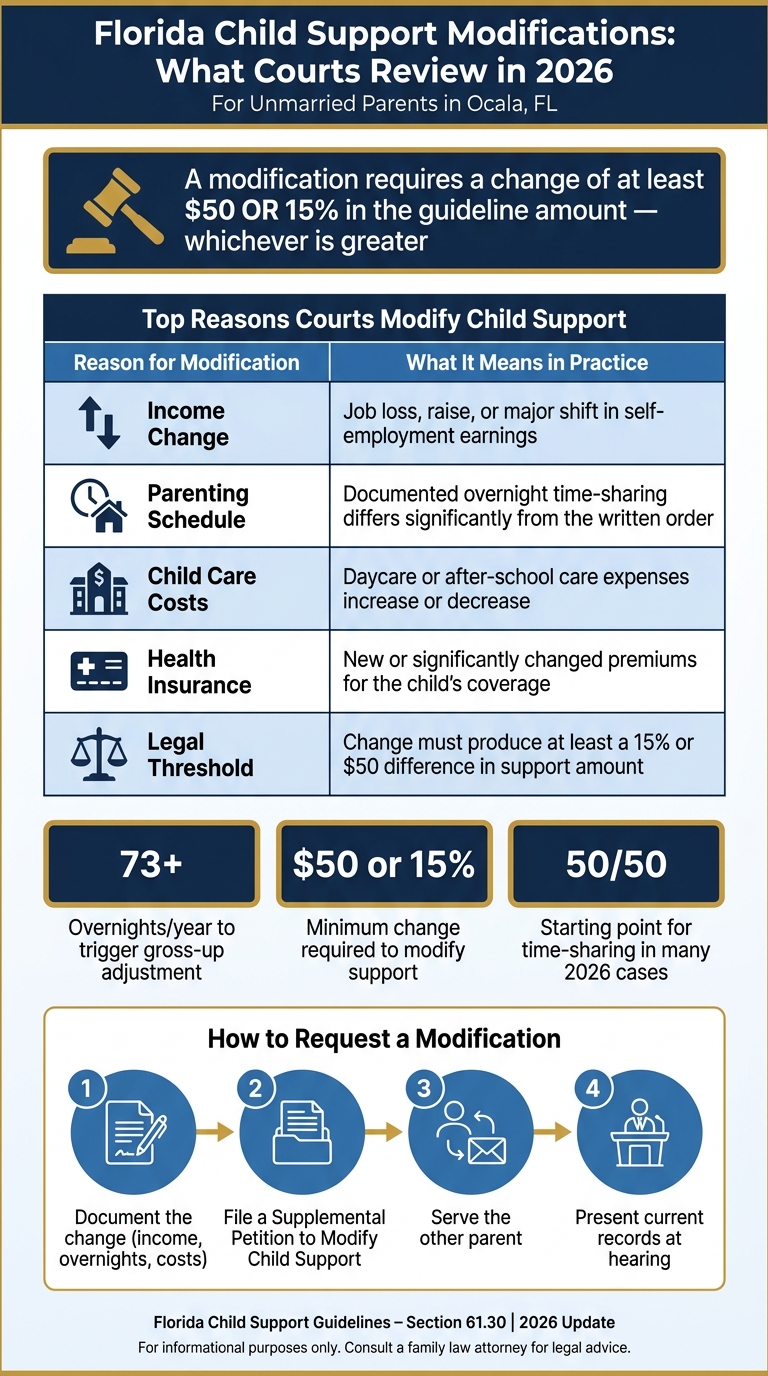
Florida Child Support Modification Reasons & Requirements 2026
How Florida handles child support modifications in 2026
Once support is set, the next fight is often about whether the order should be enforced or changed. In Florida, child support can be modified only if there has been a substantial change in circumstances that creates at least a $50 or 15% change in the guideline amount.
When courts are more likely to modify support orders
A modification still starts with the same basic rule: there must be a substantial change in circumstances. But in 2026, Florida courts are looking hard at what’s actually happening in the family, not just what the old paperwork says.
That means judges are paying close attention to shifts in income, child care costs, health insurance premiums, and documented changes in overnights since the last order. If the written schedule says one thing, but the child has been spending nights in a very different pattern, that can matter.
Here are the facts courts review most often:
| Reason for Modification | What It Means in Practice |
|---|---|
| Income change | Job loss, a raise, or a major shift in self-employment earnings |
| Parenting schedule | Documented overnight time-sharing differs significantly from the written order |
| Child care costs | Daycare or after-school care expenses go up or down |
| Health insurance | New or significantly changed premiums for the child’s coverage |
| Legal threshold | The change must produce at least a 15% or $50 difference in the support amount |
If a parent wants a change, they must file a Supplemental Petition to Modify Child Support, serve the other parent, and have their records ready. That usually means overnight logs, income records, updated pay stubs, tax returns, and expense records.
Put simply, courts want current proof. Old orders still matter, but up-to-date records often carry more weight.
What unmarried parents in Ocala should take from these 2026 trends
Key points to carry forward
Put it all together, and the main lesson is pretty simple: documentation decides most disputes.
When child support is set or changed, current records can make a big difference. For parents in Ocala, that means keeping close track of things like:
- overnight logs
- daycare receipts
- health insurance statements
- income records
Florida courts look at the actual time-sharing schedule, not just what the paperwork says, when they set support. That point matters a lot. If your day-to-day schedule has changed, but the court file hasn’t, the old order can still control the case.
If income, expenses, or time-sharing changes, file a Supplemental Petition to Modify Child Support. Don’t rely on a side agreement or a handshake deal. The current order stays in place until the petition is filed and served.
That timing can hit hard. In most cases, support doesn’t change until the court gets the petition. Florida also requires a change of at least $50 or 15%, whichever is greater.
FAQs
How do I establish paternity in Florida?
In Florida, paternity is set in one of two main ways: by signing a formal acknowledgment or through genetic testing that shows a 95% or higher chance of paternity.
Once paternity is confirmed, you have legal standing as a natural guardian. From there, you can deal with parental responsibility, child support, and time-sharing in a single court case under Florida Statute 742.
What counts as proof of overnights?
Proof of overnights means detailed, accurate records that show where the child slept each night. In Florida, courts look at documented proof to decide whether a parent meets the 20% threshold – about 73 overnights per year – and that can affect child support.
Helpful proof can include a parenting plan, a custody agreement, or a steady log, calendar, or journal with overnight records in chronological order.
When should I file to modify child support?
File as soon as a substantial, permanent, and material change in circumstances happens, like a major shift in income, parenting time, or child-related costs.
Time matters here. Changes usually aren’t retroactive, so a modification often starts on the filing date. In most cases, the change must lead to at least a $50.00 or 15% difference in support.