
If you want the short answer: adoption in Florida is permanent, while guardianship is not.
If I’m comparing the two for a family in Ocala, Florida, I look at four things first:
- Parental rights: adoption ends the birth parents’ legal rights; guardianship does not
- Decision-making: adoption gives the adoptive parent full legal parent status; guardianship gives only the power the court allows
- Court involvement: adoption ends with a final court order; guardianship often keeps the court involved after appointment
- Money and legal effects: adoption usually changes inheritance rights and may end child support; guardianship usually does not
That difference matters because it shapes almost every part of the child’s legal future. In plain terms, adoption is for a permanent family placement, while guardianship is for care and decision-making without cutting off the parents’ legal rights.
A quick fact from the article: 1 key legal split drives 6 major differences – parental rights, permanency, authority, court process, inheritance, and child support.
Quick Comparison
| Issue | Adoption | Guardianship |
|---|---|---|
| Birth parents’ rights | End | Stay in place |
| Legal parent status | Yes | No |
| Permanency | Permanent | Can be temporary or long-term |
| Court control | Ends after final order | Court may keep supervising |
| Inheritance | Usually shifts to adoptive family | Usually stays the same |
| Child support | Often ends | Often continues |
If I had to sum it up in one line, it would be this: <u>adoption changes who the child’s legal parents are, while guardianship changes who can act for the child.</u>
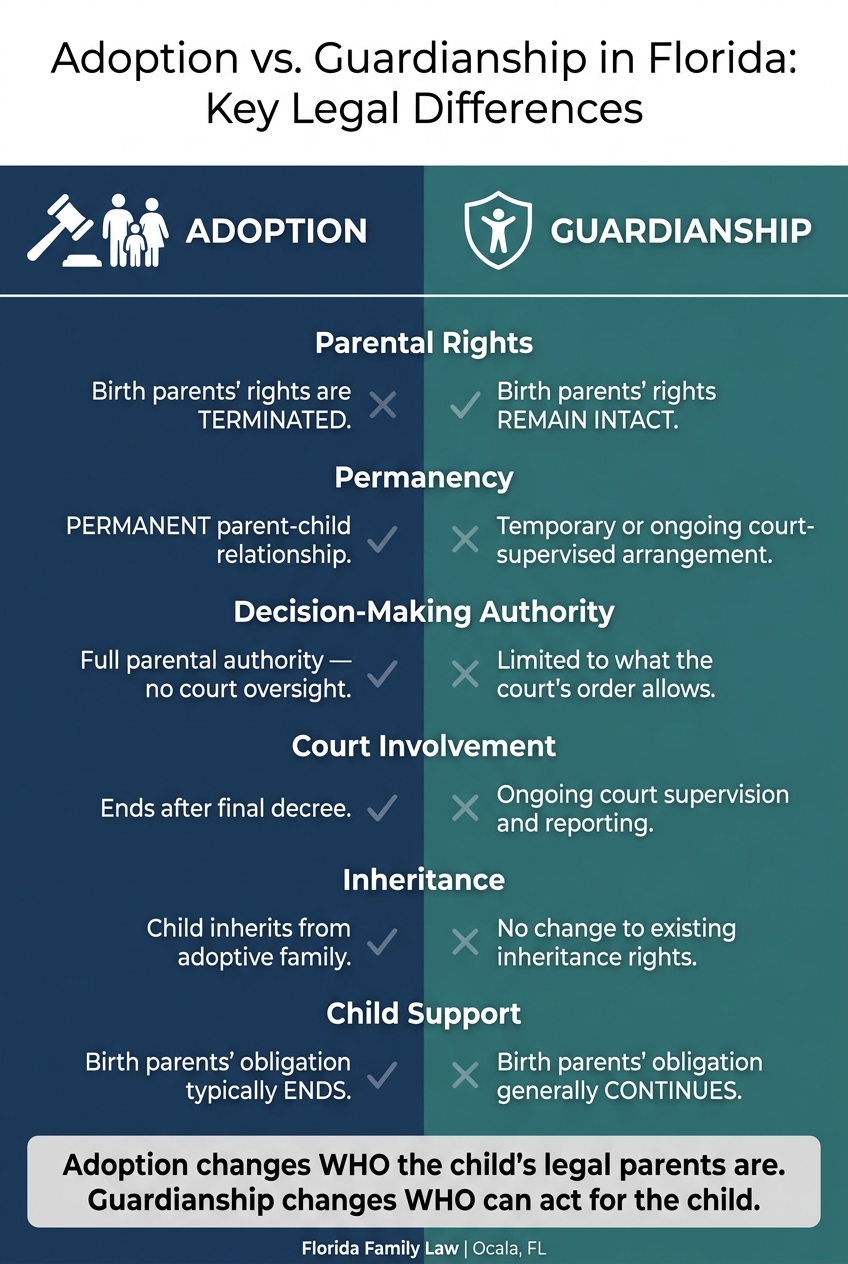
Adoption vs. Guardianship in Florida: Key Legal Differences
Adoption in Florida
Adoption is a legal process that creates a permanent parent-child relationship under Florida law. Once the court finalizes it, the adoptive parents become the child’s legal parents.
What changes legally when a child is adopted
When an adoption is finalized in Florida, the birth parents’ legal rights and responsibilities end. They no longer have legal parental authority over the child.
At that point, the adoptive parents step in as the child’s legal parents. They have full authority to make decisions about education, healthcare, and the child’s general welfare, and they do so without ongoing court supervision.
When adoption is usually the right choice
Adoption is often the right fit for families who want a permanent home and full parental authority without ongoing court oversight. If the goal is permanent legal parenthood, with no lingering legal ties to the birth parents, adoption is the clearest path.
Guardianship gives a different kind of legal authority, but it does not create the same permanent parent-child relationship.
sbb-itb-bb7ced0
Guardianship in Florida
In Florida, guardianship lets a court-appointed adult care for a child when the parents can’t, or shouldn’t, make those calls. Unlike adoption, guardianship does not create a permanent parent-child relationship.
What guardianship does and does not change legally
Guardianship gives an adult the power to make decisions for a child, but it does not end the parents’ legal rights. It also does not turn the guardian into the child’s legal parent in the same permanent way adoption does.
Depending on what the court allows, a guardian may handle:
- Personal decisions
- Medical decisions
- Financial decisions
Florida courts oversee the process through a petition and a hearing. The court also sets the limits of the guardian’s authority, so the guardian can act only within the scope of that order.
When guardianship may be the right choice
Guardianship can make sense when a child needs court-approved care or help managing money or property, but adoption isn’t the right fit.
So the next step is simple: look at how guardianship and adoption differ when it comes to parental rights, permanency, and court control.
Adoption vs. guardianship in Florida: side-by-side comparison
The main difference comes down to permanence.
Adoption creates a permanent parent-child relationship. Guardianship, by contrast, lets a court-appointed adult care for a child with limited legal authority while the birth parents’ rights stay in place. That single difference affects almost everything else, from who makes the final call to whether the arrangement is meant to last.
Parental rights, permanency, and legal authority
With guardianship, the adult may be allowed to make personal, medical, or financial decisions, but only to the extent the court order permits. The court sets the boundaries.
Adoption works very differently. It gives the adoptive parent full parental authority. In plain English, that means the legal role of parent shifts in a lasting way, not just for a short stretch or under narrow court-set limits.
Court process, inheritance, and child support effects
The two paths also move through Florida court in different ways.
Guardianship starts with a petition, a capacity review, and a hearing. Adoption follows its own court process. Once an adoption is final, it changes parental rights, inheritance, and child support in ways guardianship usually does not.
More specifically:
- Adoption can end the birth parents’ child support obligations.
- Adoption shifts inheritance rights to the adoptive family.
- Guardianship usually does neither of those things.
Comparison table
| Category | Adoption | Guardianship |
|---|---|---|
| Parental rights | Birth parents’ rights are terminated | Birth parents’ rights remain intact |
| Permanency | Permanent parent-child relationship | Temporary or ongoing court-supervised arrangement |
| Decision-making authority | Full parental authority, no court oversight | Limited to what the court’s order allows |
| Court process | Petition, termination of parental rights, finalization hearing | Petition, review, and formal hearing |
| Inheritance | Child inherits from adoptive family | No change to existing inheritance rights |
| Child support | Birth parents’ obligation typically ends | Birth parents’ obligation generally continues |
Guardianship tends to fit cases where a child needs temporary care, where decision-making power should stay limited, or where adoption is not the right long-term path. From there, the focus shifts to picking the option that lines up with the child’s needs and the family’s long-term goals.
Court process and choosing the right option
How Florida courts handle each process
Once the differences in rights and permanency are clear, the next step is the court process. The two paths move through Florida courts in different ways, and knowing what’s ahead helps families plan with open eyes.
Adoption usually starts with termination of parental rights and ends with a finalization hearing and decree. Guardianship takes a different route and leaves parental rights in place.
Guardianship begins with a petition in the child’s county. After that, the court holds a hearing to review whether the appointment is needed. Unlike adoption, guardianship often comes with continued court oversight and reporting. Put simply, guardianship usually means more court involvement than adoption.
Those process differences can make the choice a lot clearer because they show which path lines up with a family’s goals.
Key points to consider before moving forward
Adoption fits a permanent parent-child placement. Guardianship fits stability and decision-making without ending parental rights.
Families in Ocala can turn to Law Firm Ocala for guidance on which path fits their goals and the court process involved.
FAQs
Can a guardianship be ended in Florida?
Yes. A guardianship in Florida can end because it’s a legal arrangement that the court oversees.
If things change, or if the guardianship is no longer needed, an interested party can ask the court to modify it or dissolve it. Every case is different, so it may help to speak with a qualified attorney at Law Firm Ocala about how the process works.
Do birth parents still have visitation rights under guardianship?
In Florida, guardianship usually does not end parental rights. Adoption is different. It permanently ends those rights.
Whether birth parents can visit under a guardianship depends on the court order in that case and on the ward’s needs. Every case turns on its own facts, so it’s smart to talk with a qualified attorney about your situation.
How do I know whether adoption or guardianship fits my family?
It comes down to your family’s long-term goals around permanency and legal control.
Adoption is permanent. It ends the biological parents’ rights.
Guardianship lets a court-appointed person care for someone or manage that person’s affairs. But it does not always permanently end the biological parents’ rights.
Because every family situation is different, an attorney can help you figure out which option fits your needs best.