
If police in Ocala, Florida found drugs after an illegal search, a judge may keep that evidence out of court. When that happens, the State can lose the drugs, lab results, paraphernalia, and even statements tied to the search.
Here’s the short version:
- No warrant + no valid exception can mean the search was unlawful
- Bad consent, weak traffic stops, or extra detention can sink the State’s case
- Defective warrants or searches that go past the warrant’s limits can lead to suppression
- In Florida, a motion to suppress usually must be filed before trial
- If the judge grants it, the case may be dismissed, reduced, or harder to prove
- Some proof may still stay in through independent source or inevitable discovery
I’d boil it down like this: in many Florida drug cases, the fight is not just about the drugs. It’s about how police got them. In Ocala and Marion County, video, timing, and the first moments of contact often decide the issue.
Quick look:
| Issue | What it can mean |
|---|---|
| Warrantless home search | Usually illegal unless the State shows a valid exception |
| Consent search | Consent must be voluntary and from someone with authority |
| Traffic stop | The stop must be lawful and not dragged out without new facts |
| Search warrant | Must be based on probable cause and stay within its limits |
| Suppression ruling | Key drug evidence may be kept out of court |
Bottom line: if the search was illegal, the drug evidence may not come in, and that can change the whole case fast.
Police Conduct That Can Lead to Suppression
Not every police mistake gets evidence kicked out. But some types of conduct do lead Florida courts to suppress drug evidence. The main issue is simple: did police cross the legal line before they found the evidence?
Warrantless Searches Without a Valid Exception
When police search without a warrant, they need a valid exception. The most common ones are valid consent, exigent circumstances, search incident to arrest, and plain view.
If none of those exceptions fit, the search is unconstitutional. This comes up a lot with car trunks and closed containers, especially when officers search without probable cause or consent. It also shows up with phones and bags, which usually require a warrant or a clear exception. In Florida, a warrantless home search is presumed illegal unless the State proves that a valid exception applied.
Invalid Consent, Bad Stops, and Unlawful Detention
Police often lose these cases because of how they got consent or how they handled the stop.
Consent only counts if it was given voluntarily. Courts look closely at the details. If officers surrounded a person, suggested there was no choice, threatened arrest for saying no, or falsely said they already had a warrant, that consent likely won’t stand. Consent also fails if it came from someone who had no authority over the place that was searched. And when consent falls apart, any evidence tied to it may be suppressed.
Traffic stops bring a different set of issues. A stop without legal justification is unlawful, and anything found after that may be suppressed. Even a lawful stop can turn unlawful if officers drag it out without new facts to support more detention. Florida courts often review dashcam and bodycam footage closely to see whether a routine stop turned into a drug search with no legal basis.
Defective Warrants and Searches That Exceed Their Scope
A judge’s signature alone doesn’t make a warrant valid. If the warrant was defective, or police went beyond what it allowed, the evidence may be thrown out.
Courts may suppress evidence when a warrant lacked real probable cause. That can happen when it relied on an uncorroborated anonymous tip or stale information. Warrants can also fail when they describe the place to be searched or the items to be seized in vague terms, which violates the constitutional rule of particularity.
Execution matters too. Officers cross the line when they search rooms, nearby properties, vehicles, or people not covered by the warrant, or when they act after the warrant expires. Consent also has limits. It does not give police permission to open locked or unopened areas beyond what was agreed to. If drugs were found outside the warrant’s scope, that evidence may be suppressed. If that happened, the next step is asking the court to suppress the evidence.
sbb-itb-bb7ced0
How Florida Courts Review a Motion to Suppress
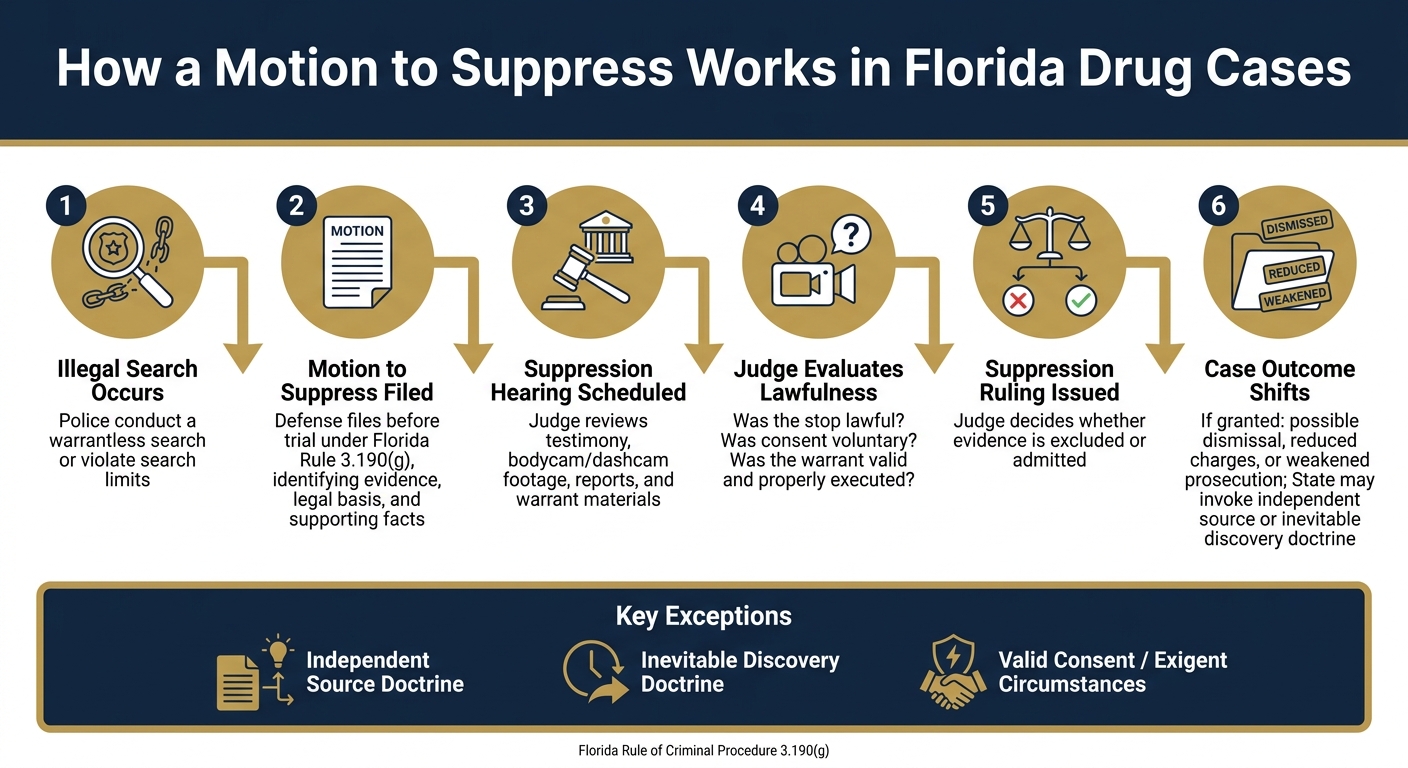
How a Motion to Suppress Works in Florida Drug Cases
After someone challenges an illegal search, the case usually moves to a motion to suppress. Then the judge decides if the evidence stays out. That decision can shape the whole case, especially when the key proof is drugs, statements, or evidence tied to the search.
What Must Be Filed and When
Under Florida Rule of Criminal Procedure 3.190(g), a motion to suppress must be filed before trial. It needs to identify the evidence at issue, the legal basis, and the facts that support the request.
Put simply, the motion should spell out:
- the specific evidence being challenged
- the legal grounds for suppression
- the facts supporting those grounds
If the motion is too vague or leaves out key facts, a judge can deny it without an evidentiary hearing. Local filing deadlines may also apply, so the motion has to be filed before the court’s cutoff.
What Happens at the Suppression Hearing
The suppression hearing is a short evidentiary hearing. The judge looks at testimony, body-camera footage, dashcam video, reports, and warrant materials. Officers are questioned about why they made the stop, what they saw, how consent was requested, and what they searched.
The defense argues that the search was unlawful. The State must prove that a valid exception applied by the greater weight of the evidence.
What Judges Examine
The judge looks at whether police had a lawful basis to stop, search, or detain. The judge also reviews whether consent was voluntary and limited, and whether any warrant was valid and properly executed.
There’s another piece too: whether the drugs, statements, or other evidence came from the illegal search. If an officer’s testimony clashes with video footage or written reports, the judge has to decide who is more believable. That call can swing the result.
If the judge grants suppression, the next question is whether enough admissible evidence is left to prove the charge.
How Suppression Affects Drug Charges in Florida
When the Case Becomes Hard to Prove
If the judge grants suppression, the next step is simple: what can the State still prove?
Sometimes, not much.
If the seized drugs are thrown out, the prosecution’s case can fall apart fast. Without the drugs themselves and the lab result, possession is often tough to prove. And when proof gets thin, dismissal becomes much more likely.
Trafficking cases can be messier, but suppression still lands a heavy blow. In a cannabis trafficking case, for example, the State has to prove the weight threshold, such as more than 25 pounds or 300 or more plants. If the drugs are kept out, prosecutors may not be able to prove that threshold at all. That can force them to drop the charge or scale it back.
Paraphernalia matters too. Items like scales, baggies, or ledgers are often used to argue that someone planned to sell drugs, not just use them. Take those items away, and the intent-to-sell argument loses steam.
Statements can be just as damaging as physical evidence. If a judge throws out a defendant’s admission that the drugs were theirs, the State loses one of its strongest ways to prove knowledge and constructive possession. That matters a lot in shared-space cases, like a car with multiple people in it or a home where more than one person lives.
After a strong suppression ruling, the pressure often shifts. Prosecutors may become more open to a dismissal or a reduced charge instead of pushing for the toughest penalties.
What Evidence May Still Come In
Even after suppression, some evidence may still get in.
Two rules often come up here:
- Independent source doctrine: Evidence may still be used if prosecutors can show it came from a separate, lawful investigation that was not tied to the illegal search.
- Inevitable discovery doctrine: Evidence may still come in if the State can prove it would have been found anyway through lawful steps, such as a routine inventory search after a lawful impound.
Here’s what that can look like in practice.
For example, if officers unlawfully enter a home and see marijuana and a scale, a court may suppress those items. But if detectives already had controlled-buy evidence and informant information before the unlawful entry, that earlier evidence can still be admissible. In that situation, trafficking charges tied to the suppressed stash may collapse, while sale charges based on the earlier lawful evidence may still move forward.
The key point is separation. The State has to show that the surviving evidence stands apart from the illegal search. If it came from an independent source, or it would have turned up anyway, it may still be used. If police found it only because of the illegal search, it stays out.
Search and Seizure Issues in Ocala and What to Do Next
How Search Issues Come Up in Ocala and Marion County Cases
When suppression rules come into play, the next step is looking at how those facts show up in Ocala and Marion County cases.
A lot of drug cases in Ocala and Marion County come down to a simple point: did police act first and get lawful authority later? That can mean entering a home, detaining a suspect, or searching a vehicle before they had the right to do it. In many of these cases, the fight centers on what happened at the door, during the stop, or in the moments before officers got a warrant.
That’s why timing and the video record matter so much. The key question is where the contact happened and whether officers had time to get a warrant. Bodycam and dashcam footage often help sort that out. They can show whether police entered the home first or whether they got real consent. They can also show whether consent was actually given or only claimed later.
How Law Firm Ocala Reviews Illegal Search Defenses
Law Firm Ocala reviews the stop, entry, consent, and warrant timeline to spot suppression issues. If the facts line up, the firm moves to suppress the evidence to weaken the charges or knock them out.
Key Takeaways
In Ocala cases, the fastest route to a suppression issue is often the first contact at a home or during a roadside stop. If suppression works, the prosecution may lose its main evidence, which can make the case much harder to prove. An early review of the footage and timeline can bring these issues to light before key deadlines pass.
FAQs
Can a drug case be dismissed after suppression?
Yes. If evidence gets thrown out after an illegal search, a drug case can be dismissed.
When police violate the Fourth Amendment, a defense attorney can ask the court to keep that evidence out of trial. If the judge agrees, prosecutors may not have enough proof left to continue the case. And when that happens, the charges are often dropped or the case is dismissed.
What makes consent to a search invalid?
Consent is not valid unless it was given freely and voluntarily.
That means police can’t pressure, trick, or scare someone into saying yes. Consent may fail if officers used coercion, deception, intimidation, threats of arrest, or an unreasonable detention to get it.
Courts don’t look at just one fact. They look at the totality of the circumstances. In plain English, they look at the whole scene, not one single moment.
That review can include:
- Your age
- Your education
- Whether you were in custody
- How the officer acted
- Whether you knew you could refuse
A judge may ask a simple question at the heart of all this: Was this person making a free choice, or were they boxed in?
Can police use evidence after an illegal search?
Generally, no. Under the Fourth Amendment and the exclusionary rule, evidence from an illegal search is usually inadmissible in court.
If police searched without a warrant, lacked probable cause, or relied on coerced consent, a defense attorney can ask the court to suppress the evidence. If the judge agrees, the charges may be reduced or the case may be dismissed.