
Handling evidence correctly is the cornerstone of any legal case in Florida. Whether you’re involved in a criminal defense, family law dispute, or personal injury claim, following Florida’s strict evidence rules can significantly impact your case. Here’s what you need to know:
- Florida Evidence Code (Chapter 90): Evidence must be relevant, properly authenticated, and meet strict admissibility standards. Hearsay is generally excluded unless it fits specific exceptions.
- Chain of Custody: Every transfer of evidence must be recorded to prevent questions about its integrity.
- Documentation and Packaging: Use tamper-proof seals, detailed labels, and proper containers to protect evidence from contamination.
- Case-Specific Nuances: Criminal cases rely on physical and testimonial evidence, family law cases on privileged communications, and personal injury claims on expert testimony and medical records.
- Common Errors to Avoid: Illegal searches, poor documentation, and failing to authenticate evidence can lead to exclusion in court.
Key takeaway: Proper evidence handling – from collection to courtroom presentation – can make or break your case. For complex cases in Ocala, Florida, working with legal professionals ensures compliance with these rules.
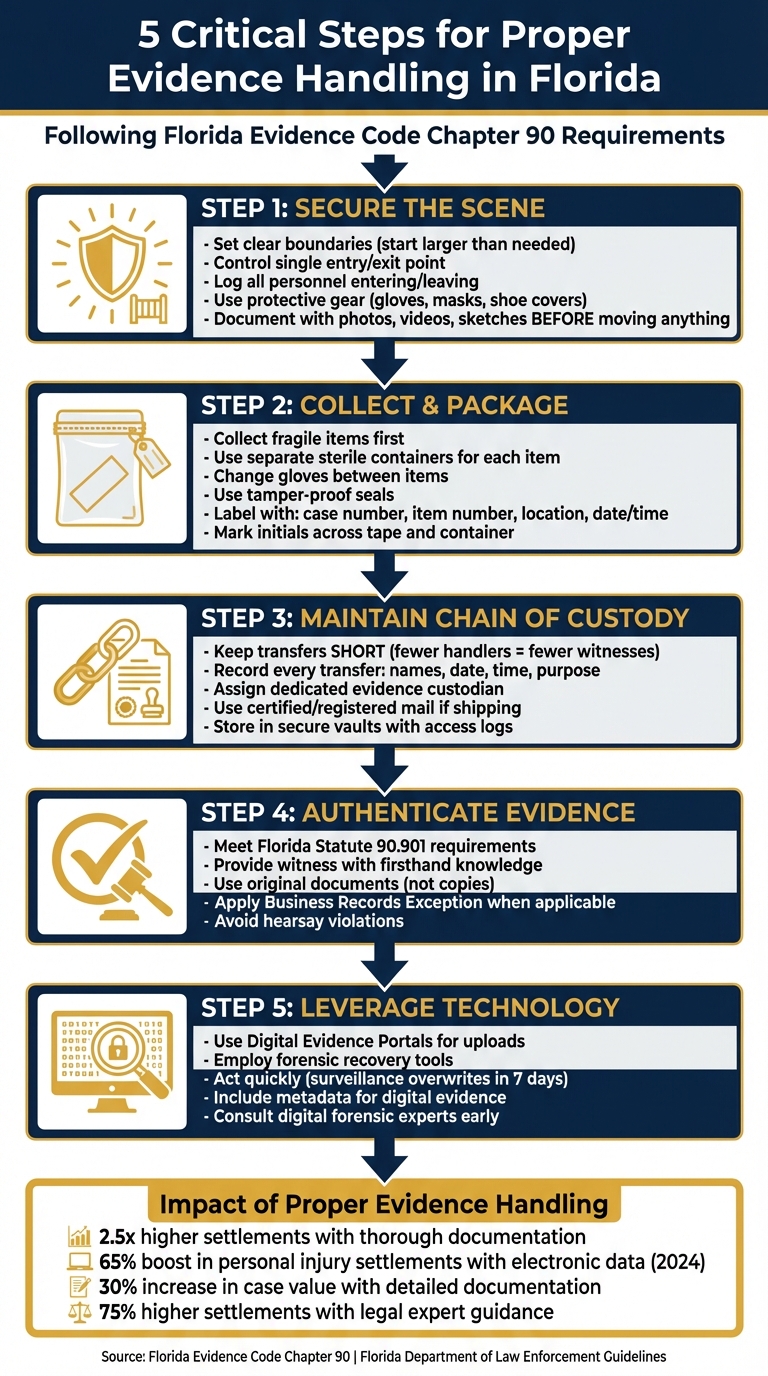
Florida Evidence Handling Process: 5 Critical Steps for Legal Cases
How to Secure and Document Evidence Properly
Handling evidence correctly from the start is critical because even a small mistake can make it inadmissible in court. Florida law requires evidence to be authenticated and presented in its original form, so every step in collecting and documenting it must be precise. These basic principles lay the groundwork for properly securing a crime scene.
Protecting the Scene and Preserving Evidence
The first step is to set clear boundaries around the scene and control access through a single entry and exit point. According to the Florida Department of Law Enforcement, it’s better to start with a larger perimeter than you think is necessary – it’s much easier to shrink the boundary later than to expand it.
Keep a detailed log of everyone who enters or leaves the scene. This record is vital for identifying any potential contamination sources. To further prevent contamination, anyone at the scene should wear protective gear like gloves, masks, and shoe covers. This not only protects the evidence but also minimizes biohazard risks.
Before moving or altering anything, document the scene thoroughly with photos, videos, and sketches. These initial records often serve as powerful evidence during trials. Fragile items should be collected first, with each piece placed in separate sterile containers. To avoid cross-contamination, change gloves between handling different pieces of evidence.
Properly Documenting Evidence Details
When collecting evidence, make sure to label each container with key information: the agency case number, item or exhibit number, location of recovery, and the date and time it was collected. This level of detail aligns with Florida Statute 90.901’s requirements for evidence authentication.
Seal all containers using tamper-proof evidence tape, and mark your initials across both the tape and the container. This ensures any tampering will be immediately visible. The FDLE explains, “an evidence package is properly sealed only if the identity of the individual creating the seal is recorded by marking their initials… and breaching the package would result in obvious damage to the package or seal.” For wet or damp items, such as blood-stained clothing, use temporary packaging to prevent leaks. Once dry, transfer the items to breathable paper containers to avoid mold growth and DNA degradation.
Careful documentation and proper handling connect the physical preservation of evidence to its legal validity. Local legal professionals, including those at Law Firm Ocala, emphasize that thorough labeling and secure packaging are key to maintaining evidence integrity and achieving favorable outcomes in Florida cases.
sbb-itb-bb7ced0
Keeping the Chain of Custody Intact
Once evidence is packaged, every transfer must be documented to protect its integrity. Any gap in this documentation can cast doubt on the evidence, potentially making it unusable in court. Florida courts demand a complete, uninterrupted record of every transfer. This rigorous process ensures the evidence remains secure, untampered, and admissible.
The Florida Department of Law Enforcement (FDLE) sums it up with a straightforward guideline:
Keep the chain of custody short by minimizing transfers. Each person having an item in their possession may be required to testify in court.
This isn’t just about simplifying the process. Fewer handlers mean fewer witnesses required to testify and a reduced chance of errors during handling. Every additional person who comes into contact with evidence increases the risk of mishandling and complicates the legal process.
Labeling and Packaging Evidence Correctly
When dealing with biological evidence like buccal swabs or blood samples, proper labeling is critical. Always include the full name of the individual from whom the sample originated on the outermost container. This detail ensures clarity and accountability.
For submissions to state labs, the FDLE Evidence Prelog web application is an invaluable tool. It allows agencies to pre-fill submission details and generate a packing slip, creating a digital record of the transfer. Be sure to leave at least a 2" x 4" clear area on the outer packaging so lab staff can attach their barcode labels without obscuring agency information.
Accurate packaging is essential, but it’s just the first step. Each subsequent transfer must be recorded with the same precision.
Recording Every Evidence Transfer
Every movement of evidence – from the crime scene to the courtroom – must be meticulously documented. Each transfer should record the names of the releaser and receiver, along with the date, time, and purpose. This creates what the National Institute of Justice calls a "chain of receipts", a detailed log tracing the evidence through every phase.
To reduce errors, assign a dedicated evidence custodian to oversee handling. If evidence must be mailed instead of hand-delivered, use certified mail with a return receipt for standard items. For high-value items like firearms or controlled substances, registered mail with a return receipt is the safest option.
Secure storage is equally important. Evidence should be kept in vaults or lockers with strict access controls. Just as with crime scenes, anyone entering or leaving these storage areas must be logged. Legal professionals, including those at Law Firm Ocala, emphasize that thorough chain of custody records can be the deciding factor in whether evidence supports a case or gets excluded during trial.
Finding Trustworthy Evidence Sources
After preserving evidence properly, the next step is identifying reliable sources to strengthen your case. In Florida, knowing what qualifies as credible under the law can make or break a case. The Florida Evidence Code outlines the standards for admissible evidence, whether you’re dealing with criminal defense, family law, or personal injury claims.
Direct Evidence Sources
Police reports play a key role in criminal cases. These reports include investigative details, lab test results, surveillance footage, and informant statements. Once an investigation is closed, police reports typically become public records, making them accessible for review.
Physical evidence is another powerful tool. Items with unique identifiers, like serial numbers, can serve as solid proof. Florida law also allows videotaped testimony from victims or witnesses under 18 or those with intellectual disabilities, adding another layer of reliability.
Digital evidence has grown in importance. Florida courts accept evidence from web mapping and satellite imaging services under Florida Evidence Code 90.2035. This means you can introduce location-based data without needing formal proof, provided it comes from a trusted source.
In addition to these direct sources, supporting records and expert opinions can further strengthen your case.
Supporting Evidence Sources
To back up direct evidence, gather materials that offer technical, business, or self-authenticating support. Expert testimony is particularly useful for explaining complex or specialized topics. According to Florida Statutes Chapter 90.702:
If scientific, technical, or other specialized knowledge will assist the trier of fact in understanding the evidence or in determining a fact in issue, a witness qualified as an expert by knowledge, skill, experience, training, or education may testify thereto in the form of an opinion.
Business records, even from out-of-state companies, are often admissible as self-authenticating documents. These records can establish timelines, transactions, or financial claims, which are essential in personal injury and family law cases.
Subpoenaed records offer another layer of evidence. Prosecutors or attorneys can use investigative subpoenas to obtain physical evidence or witness testimony. For example, legal teams at Law Firm Ocala often use subpoenas to collect medical records in personal injury cases, financial documents in divorce proceedings, or communication logs in criminal defense cases. Self-authenticating documents, like certified public records, notarized papers, and newspapers, don’t require additional verification, making them efficient and court-ready.
Common Evidence Handling Errors to Avoid
Accurate evidence collection and maintaining a proper chain of custody are essential in any legal case. Mishandling evidence can lead to its exclusion, which might weaken your position in court. Florida’s legal system enforces strict guidelines on how evidence must be gathered and verified. A single misstep can result in critical evidence being ruled inadmissible, putting your case at risk.
Collecting Evidence the Wrong Way
One of the most serious mistakes is conducting illegal searches. Under Florida’s Exclusionary Rule, any evidence obtained through warrantless searches of homes or property – without valid consent – will be suppressed and cannot be used in court. If law enforcement arrives without a warrant, it’s crucial to clearly state that you do not consent to the search.
Another common issue is failing to authenticate evidence. Florida Statute 90.901 requires evidence to be authenticated before it can be admitted. Judge Michael G. Williamson highlights this in the Practical Evidence Manual:
As a condition precedent to receiving the exhibit into evidence, there must be evidence sufficient to support a finding that the exhibit in question is what its proponent claims.
This means someone with firsthand knowledge must testify that the evidence is what you claim it to be. For instance, in criminal defense cases in Ocala, prosecutors may try to introduce digital communications – like emails or text messages – but without proper witness testimony to confirm their origin, these can be excluded.
Ensuring evidence authenticity is just as important as gathering it correctly.
Not Verifying Evidence Authenticity
Evidence can also be rejected if it’s not properly verified. For example, documentary evidence is often classified as hearsay unless it meets specific exceptions, such as the Business Records Exception under Section 90.803. Using out-of-court statements without laying the proper groundwork will likely result in the evidence being dismissed.
Florida law generally requires the original document, recording, or photograph to prove its contents. Duplicates may only be used if there’s no reasonable doubt about the original’s authenticity. Misrepresenting evidence or failing to meet these requirements can harm your credibility in court, making it harder to build a strong case.
Working with Experts and Using Technology
Handling evidence properly requires the right combination of expert guidance and modern tools to comply with Florida’s strict admissibility standards. By merging professional expertise with advanced technology, evidence can be effectively collected, preserved, and presented.
Getting Help from Legal Professionals
Experienced attorneys play a crucial role in ensuring evidence meets the requirements of Florida’s Evidence Code and Federal Rule of Evidence 702. They apply the Daubert factors, which assess aspects like testability, peer review, error rates, established standards, and acceptance within the scientific community.
From the outset, legal professionals focus on meeting these foundational requirements. For instance, in a criminal defense case in Ocala, an attorney might collaborate with digital forensic experts to retrieve data from encrypted files, damaged devices, or deleted records on laptops and cell phones. These specialists can uncover detailed digital footprints, helping establish timelines and clarify events. As the Scientific Working Group on Digital Evidence explains:
Digital forensics is the field of forensic science that is concerned with the collection, examination, analysis, and reporting of electronic data for use in criminal, civil, and administrative proceedings while preserving the integrity of the information and maintaining a strict chain of custody for the data.
Early consultation with attorneys is key to avoiding common mistakes that could lead to evidence being excluded. The professionals at Law Firm Ocala can guide you through these complex processes, whether you’re dealing with a DUI charge, a family law issue, or a personal injury case. They can also connect you with forensic analysts who have documented credentials, certifications, and experience in testifying.
Combining legal expertise with cutting-edge digital tools strengthens the reliability and admissibility of evidence.
Technology Tools for Evidence Management
Modern technology has transformed how evidence is managed, making the process more efficient and reliable. Florida courts now use digital systems to streamline case handling. For example, the Fifteenth Judicial Circuit in Palm Beach County offers a Digital Evidence Portal. This system allows attorneys to upload exhibits in formats like .pdf and .jpeg, automatically assigning exhibit numbers and digital stamps. For physical evidence that can’t be uploaded, such as original documents or large objects, the portal uses digital "placeholder" forms to maintain the sequence of exhibit numbers.
Forensic recovery tools have become indispensable for retrieving data from various devices. The Florida Department of Law Enforcement (FDLE) employs experts who use advanced software to bypass passcodes, recover web histories, and extract location data and messages. They also enhance video footage by reducing motion blur and correcting poor lighting, making surveillance evidence clearer.
These tools work hand-in-hand with strict chain-of-custody protocols, ensuring evidence remains intact and admissible. Acting quickly is often critical, especially with digital evidence. Many surveillance systems overwrite data within seven days, so delays can result in lost information. Florida Statute 90.2035 even allows courts to take judicial notice of web mapping and satellite images, provided they include essential metadata like creation dates. By combining expert knowledge with advanced tools, evidence can be secured promptly and meet all legal standards.
Conclusion
Every step in handling evidence – from collection to documentation – plays a critical role in maintaining its integrity in Florida cases. Following the Florida Evidence Code and ensuring a concise chain of custody are essential to preserving evidence effectively.
Why does this matter? Evidence that’s meticulously documented can dramatically influence case outcomes. For instance, cases with thorough documentation often secure settlements up to 2.5 times higher. In 2024 alone, well-preserved electronic data boosted personal injury settlements by 65%, while detailed pain journals increased case values by as much as 30%.
Time is of the essence when it comes to evidence. Physical evidence can degrade quickly, so act fast. Use tamper-proof seals and include clear labels with case numbers and detailed descriptions to avoid contamination or mishandling. Precision in these steps is the cornerstone of building a strong legal case.
For more complex cases – whether it’s a DUI, custody dispute, or car accident – working with experienced professionals can make all the difference. Statistics show that cases managed by legal experts result in settlements that are 75% higher than those handled without professional guidance. If you’re navigating Florida’s strict evidence requirements, reach out to the trusted team at Law Firm Ocala. They offer free consultations to help ensure your evidence is managed correctly from the very beginning.
FAQs
What should I do first to preserve evidence after an incident in Florida?
To safeguard evidence after an incident in Florida, swift action is key. Start by thoroughly documenting the scene with photos or videos. Capture damages, injuries, and the state of the property before anything gets moved or changed. Gather physical evidence, like broken items, and make sure to collect contact details from any witnesses. Be cautious not to take any steps that might alter or destroy evidence, keeping everything in its original state for any legal proceedings.
How can I prove photos, texts, or videos are authentic in Florida court?
To use photos, texts, or videos as evidence in a Florida court, you need to prove they’re authentic. This might involve witness testimony, expert evaluations, or pointing out unique features of the material. For digital evidence, courts frequently examine metadata, rely on expert comparisons, or require a well-documented chain of custody. These steps help confirm the content hasn’t been tampered with, making it acceptable for use in legal proceedings.
How do I keep a valid chain of custody for evidence I collect myself?
To ensure a valid chain of custody, it’s crucial to document every stage of evidence collection, handling, and storage. This includes recording details like the date, time, location, and the names of everyone involved. Evidence should be placed in tamper-evident containers and marked with unique labels to maintain integrity.
Keep a detailed log of all transfers, specifying who handled the evidence and when. Additionally, storing evidence in secure, locked spaces with restricted access ensures it remains intact and credible for legal proceedings. Proper handling is key to maintaining its admissibility in court.