
If you’ve been arrested for a DUI in Florida, you might have an option to avoid a criminal record through a DUI diversion program – if you meet specific requirements. These programs are only available in certain counties, like Ocala, and focus on education and rehabilitation rather than punishment. Here’s what you need to know:
- Eligibility: First-time offenders with no prior DUI or felony convictions and a misdemeanor DUI charge.
- Disqualifiers: High BAC (typically over 0.20%), involvement in a crash, minors in the car, or additional charges.
- Program Process: Requires completing DUI school, community service, random screenings, and other conditions.
Acceptance isn’t guaranteed, as the State Attorney’s Office has full discretion. A skilled DUI attorney can help improve your chances. Programs like RIDR, DROP, and DETER vary by county, so local rules matter.
Basic Requirements for DUI Diversion Programs
First-Time DUI Offenders
In Florida, diversion programs are reserved for individuals with no prior DUI convictions or alcohol-related driving offenses – anywhere. Your record must be spotless when it comes to DUI charges. The state also evaluates your history for serious alcohol-related incidents. If you’ve ever participated in a pretrial intervention, deferred prosecution, or juvenile diversion program, you’re likely to be ineligible.
Another key factor: your DUI charge must be a misdemeanor.
Misdemeanor DUI Charges Only
Florida’s diversion programs are strictly for misdemeanor DUI charges. If you’re facing a felony DUI charge, you’re automatically disqualified. Felony cases fall under the jurisdiction of the Department of Corrections and follow a separate legal process.
Additional Qualifications
Beyond the core requirements, you must be a legal U.S. resident with no prior felony convictions and no more than one unrelated misdemeanor. Even if you meet these criteria, acceptance isn’t guaranteed. The Office of the State Attorney has full discretion over who gets referred.
"The prosecutor handling your case has a great deal of discretion as to whether or not they will refer your case to diversion. There is nothing that can be done to force your way into a diversion program." – Orlando Criminal Team
Having a skilled DUI defense attorney in Ocala – like those at Law Firm Ocala – can make a big difference. They can help you present your case effectively and potentially improve your chances of being referred to a diversion program.
What Disqualifies You from DUI Diversion Programs
High Blood Alcohol Content or Crash Involvement
If your BAC is above 0.20%, you’re likely ineligible for most DUI diversion programs in Florida. While the legal limit stands at 0.08%, and enhanced penalties apply at 0.15%, many counties use 0.20% as the cutoff. Some areas may even set the threshold slightly higher, at 0.22%.
Involvement in any type of collision – no matter how minor – typically disqualifies you. This includes situations like hitting a curb, causing property damage, or more serious crashes. If the incident involves severe injury or a fatality, it escalates to a felony charge, which automatically removes eligibility for misdemeanor diversion programs. Additional aggravating factors can further limit your chances.
Aggravating Circumstances
Certain circumstances beyond a high BAC or crash can also block you from entering a diversion program. For example:
- Having a passenger under 18 in the vehicle at the time of arrest
- Driving with a suspended or revoked license
- Driving more than 20 mph over the speed limit
- Possessing weapons or facing drug charges alongside your DUI
These factors indicate to prosecutors that a diversion program may not be suitable for your case.
Additional Criminal Charges or Commercial Driver’s License
Other circumstances that can disqualify you include facing additional charges, such as drug offenses or weapon possession, alongside your DUI. Diversion programs are designed to address isolated DUI incidents, not complex cases involving multiple violations.
If you hold a Commercial Driver’s License (CDL), you’re automatically excluded from these programs. Federal and state laws prohibit "masking" alcohol-related offenses for CDL holders due to stricter safety guidelines. With a BAC limit of just 0.04%, CDL drivers face tougher standards and can lose their commercial driving privileges for a year following a conviction.
If you’re uncertain about your eligibility, reaching out to experienced DUI defense attorneys at Law Firm Ocala can provide clarity on your options and help you navigate the next steps in your case.
Types of DUI Diversion Programs in Florida
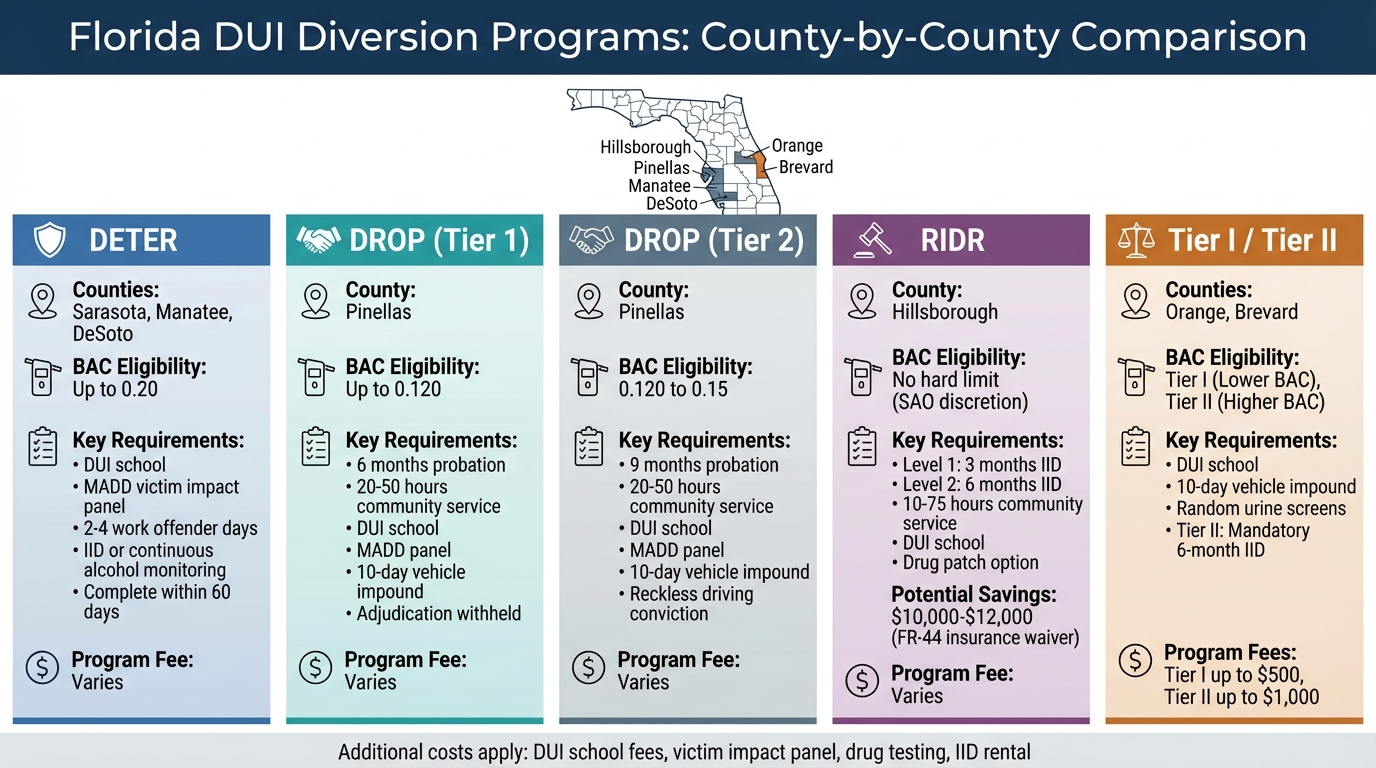
Florida DUI Diversion Programs Comparison by County
Florida provides several DUI diversion programs for first-time offenders, with requirements and conditions differing by county. Here’s a breakdown of the main programs to help you understand their specifics.
DETER (Driver Enhanced Treatment Education Rehabilitation) – Offered in Sarasota, Manatee, and DeSoto counties, DETER is available to individuals with a BAC of up to 0.20. Participants must complete DUI school, attend a MADD victim impact panel, serve work offender days, and use either an ignition interlock device (IID) or continuous alcohol monitoring. All these requirements must be fulfilled within 60 days.
DROP (DUI Rehabilitation of Offenders Program) – Available in Pinellas County, DROP is divided into two tiers based on BAC levels. Tier 1 applies to BACs up to 0.120 and includes six months of probation with adjudication withheld. Tier 2 applies to BACs between 0.120 and 0.15, requiring nine months of probation and a reckless driving conviction. Those with a BAC over 0.15 are not eligible. Both tiers also require 20 to 50 hours of community service and a 10-day vehicle impoundment.
RIDR (Reducing Impaired Driving Recidivism) – Hillsborough County’s RIDR program focuses on using ignition interlock devices for first-time offenders. Level 1 requires three months of IID use, while Level 2 mandates six months. Additionally, participants may need to complete up to 75 hours of community service, depending on their BAC or refusal to take a test. Completing RIDR can result in significant savings, potentially avoiding the FR-44 insurance requirement, which could save participants between $10,000 and $12,000 over three years.
Tier I and Tier II Programs – Available in Orange and Brevard counties, these programs differ mainly in cost and monitoring. Tier I has a fee of up to $500, while Tier II costs up to $1,000 and includes a mandatory six-month IID requirement. Both tiers involve DUI school, random urine screenings, and a 10-day vehicle impoundment. Participants are also responsible for additional expenses such as DUI school fees, victim impact panel costs, drug testing, and IID rental fees.
Program Requirements Comparison
The table below highlights the main criteria for each program:
| Program | Primary Location | BAC Eligibility | Key Requirements | Monetary Contribution |
|---|---|---|---|---|
| DETER | Sarasota / Manatee / DeSoto | Up to 0.20 | DUI school, MADD panel, 2–4 work offender days, IID or alcohol monitoring | Varies |
| DROP | Pinellas | Up to 0.15 | 20–50 community service hours, DUI school, MADD panel, 10‑day vehicle impound | Varies |
| RIDR | Hillsborough | No hard limit (SAO discretion) | 10–75 community service hours, IID (3–6 months) or drug patch, DUI school | Varies |
| Tier I | Orange / Brevard | Lower BAC | DUI school, 10‑day vehicle impound, random urine screens | Up to $500 |
| Tier II | Orange / Brevard | Higher BAC | Mandatory 6‑month IID, DUI school, random urine screens | Up to $1,000 |
sbb-itb-bb7ced0
How to Apply for DUI Diversion Programs
Filing Your Application
To get started with a DUI diversion program, you must first receive a referral from the Office of the State Attorney – this isn’t something you can initiate on your own. Your attorney will review your case to ensure you meet the eligibility criteria and check for any disqualifiers, such as a BAC over 0.22, involvement in an accident, or having a minor in the vehicle.
If you’re in the 6th Judicial Circuit, you’ll need to submit your application before your second pretrial hearing. Along with your application, you’ll pay a nonrefundable $50 fee and complete the necessary forms and waivers.
For expert legal advice, consider reaching out to Law Firm Ocala, which has experience in DUI defense cases in Florida.
Once your application is submitted, the State Attorney’s office will begin its review process.
State Attorney Review and Decision
After your attorney secures a referral from the prosecutor, the diversion department will examine your criminal history and other case details. The prosecutor has the sole authority to approve or deny your entry into the program, based on factors like your BAC level, whether there was property damage or injury, and your willingness to meet the program’s terms.
"The prosecutor handling your case has a great deal of discretion as to whether or not they will refer your case to diversion. There is nothing that can be done to force your way into a diversion program." – Orlando Criminal Team
Even the judge cannot overrule the prosecutor’s decision, which is why having skilled legal representation is so important when negotiating with the State Attorney’s office.
If your application is approved, the process moves forward to court confirmation.
Court Approval and Program Entry
Once the State Attorney approves your application, you’ll sign a formal diversion agreement. This document outlines the program’s terms, which often include completing community service hours, attending DUI school, and sometimes installing an ignition interlock device. You’ll also need to pay any associated program fees. Official enrollment begins only after you’ve signed this agreement.
"You are not on the Pretrial Diversion program until the day you sign the contract with the State Attorney." – Florida Safety Council
Following your agreement, the court will review and approve the plea resolution and the recommended terms. Judges typically defer to the State Attorney’s recommendations. Once the court grants approval, your case is paused while you work through the program requirements. Be ready to pay the program fees upfront – $500 for Tier I or $1,000 for Tier II in Orange County – along with additional costs for DUI school, victim impact panels, drug testing, and ignition interlock device rentals.
Conclusion
Eligibility for DUI diversion in Florida comes with clearly outlined requirements. You must be a first-time misdemeanor DUI offender, but even meeting these criteria doesn’t guarantee acceptance. The State Attorney’s Office has the final say, and entry into the program is never automatic.
Disqualifying factors include certain BAC levels, involvement in a crash, and other circumstances that vary depending on the county. These specifics make it crucial to understand the local rules and how they apply to your case.
Because of the strict guidelines and differences across counties, having an experienced attorney is key. A lawyer can review your situation, negotiate with the State Attorney’s Office, and help you navigate the application process.
If you’re dealing with DUI charges in Ocala, Law Firm Ocala offers skilled defense services. They provide free consultations to discuss your case and determine your options. Reach out to them for immediate assistance.
FAQs
What are the advantages of joining a DUI diversion program in Florida?
Participating in a DUI diversion program in Florida comes with some meaningful benefits. For those who qualify, it offers a chance to avoid a criminal conviction, which can help safeguard their record and lessen the long-term fallout from a DUI charge.
These programs emphasize rehabilitation by incorporating education and counseling. Participants gain tools to make smarter choices and reduce the likelihood of repeat offenses. Completing the program successfully can also ease legal and financial pressures, making it an appealing option for eligible individuals.
How can a DUI attorney help me qualify for a diversion program in Florida?
A DUI attorney can play a key role in helping you qualify for a diversion program by thoroughly assessing your situation and guiding you through the process. They’ll review your case to see if it aligns with the program’s criteria, such as being a first-time offender or having no prior criminal history.
Beyond that, they can represent you when dealing with the Office of the State Attorney, presenting your case in a way that highlights your eligibility. Since acceptance into these programs isn’t guaranteed and depends on various factors, having an attorney’s expertise can be a game-changer in navigating the system and improving your chances of a positive outcome.
What are the costs of DUI diversion programs in Florida?
Yes, joining a DUI diversion program in Florida usually comes with associated costs. These expenses can range anywhere from $300 to $1,750, depending on the county and the specific requirements of the program. The fees often cover things like enrollment, counseling sessions, and monitoring services.
Since costs can differ based on location and program specifics, it’s a good idea to consult with a local legal expert or program administrator for the most accurate details. If you’re in Ocala, Law Firm Ocala can assist you with navigating the process and provide the guidance you need to work toward a favorable outcome.