
The RICO Act is a powerful legal tool used in Florida to target organized crime, including drug trafficking operations. Unlike standard drug charges, RICO focuses on dismantling entire criminal enterprises, holding leaders accountable for their organization’s activities. Florida’s RICO statute, outlined in Chapter 895, allows prosecutors to combine multiple crimes into a single first-degree felony charge, carrying up to 30 years in prison, $10,000 in fines, or treble damages.
To secure a RICO conviction, prosecutors must prove:
- The existence of an enterprise (formal or informal).
- A pattern of racketeering activity involving at least two related predicate offenses within five years.
Drug trafficking qualifies as a predicate offense under Florida law, with weight thresholds for substances like cocaine, fentanyl, and methamphetamine often escalating charges. RICO penalties also include asset forfeiture, targeting homes, vehicles, and financial accounts tied to criminal activity.
Defending against RICO charges often involves challenging the existence of an enterprise and disputing the pattern of criminal acts. If you’re facing RICO charges in Ocala, Florida, consulting an experienced attorney can help identify weaknesses in the prosecution’s case and protect your rights.
Florida’s RICO Act Explained
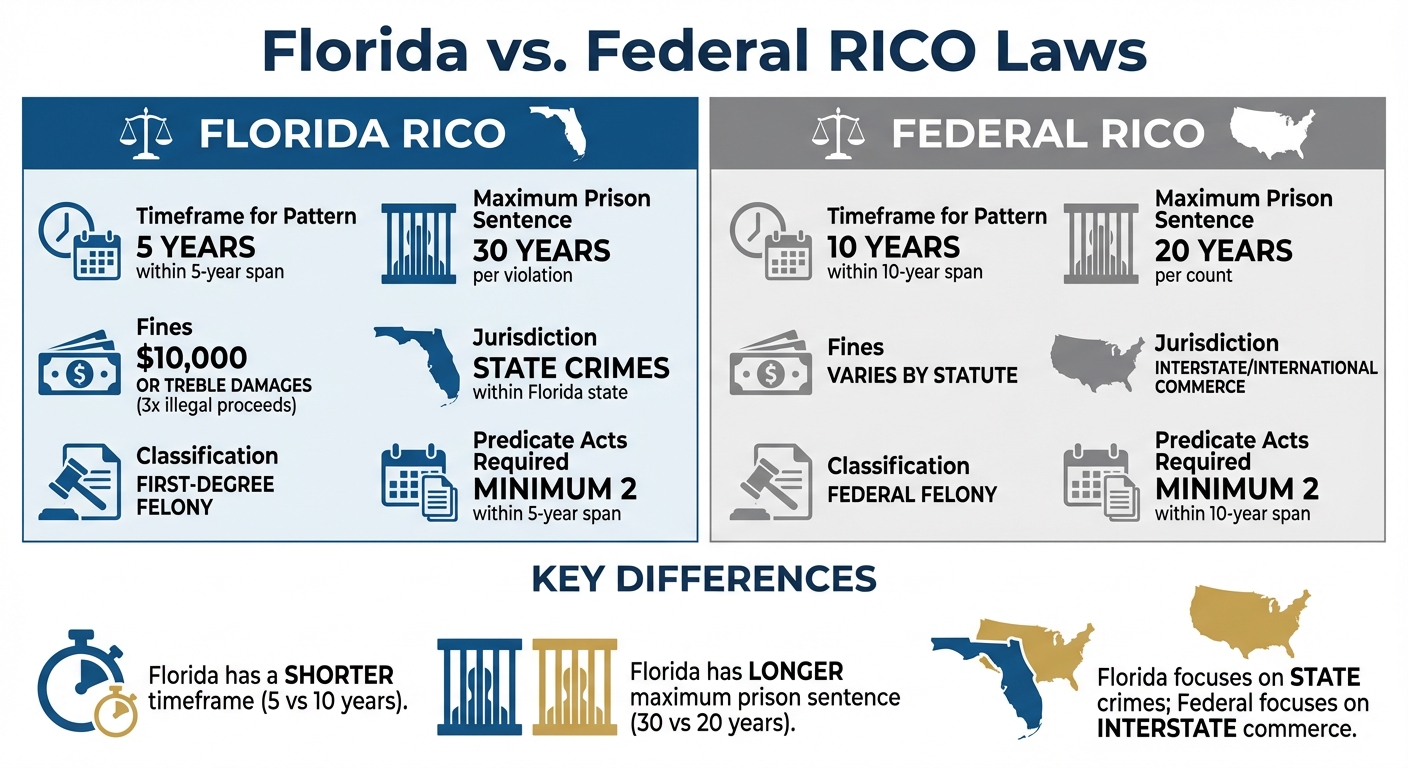
Florida RICO vs Federal RICO Laws Comparison Chart
What Is the RICO Act?
The Florida Racketeer Influenced and Corrupt Organization Act is a powerful tool for prosecutors aiming to dismantle organized crime. Unlike laws that focus on individual offenses, Florida’s RICO Act targets entire criminal enterprises.
"Florida Statutes 895 allows prosecutors to charge a complete enterprise all at once." – Sammis Law Firm
Under this law, three main activities are prohibited: using proceeds from racketeering to acquire property or businesses, controlling an enterprise through racketeering, or participating in an enterprise through a pattern of racketeering activity. The term "enterprise" is broadly defined, covering individuals, corporations, partnerships, and even informal groups.
Racketeering activity refers to committing, attempting, or conspiring to commit certain "predicate" crimes, such as drug trafficking or fraud schemes. Florida’s statute also incorporates all federal RICO predicate offenses, giving it a wide scope to address various criminal behaviors.
These features make Florida’s RICO Act distinct and set the stage for how it differs from its federal counterpart.
State vs. Federal RICO Laws
Although Florida’s RICO Act shares similarities with the federal version, there are key differences that influence how cases are handled across the state, including in places like Ocala. One major difference lies in timing requirements. Florida law mandates that predicate acts must occur within a five-year span to establish a pattern of racketeering, whereas federal law allows a ten-year timeframe. This shorter window in Florida can make it more challenging to link older crimes to newer ones.
Penalties also vary. A RICO violation in Florida is classified as a first-degree felony, carrying up to 30 years in prison and fines of $10,000 or treble damages. In contrast, federal RICO convictions can result in up to 20 years per count. Additionally, Florida’s law focuses on crimes committed within the state, while federal RICO laws address activities that affect interstate or international commerce.
Required Elements for RICO Violations in Drug Trafficking Cases
To successfully prosecute under RICO in drug trafficking cases, prosecutors must establish two key elements: the existence of a criminal enterprise and a pattern of related criminal activities.
Proving an Enterprise Exists
Before RICO charges can proceed, prosecutors need to demonstrate the presence of an enterprise. Under Florida law, the definition of "enterprise" is intentionally broad, covering everything from individuals and corporations to partnerships, unions, and other legal entities. It also applies to informal groups or associations where individuals are "associated in fact", even if no formal legal structure exists.
This expansive definition allows Florida prosecutors to target both legitimate businesses used for illegal purposes and purely criminal organizations. For example, a drug cartel or a smuggling ring qualifies as much as a legitimate company being exploited for trafficking activities. Florida law explicitly recognizes a "criminal gang" as an enterprise under RICO, which enables authorities to pursue charges against street gangs involved in drug distribution alongside more sophisticated trafficking networks.
"Enterprise means any individual, sole proprietorship, partnership, corporation, business trust, union chartered under the laws of this state, or other legal entity, or any unchartered union, association, or group of individuals associated in fact although not a legal entity; and it includes illicit as well as licit enterprises." – Florida Statute § 895.02
Once the existence of an enterprise is established, the next step is proving a pattern of racketeering activity.
Pattern of Racketeering Activity
After proving the enterprise, prosecutors must show a consistent and connected pattern of criminal acts. This involves presenting evidence of at least two predicate acts of criminal conduct, specifically chargeable under Florida Statutes Chapter 893, which governs drug-related offenses.
Timing plays a critical role here. The most recent predicate act must occur within five years of a prior act, and at least one of these acts must have taken place after October 1, 1977. These acts cannot be isolated incidents; they must share common threads, such as similar intentions, results, accomplices, victims, or methods.
Prosecutors must establish both relationship and continuity between the acts. Predicate acts need to be clearly connected to one another, and the continuity aspect requires showing that these acts present an ongoing threat of criminal behavior. Courts often presume this threat in drug trafficking enterprises, especially when the organization exists primarily for illegal purposes. A series of related acts over a substantial period – typically longer than six months – meets the closed-ended continuity standard.
How RICO Applies to Drug Trafficking Cases in Florida
RICO charges come into play in drug trafficking cases when the activity is tied to an organized enterprise. This law allows prosecutors to bundle multiple drug-related offenses into a single, more severe charge, making it a powerful tool against large-scale drug operations.
Drug Trafficking as a Predicate Offense
According to Florida Statutes § 895.02(a), any crime outlined in Chapter 893 (Drug Abuse Prevention and Control) qualifies as "racketeering activity." This means that manufacturing, selling, or distributing controlled substances can serve as a predicate offense if it’s connected to an enterprise. The key difference between a standard drug charge and a RICO charge is this enterprise connection.
"Racketeering usually means a pattern of crimes tied to an enterprise – think organized schemes like fraud rings, drug trafficking networks, or public-corruption operations." – Thomas Fighter, Attorney
Prosecutors often strengthen RICO cases by linking drug trafficking to other crimes like money laundering, gang activity, public corruption, or violent acts. For example:
- Money laundering: Used to hide profits from drug sales through financial transactions.
- Gang activity: Charges may escalate if trafficking supports a gang’s operations.
- Public corruption: Bribing officials to protect the drug operation can add another layer to the charges.
- Violent crimes: Acts like homicide or kidnapping to maintain control over distribution networks are often included as predicate offenses.
Next, let’s look at how weight thresholds for drugs can escalate these charges under RICO.
Weight Thresholds for Drug Trafficking
Florida law upgrades simple possession charges to trafficking based solely on the weight of the substance, regardless of intent to sell. Under Fla. Stat. § 893.135, exceeding specific weight thresholds triggers first-degree felony trafficking charges, which can then serve as RICO predicates.
Here are the weight thresholds for common substances:
- Cocaine: 28 grams
- Fentanyl and Heroin: 4 grams each
- Methamphetamine: 14 grams
- MDMA: 10 grams
- Cannabis: 25 pounds or 300 plants
- LSD: 1 gram
- GHB: 1 kilogram
Even if there’s no evidence of intent to distribute, possessing amounts above these limits can lead to trafficking charges. When multiple trafficking incidents are linked to an enterprise, prosecutors may pursue RICO charges. These charges carry severe consequences, including up to 30 years in prison, fines up to $10,000, or treble damages – three times the value gained from the illegal activity.
For legal assistance in Ocala, visit Law Firm Ocala.
sbb-itb-bb7ced0
Penalties for RICO-Related Drug Trafficking Offenses
Florida imposes some of the toughest penalties for RICO convictions, especially when tied to drug trafficking. These include up to 30 years in prison, hefty fines, and the seizure of assets.
First-Degree Felony Punishments
RICO violations fall under first-degree felonies, which means offenders face a maximum of 30 years in state prison. Fines can reach up to $10,000, but courts often go further by imposing treble damages – three times the amount of the profits gained or losses caused by the criminal activity. For example, if the illegal activity generated $500,000, the court could order a staggering $1.5 million in treble damages.
Additionally, Florida’s asset forfeiture laws allow the state to confiscate any property tied to racketeering. This includes homes, vehicles, bank accounts, and other assets. If the original property is no longer available, the court can order the forfeiture of substitute assets of equal value. These measures are designed to dismantle organized drug trafficking operations at their core.
RICO vs. Standalone Drug Trafficking Penalties
RICO charges differ significantly from standalone drug trafficking offenses. While standalone charges typically focus on a single transaction and carry mandatory minimum sentences based on the amount of drugs involved – such as 3, 7, 15, or 25 years for specific quantities – RICO cases address the broader criminal enterprise. Even though RICO itself doesn’t include mandatory minimums, defendants are still subject to the minimum sentences tied to the underlying trafficking charges.
The financial penalties also vary. For instance, standalone cocaine trafficking involving 28–200 grams requires a mandatory $50,000 fine. In contrast, RICO charges allow prosecutors to seek treble damages, which can far exceed the standard fines. Another key difference is the scope: standalone charges target individual transactions, while RICO cases hold defendants accountable for the collective actions of the entire organization. In places like Ocala and throughout Florida, this means defendants could face liability for the full extent of the enterprise’s criminal activities.
For help navigating RICO or drug trafficking charges in Ocala, visit Law Firm Ocala.
Defense Strategies Against RICO Charges in Drug Trafficking Cases
When facing RICO charges in drug trafficking cases, defense attorneys often aim to dismantle the prosecution’s claims by challenging the existence of an organized enterprise and disputing the alleged pattern of criminal activity. A key approach is to argue that the incidents in question were isolated and lacked the coordination necessary to meet RICO’s requirements. Another focus is undermining the cohesion of the supposed criminal enterprise.
Challenging the Existence of an Enterprise
For a RICO conviction, prosecutors must prove that the defendants operated as a unified group with a shared purpose. Defense attorneys frequently counter this by showing that individuals acted on their own rather than as part of an organized entity. While Florida law defines an enterprise broadly, it still requires evidence of a structured and ongoing relationship.
In cases where a legitimate business is accused, the defense may argue that any drug-related activities stemmed from rogue employees acting independently, outside the company’s usual operations. The goal is to demonstrate that these actions were anomalies and not reflective of the business’s normal practices. Additionally, defendants might contend that isolated incidents of misconduct or unawareness of illegal funds do not equate to an organized enterprise. If prosecutors allege the existence of a criminal gang, defense teams will scrutinize whether the group meets Florida’s legal standards under s. 874.03, focusing on the continuity and relationships involved to weaken the prosecution’s claims.
Disproving a Pattern of Racketeering Activity
To establish a RICO violation, prosecutors must prove a pattern of racketeering activity, which requires continuity over time. Defense attorneys often challenge this by highlighting inconsistencies that disrupt the necessary connection between alleged acts. They may point to differences in methods, victims, accomplices, or timing to argue that the incidents were isolated and unrelated.
"The ‘pattern’ element often presents the biggest challenge to a plaintiff in stating a civil RICO claim because it requires the plaintiff to show some ongoing threat of criminal activity." – Karen D. Walker and Michael G. Tanner, Partners, Holland & Knight LLP
The timing of the alleged activities is another critical factor. Courts generally require that the criminal acts span a substantial period to qualify as a pattern. For instance, the 11th Circuit has ruled that illegal activity lasting only a few months – such as six months – is insufficient to establish the necessary continuity. Defense attorneys, including those at Law Firm Ocala, carefully analyze the dates of alleged drug sales or trafficking events to determine if they fall outside the statutory window or lack the duration needed to meet RICO’s requirements.
Conclusion
RICO charges combine various criminal acts into a single first-degree felony, carrying a potential prison sentence of up to 30 years. In addition to incarceration, a conviction can lead to fines as high as $10,000 or even treble damages – three times the amount of illegal proceeds – and the forfeiture of assets.
Recent federal cases demonstrate how aggressively prosecutors pursue RICO charges. These cases often rely on extensive evidence, such as years of surveillance, wiretap recordings, and complex financial records. Successfully challenging such evidence requires a detailed legal approach, as prosecutors must prove the existence of an organized enterprise and a consistent pattern of criminal activity.
"The importance of early intervention by an experienced criminal defense attorney cannot be overstated." – Scott N. Richardson, P.A.
If you’re facing RICO charges related to drug trafficking in Ocala, Florida, seeking legal advice immediately is critical. Skilled attorneys at Law Firm Ocala can identify weaknesses in the prosecution’s case, such as gaps in proving an organized enterprise or inconsistencies in the alleged pattern of criminal acts. They can also challenge the timeline and connections prosecutors rely on to build their case.
RICO charges don’t just affect the accused – they can devastate families through asset seizures and long-term consequences. Acting early and working with experienced defense counsel can mean the difference between decades behind bars and a more favorable outcome, such as reduced charges or even dismissal. This makes it clear why scrutinizing the structure of the alleged enterprise and the links between predicate acts is so crucial.
FAQs
How is Florida’s RICO Act different from the federal version?
Florida’s RICO Act, detailed in Chapter 895 of state law, takes inspiration from the federal Racketeer Influenced and Corrupt Organizations Act but includes distinct provisions that extend its reach. Both laws require an enterprise and a pattern of at least two predicate crimes, but Florida goes a step further by explicitly recognizing criminal gangs as enterprises. It also allows prosecutors to incorporate prior convictions into new RICO cases, which can broaden liability in organized crime cases, such as those involving drug trafficking.
Florida’s RICO statute also provides robust civil tools. For instance, the state can seize property connected to racketeering activities and enforce confidentiality on investigative subpoenas. Penalties under Florida law are harsher than their federal counterpart, with RICO violations classified as first-degree felonies. Convictions can lead to up to 30 years in prison and fines as high as $10,000, surpassing the federal maximum of 20 years per count.
Facing RICO charges in Florida can be overwhelming, but having knowledgeable legal representation is essential. Law Firm Ocala offers dedicated criminal defense services, designed to tackle the intricacies of Florida’s RICO laws while safeguarding your rights.
How can someone challenge the existence of an enterprise in a RICO drug trafficking case?
To dispute the "enterprise" aspect in a RICO case, defendants can argue that the alleged organization doesn’t meet the legal criteria of a distinct, ongoing group united by a common purpose. Courts typically look for structure, continuity, and coordinated activity among the members. If the prosecution fails to establish these elements, the enterprise claim could fall apart. For instance, demonstrating that the group functions more like a loose collection of independent individuals – without formal agreements, a hierarchy, or ongoing relationships – can significantly weaken the case.
Defendants might also contest the notion of a common purpose or direction and control by showing that participants acted independently, without shared leadership or coordination. Evidence pointing to sporadic or unrelated criminal acts, rather than organized efforts, can further challenge the prosecution’s argument. The skilled attorneys at Law Firm Ocala can carefully examine the details of your case and craft strategies to dismantle weak enterprise claims, particularly in Florida drug trafficking cases.
What are the penalties for drug trafficking under RICO laws in Florida?
A conviction for drug trafficking under Florida’s RICO laws carries harsh consequences. Penalties can include a life felony sentence, fines that may reach up to $500,000, and the loss of assets connected to the offense. Depending on the details of the case, additional punishments might also be imposed.
Facing RICO-related charges? It’s essential to work with an experienced attorney who can safeguard your rights and guide you through the legal challenges of these serious accusations.