
Florida’s sentencing system uses a scoresheet to calculate penalties for felony offenses. This system assigns points for factors like the primary offense, prior convictions, and victim injuries. If errors occur, they can lead to harsher sentences or mandatory prison time. Here’s a breakdown of the five most common scoresheet mistakes:
- Miscalculating the Primary Offense: Errors in classifying the severity of the main charge can inflate sentencing points.
- Incorrect Prior Record Scoring: Misapplying old or out-of-state convictions can unfairly increase scores.
- Legal Status and Enhancement Errors: Points for probation violations or firearm use are often added without proper evidence.
- Victim Injury Points: Overstating injuries or double-counting them across charges can skew the total.
- Multiple Counts Miscalculations: Redundant scoring across charges can artificially raise the total.
These mistakes can significantly impact sentencing, making accurate scoresheet reviews critical. Defense attorneys, like those at Law Firm Ocala, focus on identifying and correcting these errors to ensure fair sentencing outcomes.
How Florida Scoresheets Work
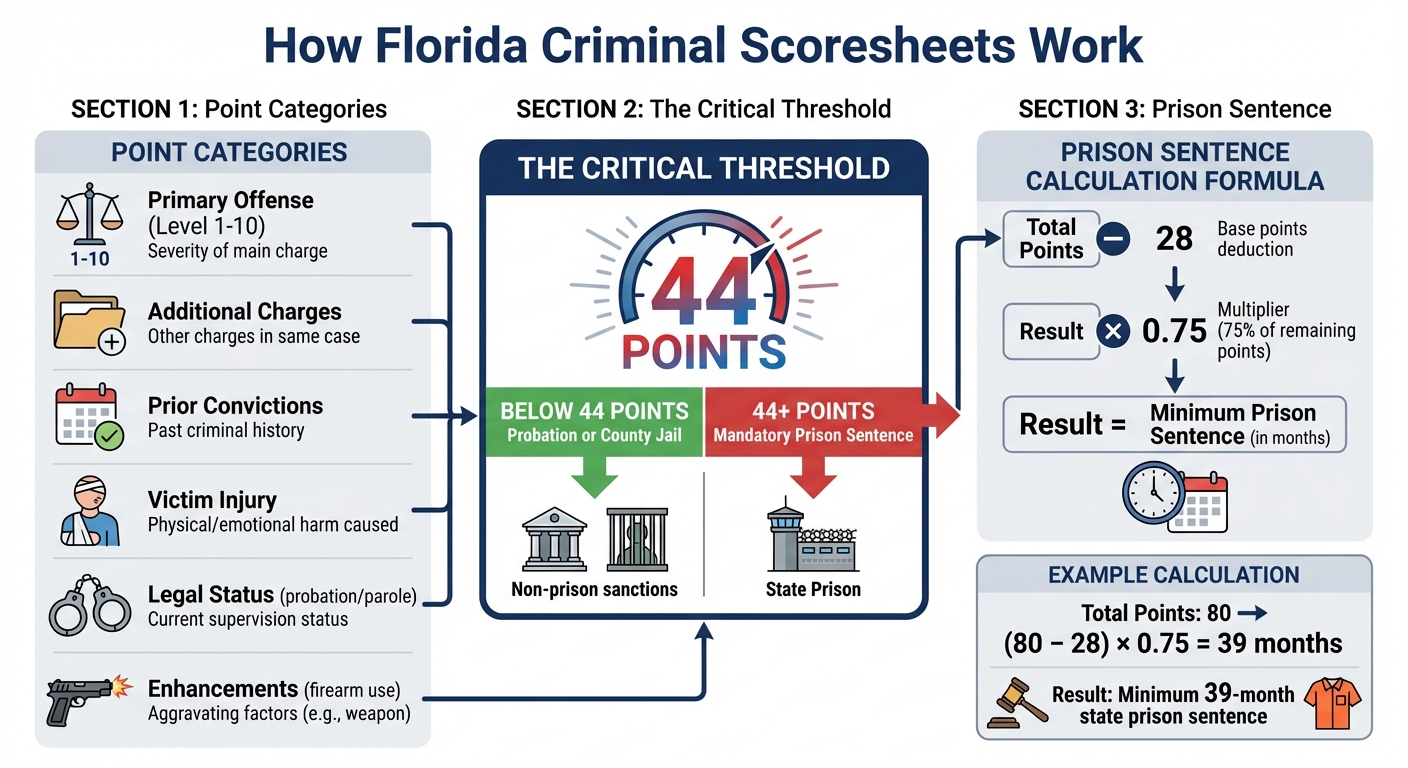
Florida Criminal Scoresheet Point Calculation System and Sentencing Formula
Florida’s Criminal Punishment Code (CPC), outlined in Florida Statutes §921.002–§921.0027, uses a point-based scoresheet system to determine sentencing for most felony offenses. This system assigns points based on several factors, including the primary offense, additional charges, prior convictions, victim injury, legal status (like probation), and enhancements (such as firearm use). These points establish the framework for sentencing decisions.
When the points are totaled, they determine the minimum sentence allowed. If the scoresheet reaches 44 points or more, a mandatory prison sentence is calculated using the formula: (Total points – 28) × 0.75 = lowest permissible prison sentence in months. For example, if someone’s scoresheet totals 80 points, the minimum sentence would be about 39 months in state prison. However, if the total is below 44 points, options like probation or county jail often come into play. While the scoresheet sets the minimum sentence, judges can impose penalties up to the statutory maximum for the offense, which is determined separately by law.
The State Attorney’s Office or a court clerk typically prepares the initial scoresheet, sometimes with input from probation officers or the Department of Corrections. Errors can occur, and they’re often identified during plea negotiations when defense attorneys review the scoresheet or at the sentencing hearing when the judge invites objections to the calculations.
Florida appellate courts require strict compliance with the CPC scoring rules. Even minor errors – like misclassifying an offense level or miscounting prior convictions – can lead to reversed sentences if they significantly impact the sentencing range. For instance, in a Sarasota case, a defendant originally received 15 years in prison for armed kidnapping and robbery. On appeal, the State admitted there was no evidence the defendant had a weapon, which led to a reclassification of the offense level. This reduced the lowest permissible sentence from about 10.2 years to a much lower threshold, and the appellate court ordered resentencing.
These precise point calculations make accuracy critical. Defense attorneys carefully examine every detail on the scoresheet to ensure fairness. The next sections will explore how to spot and fix common errors in these calculations, emphasizing why every point can make a difference.
1. Miscalculating the Primary Offense
The primary offense is the foundation of the scoresheet, determining how sentencing points are assigned. Under Florida Statute §921.0022(3), offenses are ranked by severity levels, from Level 1 (least severe) to Level 10 (most severe). Each level carries a specific point value – for example, a Level 5 offense equals 28 points, while a Level 10 offense is worth 74 points. Misclassifying an offense, such as labeling a Level 6 offense (32 points) as a Level 4 offense (18 points), can throw off the entire calculation and lead to incorrect sentencing outcomes.
Take the 2011 Broward County DUI case involving defendant J.P. as an example. Prosecutors mistakenly added 11 outdated prior convictions to J.P.’s scoresheet, even though Florida law excluded those convictions due to his recent release. This mistake inflated his sentence to 132 months. Fortunately, the appellate court intervened and ordered a resentencing.
Defense attorneys play a critical role in ensuring that offense classifications and prior convictions are calculated correctly according to the law. A single misclassification can result in a harsher sentence than warranted. If errors made by the State Attorney’s Office or court clerks are identified during plea negotiations or before sentencing, they can be challenged to ensure the scoresheet accurately reflects the charges. Up next, we’ll look at how prior record scoring errors can impact sentencing.
2. Incorrect Prior Record Scoring
In Florida, prior convictions play a key role in determining sentencing scores, but they must be accurately documented and categorized. Every prior offense should be verified using official records like court judgments, NCIC/FCIC records, or clerk files – not arrest histories alone. The Florida scoresheet manual emphasizes this because errors in prior record scoring are among the most common and can drastically affect sentencing outcomes.
One frequent mistake involves the misapplication of the 10-year decay rule. If a defendant has gone 10 consecutive years without a conviction since their last release from confinement, probation, or other sanctions, those older convictions should not be included in the scoresheet. Failing to follow this rule can unfairly inflate scores, leading to harsher sentences, such as mandatory prison time, when probation might have been an option.
Another issue arises with out-of-state convictions. These must be carefully matched to equivalent Florida offenses. Prosecutors sometimes assign these convictions a higher severity level than Florida law allows, which artificially increases the score. Additionally, juvenile adjudications, dismissed charges, and cases with withheld adjudication are often wrongly included, even when they don’t meet the criteria under the Criminal Punishment Code.
Defense attorneys have a critical role in ensuring accuracy. They should meticulously review the date, classification, and point value of every prior conviction. Even a single misstep in scoring can mean the difference between probation and mandatory prison time.
3. Errors in Legal Status, Community Sanction, and Enhancement Points
Legal status points tack on 6 points to a scoresheet when a defendant commits the primary offense while under supervision – such as probation, community control, parole, or pretrial release. The problem arises when prosecutors assign these points without proper proof. For example, if someone completed probation more than 10 years ago, it shouldn’t count. Yet, outdated statuses often remain on scoresheets, inflating sentences unfairly.
Beyond legal status, community sanction violation points are another area prone to errors. These points apply when someone violates probation or community control. However, there’s a critical distinction between technical violations (like missing an appointment) and new-law violations (committing a new crime). Courts sometimes assign the harsher new-law violation points even when the violation was purely technical. Worse, points may be added for alleged violations that were never proven or admitted. In some cases, double-counting violations can unjustly trigger mandatory prison sentences.
Enhancement points are another common issue, requiring specific legal conditions to apply. For instance, firearm enhancements add 18-25 points, but only if the defendant personally possessed the weapon. In a 2023 appellate case from Sarasota, a defendant’s sentence was reduced from 15 years to a 10.2-year minimum after the court found that firearm and injury points were improperly added. The state admitted the defendant didn’t personally possess the weapon, and there was no solid evidence for the pepper spray injury points.
Courts sometimes stack multiple enhancements for the same conduct, even though only one enhancement is allowed. Without a specific jury finding or a clear factual admission, these enhancements are invalid. Defense attorneys must carefully review scoresheets to ensure each enhancement is properly documented and legally justified. Removing just one improper enhancement can significantly lower a sentence and, in some cases, help avoid mandatory prison time.
sbb-itb-bb7ced0
4. Misapplication of Victim Injury Points
Victim injury points are additional points added to a sentencing scoresheet when a crime results in physical injury or death. Under Florida’s Criminal Punishment Code, these points are assigned based on the severity of the injury – ranging from death and severe bodily harm to moderate or slight injuries, along with specific categories for sex offenses. These points can significantly increase a defendant’s total score, potentially leading to mandatory prison time.
The issue arises when prosecutors exaggerate the severity of injuries. Take, for example, a situation where a victim experiences brief discomfort and declines medical treatment, yet the scoresheet reflects "severe injury" points as though the victim was hospitalized. Florida appellate courts frequently overturn sentences in cases where victim injury points were added without proper evidence or were scored at an incorrect severity level.
Another error often seen is double-counting the same injury across multiple charges. While rules allow injury points for each victim harmed, they do not permit duplicating points for the same injury from a single incident. Defense attorneys play a critical role in ensuring that these points are backed by solid evidence, such as medical records or testimony that clearly establishes the injury and its connection to the crime. For instance, exposure to pepper spray might qualify as a "slight" injury, but only if there is credible evidence to support it.
Accurate scoring of victim injury points is crucial because even small errors can have major consequences. A defendant hovering near the 44-point threshold could face mandatory prison time instead of probation or county jail if high injury points are wrongly added. Law Firm Ocala specializes in identifying these mistakes by carefully reviewing evidence and filing motions to correct sentencing errors.
5. Incorrect Treatment of Multiple Counts and Sentencing Calculations
Handling multiple charges requires precision when consolidating and calculating points across all counts. Mistakes in this process can significantly inflate a defendant’s total score, potentially pushing them past the critical 44-point threshold. This threshold is what separates eligibility for probation or county jail from mandatory prison time.
A common issue arises with improperly scoring prior convictions across multiple counts. For example, prosecutors may mistakenly include old convictions that should be excluded under Florida’s "washout" rule. This rule excludes convictions older than 10 years if no new offenses occurred in the interim. When these outdated convictions are factored in, sentencing outcomes can be unnecessarily severe. Combined with redundant scoring practices, this can drastically increase the total score, highlighting the importance of a thorough review.
Another frequent error involves redundant point application across multiple counts, where the same conduct is essentially counted twice. This often happens in cases with multiple victims or charges stemming from a single incident. For instance, victim injury points or legal status enhancements may be improperly duplicated across counts instead of being accurately allocated. Such stacking of enhancements for identical conduct can lead to inflated sentencing calculations.
At Law Firm Ocala, scoresheets in multi-count cases are meticulously reviewed to catch these errors. Defense attorneys play a critical role in ensuring that prior convictions are within the allowed timeframe, points are not duplicated, and the primary offense is clearly distinguished from additional charges. Even minor miscalculations can shift a sentence from probation to years behind bars, making careful scrutiny of multi-count cases absolutely essential.
How to Review Scoresheets for Errors
When reviewing a Florida criminal scoresheet, it’s essential to take a step-by-step approach to ensure every detail aligns with official case records. Start by double-checking the defendant’s information – such as their name, case number, and county – and make sure the correct CPC scoresheet version is being used, as outlined in Rule 3.992. These initial checks can help catch simple administrative mistakes that might otherwise affect sentencing.
Pay close attention to prior record details. Obtain certified disposition records to verify the dates, degrees, and scoring rules for prior offenses. Confirm that each conviction falls within the required timeframe for scoring. Misclassifying a third-degree felony as a more serious offense can lead to inflated points, so accuracy here is critical. Additionally, remove any items that shouldn’t be included, such as juvenile adjudications, minor traffic infractions, or out-of-state offenses that aren’t eligible for scoring.
When reviewing legal status and enhancements, compare probation orders, violation reports, and related documents to confirm whether the defendant was under supervision at the time of the offense. For firearm enhancements, ensure there’s proper documentation beyond an arrest report. Victim injury points must be backed by medical records or a trial verdict, and any special-victim enhancements – for children, elderly individuals, or law enforcement – should match the exact language in the charges. These details are essential to avoid the kinds of sentencing errors discussed earlier.
For cases involving multiple counts, it’s important to combine current offenses without duplicating points. Afterward, recalculate the total to ensure accuracy. If the total exceeds 44 points, the stakes are high, as even a single error could shift the outcome from probation to mandatory prison time. A thorough review of multi-count calculations ensures no errors tip the balance unfairly.
Attorneys at Law Firm Ocala specialize in carefully examining scoresheets for cases involving DUI, drug offenses, theft, and domestic violence. They gather the necessary evidence and documentation to catch errors before sentencing, leveraging their criminal defense expertise to help clients understand their charges and safeguard their constitutional rights throughout the legal process.
Conclusion
Examining scoresheet errors is a crucial step in ensuring fair sentencing outcomes. In Florida, criminal scoresheets play a significant role in determining whether a defendant qualifies for probation or faces mandatory prison time. Even a single error can lead to life-altering consequences. For instance, in one case, a miscalculation resulted in an unjust 132-month sentence, which was later overturned due to the incorrect application of the 10-year rule.
As highlighted earlier, technical mistakes in scoresheet calculations often result in sentencing disparities. Unfortunately, many defendants lack the knowledge or experience to identify these errors. Scoresheet calculations involve intricate processes, rigid timelines for factoring in prior offenses, and meticulous documentation requirements – making professional oversight essential. Without expert review, these critical mistakes may remain unnoticed until after sentencing, when options for correction are far more limited.
"At LAW FIRM OCALA, our interest is in you and your case within the context of the law. We are not here to judge you. We are here to defend and protect your rights according to the Constitution and the State of Florida, and to make sure you are treated fairly under the law." – LAW FIRM OCALA
Considering the high stakes, seeking prompt legal assistance is non-negotiable. Facing criminal charges? Time is of the essence. Prosecutors are already working to build their case, and any errors in your scoresheet must be identified and contested before sentencing. Since even one misstep can significantly impact your sentence, having an expert review your scoresheet is essential. Law Firm Ocala provides free consultations to analyze your case, verify scoresheet accuracy, and safeguard your constitutional rights throughout the legal process. Reach out today to ensure your sentence reflects the truth, not preventable errors.
FAQs
What happens if there are errors in a Florida criminal scoresheet?
Errors in Florida criminal scoresheets can have serious consequences. A single mistake might result in harsher prison sentences, improper penalties, or unnecessary delays in the legal process. Accuracy in these scoresheets is essential to ensure fair sentencing and uphold the integrity of the judicial system.
What steps can defense attorneys take to catch and fix errors on criminal scoresheets?
Defense attorneys play a critical role in ensuring criminal scoresheets are accurate by meticulously reviewing them and cross-checking with official court records. They focus on verifying key details like the correct listing of charges, proper point calculations, and accurate sentencing information.
When errors are identified, attorneys gather relevant evidence to support their findings and address the issue with the court as quickly as possible. Having a seasoned criminal defense lawyer on your side can make all the difference in catching mistakes that could heavily impact sentencing outcomes.
Why is it essential to check for errors on scoresheets before sentencing?
Ensuring scoresheets are thoroughly reviewed for errors before sentencing is a crucial step in maintaining the integrity of the legal process. Even small mistakes can result in unfair penalties, incorrect sentencing, or additional legal hurdles that could have been avoided.
By catching and addressing these errors early, you can help prevent delays, reduce the risk of unfair outcomes, and ensure that the sentencing process remains accurate and equitable. This review is a key safeguard in protecting the rights of the defendant and promoting a fair resolution.