
When navigating legal cases in Florida, your success depends on two critical elements: case details and legal strategy.
- Case details are the factual foundation of your case – things like evidence, timelines, witness statements, and documents. These facts answer the question: What happened?
- Legal strategy is your attorney’s plan for using those facts within the framework of Florida law to achieve your goals. It answers: What should we do about it?
These two components work together to build a strong case. While case details remain fixed, your legal strategy evolves as new information emerges or circumstances change. Both are essential for achieving the best possible outcome, whether you’re dealing with criminal charges, family law disputes, or injury claims.
Key Takeaways:
- Case details provide the "who, what, when, where, and how."
- Legal strategy determines how to use those facts to protect your rights.
- Your role is to provide accurate, complete, and honest information.
- Legal strategies adapt to new evidence, court rulings, or negotiations.
Case Details: The Facts That Form Your Case
What Case Details Include
Case details are the building blocks of your case, outlining what truly happened in your situation. In Florida criminal, family, and injury cases, attorneys organize these details into specific categories. These include evidence and documentation (such as police reports, body-cam videos, medical records, photos, texts, emails, financial records, and previous court orders), timeline (a step-by-step breakdown of events), parties and witnesses (names, contact details, and roles of everyone involved), and procedural history (case numbers, filed pleadings, motions, prior orders, and hearing outcomes).
Each type of case in Florida emphasizes different details. For criminal defense cases, the focus is on arrest circumstances, police statements, physical evidence like blood or breath test results, and prior convictions. Family law cases prioritize income records, work schedules, caregiving histories, and documentation of issues like domestic violence or substance abuse. In injury cases, key details include accident scene evidence, medical evaluations, treatment timelines, and employment records. These carefully organized facts lay the groundwork for your attorney to build a solid legal strategy.
Why Accuracy Matters
In Florida law, specific details often make or break a case. Even small discrepancies can have a huge impact. For example, in criminal cases, details about timing, distances, or prior interactions can determine whether police actions were lawful. In family law, accurate income figures and parenting schedules can significantly affect child support or custody rulings. For injury cases, proving how the injury happened and its medical timeline is crucial for establishing causation and damages.
Judges rely heavily on clear, well-documented facts. Incomplete or inaccurate information can damage credibility and make it harder for your attorney to argue your case effectively. Lawyers also use case law with similar fact patterns to strengthen your position, which is only possible if your facts are thoroughly documented. This level of accuracy is critical for forming a sound legal strategy, as discussed further in later sections.
Your Role in Providing Case Details
It’s your responsibility to provide all relevant, accurate information – even details that might seem trivial. Missing or incorrect information can lead to serious problems: your attorney could be blindsided by evidence or testimony that contradicts your story, your credibility could be questioned, and opposing counsel might exploit inconsistencies to argue that you’re being dishonest or exaggerating.
To help your case, prepare a detailed written timeline, gather all relevant documents (such as texts, emails, screenshots, medical bills, and court records), and create a list of witnesses with their contact information. Be upfront about any prior legal issues, including arrests, injunctions, divorces, or investigations by DCFS. Discuss sensitive topics openly with your attorney, knowing that confidentiality protects you. This helps your lawyer anticipate how opposing counsel might use that information against you.
Law Firm Ocala stresses the importance of providing accurate and complete details. Their role isn’t to judge you but to defend your rights within the framework of the law. By sharing all relevant facts, you give your attorney the tools they need to build a strong, effective strategy tailored to your case.
Legal Strategy: Your Attorney’s Plan for Your Case
What Legal Strategy Includes
A legal strategy is how your attorney connects the facts of your case to the law to achieve the best possible results. It’s about applying legal rules to your specific situation, evaluating strengths and weaknesses, and anticipating challenges from the opposing side. Whether it’s avoiding jail time in a DUI case, securing parenting time in a custody dispute, or maximizing compensation in an injury claim, your attorney crafts a plan tailored to your goals.
This strategy involves selecting key evidence and witnesses and deciding on procedural steps, like filing motions to suppress evidence, managing discovery, or determining whether to negotiate, seek dismissal, or go to trial. A strong legal strategy weaves the case details into a clear and persuasive narrative that supports your position. Essentially, your attorney transforms the facts of your case into a story that aligns with the law and strengthens your argument. This approach not only navigates the complexities of Florida’s legal system but also prioritizes protecting your rights. And as your case progresses, the strategy adapts to new developments.
How Strategy Changes as Your Case Progresses
Once a strategy is in place, flexibility becomes key. Legal strategies are never static – they evolve as new information and circumstances arise. For instance, during discovery, new evidence such as police reports, medical records, or digital data might surface, either reinforcing or undermining certain arguments. Court decisions on motions can also shift the direction of the case. If a judge grants a motion to suppress evidence in a criminal case, for example, your attorney might push for dismissal. If the motion is denied, negotiating a plea deal could become a more viable option.
Settlement or plea offers often require a reassessment of the risks and benefits of going to trial versus accepting a deal. Additionally, changes in the law or new legal precedents might lead your attorney to revisit the case’s overall approach, adjusting tactics and keeping you informed about how these shifts affect your options and potential outcomes.
Legal Strategy Examples in Florida Cases
Legal strategies take different forms depending on the type of case. In Florida DUI cases, for example, the focus is often on challenging the traffic stop and the evidence gathered afterward. If an officer lacked reasonable suspicion for the stop, your attorney might file a motion to suppress, arguing that all subsequent evidence – like breath test results or field sobriety observations – should be excluded. They might also question the reliability of sobriety tests, pointing to factors such as uneven pavement, poor lighting, or medical conditions, sometimes using expert testimony to strengthen the argument. Additionally, your attorney will review whether Florida’s implied consent warnings were properly given and whether testing equipment met state standards. Depending on how these arguments hold up, the strategy may shift between seeking dismissal, negotiating reduced charges, or exploring diversion programs.
In Florida child custody disputes, the strategy revolves around proving that your parenting plan aligns with the child’s best interests under state law. This involves gathering school records, medical reports, communication logs, and witness statements to show who has provided stability and support for the child. Your attorney will frame your actions within Florida’s best-interest factors, including your ability to maintain a stable home, meet the child’s developmental needs, and encourage a healthy relationship with the other parent. Law Firm Ocala uses its deep understanding of local judges and court practices to create strategies that align with how cases are typically handled in Ocala and surrounding areas, drawing from extensive experience in criminal defense, family law, and injury cases.
Main Differences Between Case Details and Legal Strategy
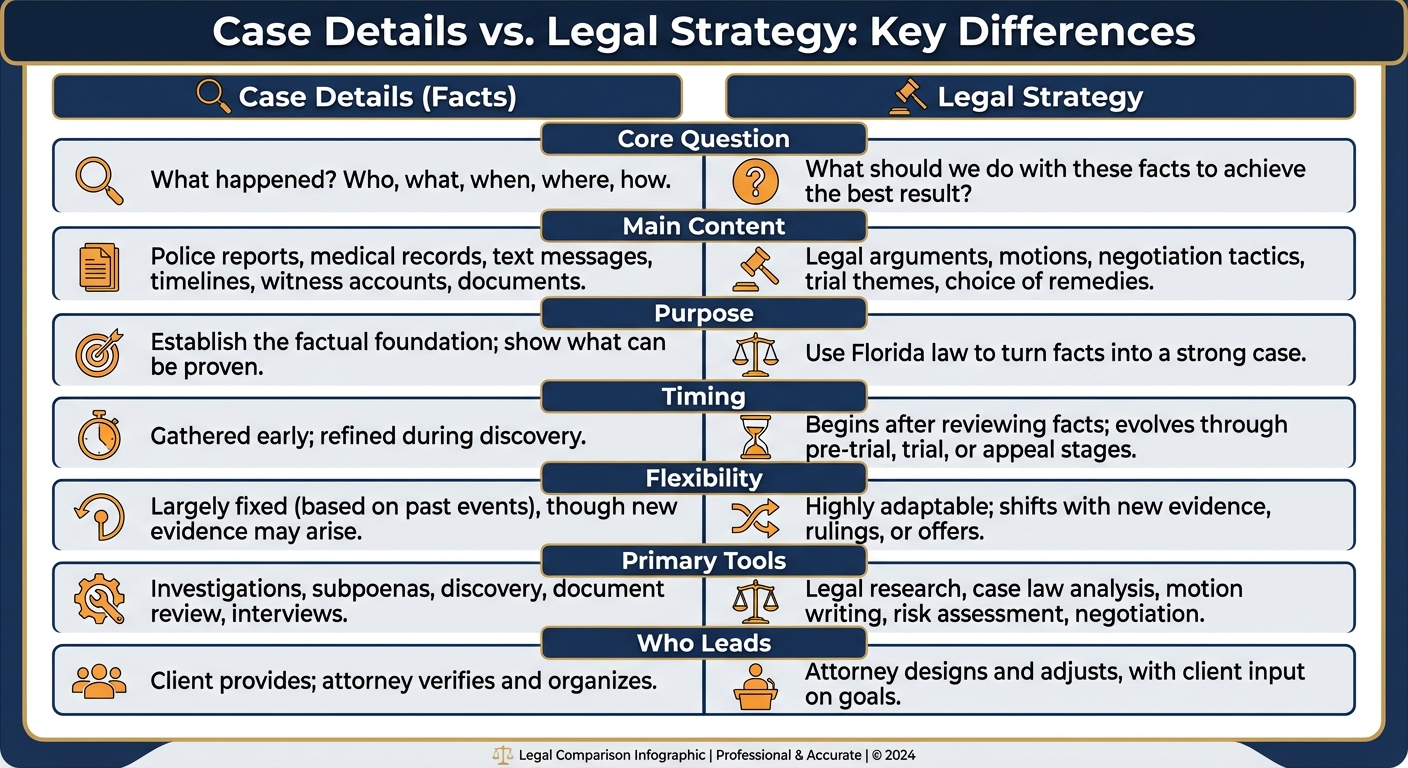
Case Details vs Legal Strategy: Key Differences in Florida Law
Different Purposes and Focus Areas
Case details and legal strategy play very different roles in any legal matter. While case details provide the foundation, legal strategy builds the roadmap to achieve your desired outcome.
Case details answer the question, "What happened?" These are the objective facts of your case – dates, locations, people involved, documents, injuries, and any physical evidence. They create a clear picture of events, helping your attorney understand what can be proven and what legal options are available. Essentially, case details focus on the "who, what, when, where, and how" of your situation.
Legal strategy, on the other hand, addresses, "What should we do about it?" This is where your attorney uses the facts to pursue a specific legal goal, such as dismissing charges, negotiating better custody terms, reducing penalties, or obtaining fair compensation. Strategy involves applying Florida law to your case, deciding which evidence to highlight, which motions to file, and whether to negotiate or proceed to trial. While case details explain what happened, legal strategy determines how to use those facts to protect your rights and achieve the best possible outcome.
Next, let’s explore how timing plays a role in shaping these two elements.
Timing and Flexibility Differences
Case details and legal strategy differ not only in purpose but also in how they evolve over time. Case details are collected as early as possible, often during your first consultation. These facts are based on past events – like the date of a DUI stop, the damage from a car accident, or when a spouse moved out – and remain largely fixed. While new evidence or witnesses might emerge during discovery, the core facts don’t change.
Legal strategy, however, is a dynamic process that adapts as your case progresses. It starts after the initial review of facts and evolves through various stages, such as filing motions, negotiating, or preparing for trial. For example, a judge’s ruling might shift the focus from seeking dismissal to negotiating a plea deal. Strategy remains flexible, responding to new developments, while case details serve as the anchor for all decisions.
Comparison Table: Case Details vs. Legal Strategy
| Aspect | Case Details (Facts) | Legal Strategy |
|---|---|---|
| Core Question | What happened? Who, what, when, where, how. | What should we do with these facts to achieve the best result? |
| Main Content | Police reports, medical records, text messages, timelines, witness accounts, documents. | Legal arguments, motions, negotiation tactics, trial themes, choice of remedies. |
| Purpose | Establish the factual foundation; show what can be proven. | Use Florida law to turn facts into a strong case. |
| Timing | Gathered early; refined during discovery. | Begins after reviewing facts; evolves through pre-trial, trial, or appeal stages. |
| Flexibility | Largely fixed (based on past events), though new evidence may arise. | Highly adaptable; shifts with new evidence, rulings, or offers. |
| Primary Tools | Investigations, subpoenas, discovery, document review, interviews. | Legal research, case law analysis, motion writing, risk assessment, negotiation. |
| Who Leads | Client provides; attorney verifies and organizes. | Attorney designs and adjusts, with client input on goals. |
sbb-itb-bb7ced0
How Case Details Influence Legal Strategy
Case Details as the Starting Point
When it comes to crafting an effective legal strategy, every path begins with a deep dive into the details of the case. These details act as the foundation lawyers rely on to evaluate options, anticipate outcomes, and decide whether to file motions, negotiate settlements, or prepare for trial. In short, case details are the building blocks of any solid legal plan.
During an initial review, attorneys focus on key pieces of information: dates and timelines, police reports, medical records, contracts, witness identities, physical evidence, and even prior communications like emails or text messages. This information helps determine whether claims meet statutes of limitations, whether the required elements of a case can be proven, and what defenses might apply. For instance, in a DUI case, the specifics of the traffic stop or how sobriety tests were conducted could directly influence motions to suppress evidence or challenge test accuracy.
Accurate facts also allow lawyers to draw comparisons with existing case law. By linking your situation to favorable precedents or distinguishing it from unfavorable rulings, attorneys can craft arguments that support your case. Without clear, reliable details, it’s nearly impossible to identify the right claims, defenses, or procedural moves. This initial fact-gathering process is crucial, laying the groundwork for adapting strategies as new information comes to light.
Changing Strategy When New Details Emerge
Legal strategies aren’t set in stone – they evolve as new evidence or circumstances arise. A single piece of new evidence, like a damaging document, an updated expert report, or newly revealed surveillance footage, can shift the focus from preparing for trial to negotiating a settlement. On the flip side, uncovering favorable evidence can embolden a more aggressive approach, such as filing motions or pushing for trial.
Take criminal defense as an example: a late-disclosed lab result or video evidence might lead your attorney to file additional suppression motions or reconsider plea negotiations. In family law, changing circumstances – such as a parent’s job loss or relocation – might require adjustments to custody proposals or even amended pleadings. Attorneys rely on procedural tools like amended complaints, motions to compel discovery, or motions in limine to ensure that the legal strategy aligns with the most up-to-date facts. This flexibility is especially important in Florida, where specific laws and court practices can heavily influence outcomes.
Florida Laws and Court Procedures
In Florida, even minor factual variations can have a significant impact on legal strategies. Small differences in details can shape the defenses or motions available in a case. For example, in drug-related cases, factors like where contraband was found, who had access to the area, and whether officers obtained consent to search can all affect arguments about probable cause and Fourth Amendment rights. These details help attorneys decide whether to seek dismissal, negotiate a plea to avoid mandatory minimums, or prepare for trial with a focus on reasonable doubt.
Family law in Florida is similarly fact-driven. Courts base parenting decisions on the best interests of the child, which often hinge on specific details about each parent’s caregiving history, involvement in school activities, work schedules, and housing stability. Attorneys at firms like Law Firm Ocala use documentation – such as school records, calendars, and text messages – to support or challenge claims about which parent has historically met the child’s needs. These facts directly influence whether negotiation or trial is the best route to secure a favorable parenting plan, such as equal timesharing or conditions for ensuring the child’s safety.
Getting Ready for Your First Court Appearance
Preparing for your first court appearance means understanding the details of your case and having a clear legal strategy in place.
What Happens at Your First Appearance
In Florida criminal cases, the first court appearance usually happens within 24 hours of an arrest. This hearing is quick – often just a few minutes – and focuses on procedural matters. The judge will explain the charges against you, confirm your right to an attorney, and decide on bond conditions. These conditions might include the bond amount, release on your own recognizance, or continued custody. The court may also impose restrictions like no-contact orders, travel limitations, drug testing, or GPS monitoring.
Family law cases follow a different process. Instead of dealing with arrest or custody, the first hearing – often called a case management conference – centers on organizing the case and addressing immediate concerns. The judge will check that required documents, like financial affidavits and parenting plans, have been submitted. They’ll also set deadlines for mediation and discovery and may issue temporary orders regarding child custody, support, or the use of shared property. These hearings aim to stabilize the situation and outline a timeline for resolving the case, rather than making any final decisions.
These initial steps are essential for preparing to meet with your attorney.
How to Prepare With Your Attorney
Before your first court appearance, meet with your attorney to go over the details of your case and develop a strategy. Bring all relevant documents, such as arrest reports, emails, text messages, photos, medical records, witness contact information, and a timeline of events. In criminal cases, your attorney will need information about your job, family responsibilities, and community connections to argue for lower bond amounts or more favorable release conditions. For family law matters, gather financial records (like pay stubs, tax returns, and bank statements), your children’s schedules, and evidence of your caregiving role to support requests for temporary custody or support.
During this meeting, ask your attorney what to expect at the hearing. Find out which issues the judge can address immediately and which will be handled in later hearings. Ask if you’ll need to speak, as attorneys often advise against discussing the alleged offense during criminal hearings. Instead, you may only need to answer basic background questions. Your attorney can also outline possible outcomes, such as typical bond amounts or temporary parenting arrangements, so you can prepare for likely scenarios and avoid surprises.
Discuss courtroom expectations, including when to arrive, how to dress, and how to behave. Judges pay attention to non-verbal cues, so avoid actions like eye-rolling, negative reactions, or trying to communicate with the other party – especially in cases involving domestic violence or custody disputes. Your attorney can guide you on maintaining calm and respectful body language to leave a good impression.
Working With Law Firm Ocala

Law Firm Ocala leverages its experience in Marion County and Central Florida courts to help clients prepare for their first appearances in criminal defense, family law, and personal injury cases. The firm’s familiarity with local judges, prosecutors, and court procedures allows their attorneys to focus on key aspects of your hearing. In cases involving DUI, drug charges, theft, or domestic violence, they can quickly gather and present information about treatment programs, community ties, or weaknesses in the prosecution’s case to seek better bond conditions and protect your rights.
For family law cases like divorce, child custody, and support, the firm helps clients meet local financial documentation requirements and organize parenting information. This preparation ensures that temporary orders reflect the expectations of local courts. In personal injury cases, Law Firm Ocala assists clients by organizing medical records, insurance communications, and evidence of damages to strengthen their position from the outset. Their local expertise allows them to tailor their approach to your specific case and the courthouse handling it.
Conclusion: Using Case Details and Legal Strategy Together
What to Remember
Case details – facts, documents, timelines, and evidence – are the building blocks of your case, while legal strategy turns those pieces into a plan that protects your rights. Neither can succeed on its own. Providing complete and accurate information gives your attorney the tools to explore every legal avenue, and a well-thought-out strategy uses those tools to pursue your goals effectively.
Your role is crucial: sharing honest, organized information strengthens your case. Leaving out important documents or details can weaken your defense, so collaboration is key. By promptly sharing information, asking questions, and following your attorney’s advice, you help ensure your case remains strong. Legal strategies evolve with new evidence, so maintaining open communication with your attorney allows for timely adjustments, rather than scrambling at the last minute. This partnership is the foundation of a strong, goal-oriented approach.
How Law Firm Ocala Can Help
At Law Firm Ocala, the process starts with a thorough review of your case details – police reports, medical records, financial statements, electronic communications, and any prior legal history. This deep dive uncovers potential issues, defenses, and evidence-related challenges. From there, the firm crafts a personalized strategy tailored to the courts of North Central Florida. Whether it’s identifying the right defenses, filing motions, or planning negotiation tactics, they adjust their approach as new information or settlement opportunities arise.
Their experience with Marion County and Central Florida courts ensures their strategies align with Florida statutes, local judges, and past case outcomes. Every case is unique – traffic stops, prior convictions, safety concerns, or parenting histories all demand different approaches. By merging detailed case analysis with adaptable planning, Law Firm Ocala works to deliver the best possible results for each client’s situation.
FAQs
What’s the best way to ensure my case details are accurate and complete?
To ensure your case details are thorough and precise, begin by collecting all necessary documents. This might include contracts, emails, letters, or police reports. Take the time to go through these materials carefully to confirm their accuracy and pinpoint any missing information.
It’s equally important to consult with an experienced attorney. They can help double-check your facts, identify any overlooked details, and make sure every critical element is addressed. These steps will not only solidify your case but also set a strong foundation for building an effective legal strategy.
What can cause a legal strategy to change during a case?
Legal strategies often shift as a case unfolds, influenced by a variety of factors. For instance, new evidence can come to light, altering the direction or focus of the case. Similarly, unexpected developments – like a sudden change in the narrative – might require a reassessment of priorities.
Witness testimony is another game-changer, as it can reveal details that reshape the legal approach. On top of that, evolving legal precedents or rulings might directly impact how a case is argued.
Other considerations, like a client’s financial or personal circumstances, can also play a role in driving strategy changes. And let’s not forget jurisdictional requirements, which may demand specific adjustments to stay compliant and effective. In the end, being adaptable and responsive is at the heart of strong legal representation.
Why do legal strategies need to be flexible?
Legal strategies must be dynamic because no case stays static. As new evidence surfaces, unforeseen events unfold, or legal conditions shift, the trajectory of a case can change dramatically. Adjusting strategies along the way enables attorneys to safeguard their clients’ rights and aim for the best possible results.
Being adaptable allows legal representation to remain strong, even when faced with complicated or unpredictable scenarios. This readiness to pivot is essential for tackling challenges and making the most of emerging opportunities.